
1. Two Functions, Two Sizing Logics
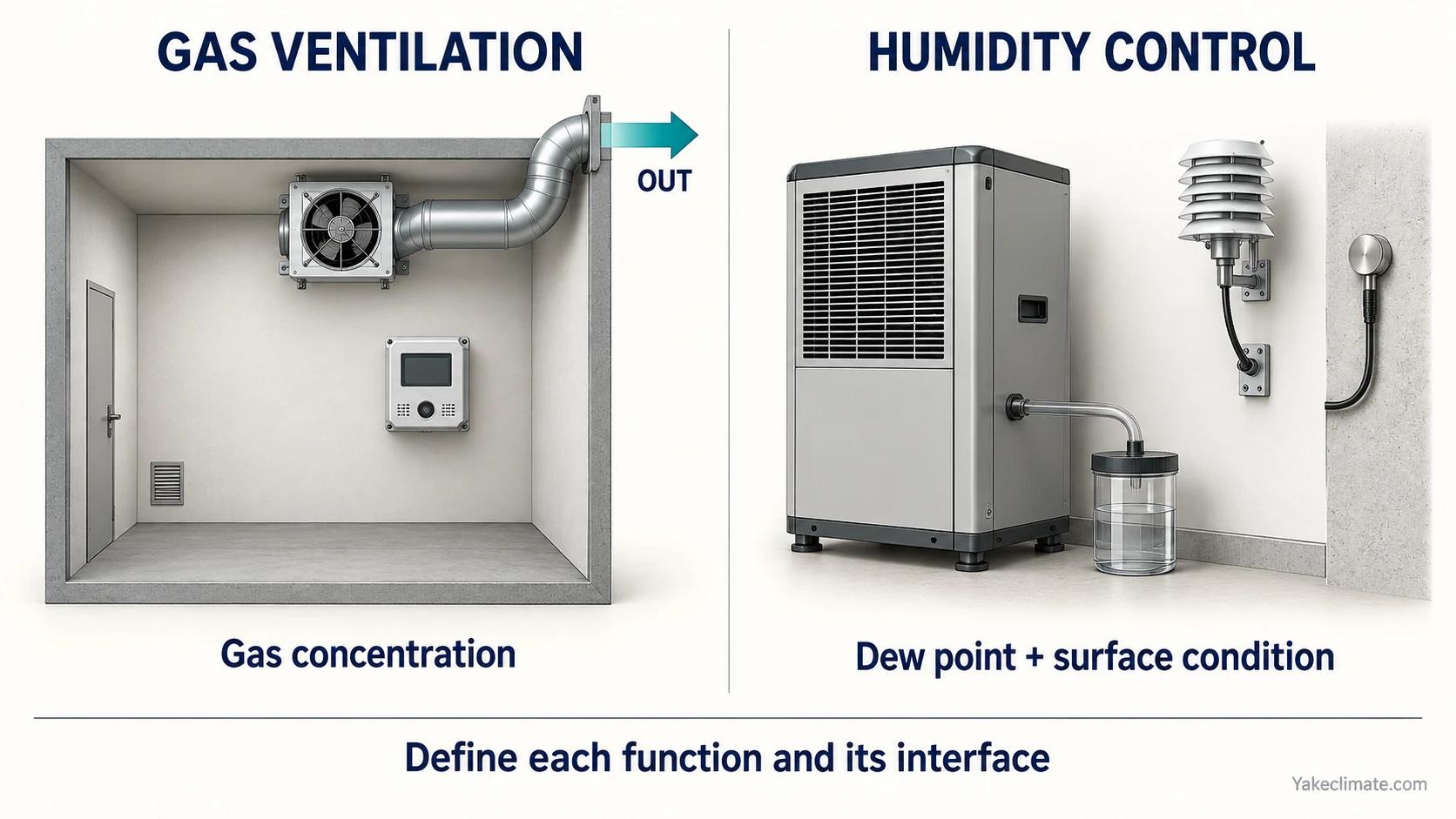
Ventilation is airflow that dilutes or removes gas from a space. Dehumidification is the removal of water vapor to lower the air's dew point. They are often specified as one requirement. They are not.
- Ventilation is a safety function. It manages gas concentration.
- Dehumidification is a reliability function. It manages surface condition.
- They are sized by different logic, triggered by different events, and in humid climates they actively work against each other.
A project that treats them as one line item usually ends up with a system that satisfies neither.
2. Battery Chemistry Drives the Ventilation Problem
The ventilation logic depends on what the battery does during normal operation. Lead-acid and lithium-ion behave differently, and applying one chemistry's logic to the other sizes the system for the wrong event.
| Lead-acid | Lithium-ion | |
|---|---|---|
| Normal operation | Vented types may release hydrogen during charging | Normally sealed; abnormal failure can release hazardous gases |
| Event of concern | Charging conditions and gas generation | Product-specific abnormal failure and gas release |
| Gas | Hydrogen generation depends on battery and charging state | Composition and volume depend on the tested product and scenario |
| Sizing logic | Use adopted standard, charger and cell data, qualified engineer | Use product test results, adopted code and qualified fire-protection design |
| Typical standards | IEEE/ASHRAE 1635; IEC 62485-2 where applicable | NFPA 855 and UL 9540A where applicable |
Gas composition and release behavior depend on the battery technology, test configuration, and failure scenario. Use the actual product test report rather than treating a general list as a design basis.
Lead-acid: steady-state hydrogen dilution
Vented lead-acid batteries may emit hydrogen during charging. The design engineer must determine the gas-generation basis, applicable concentration criterion, and ventilation requirement from the adopted standard and the actual charger and cell data.
Project methods may use different inputs and units. This article does not prescribe a safety airflow formula; record the battery type, cell configuration, charger operating modes, and adopted design method before the environmental load is calculated.
ASHRAE describes IEEE/ASHRAE 1635 as the reference for stationary-battery hydrogen-generation and ventilation methods. Use the applicable edition and the project-specific calculation prepared by the responsible engineer; do not substitute a generic constant from this article.
Lithium-ion: event-based protection
Lithium-ion systems are normally sealed, but abnormal failures can release hazardous gases. Ventilation, detection, and explosion-control decisions require the actual product test evidence and the installation-specific fire-protection design.
For stationary storage, the adopted fire and electrical codes and the product-specific tests establish the safety case. The following considerations are inputs for that review, not universal airflow settings:
- Determine whether the installation needs gas-concentration reduction or another explosion-control measure from the adopted code, enclosure configuration, and product test evidence. Do not assign a generic LFL setpoint to every system.
- A floor-area airflow rate or gas-detector trigger cannot be applied to every lithium-ion installation. The responsible fire-protection engineer must establish the applicable method and parameters for this product and jurisdiction.
- Where the adopted safety case calls for explosion control, NFPA 68 or NFPA 69 may inform the selected approach. Its use and sizing remain matters for qualified fire-protection design and the actual test data.
- UL 9540A results for the specific product and representative installation configuration are relevant to the safety review; they do not by themselves authorize a generic ventilation rate.
UL Solutions reports that the sixth edition of UL 9540A was published in March 2026 and describes a 1 January 2027 effective date. Neither date alone identifies the code edition adopted for this installation or replaces review of the actual product test report.
The exact requirement depends on the battery technology, enclosure type, location, adopted code edition, and the authority having jurisdiction. That determination belongs to the project's fire protection and electrical engineers of record.
For environmental equipment, the point is simpler: whatever ventilation rate the safety case establishes becomes an input to the humidity problem, because that air comes from outside.
3. What Ventilation Cannot Do
Ventilation moves air. It has three limits that matter for equipment reliability.
- With ventilation alone and no separate moisture-removal process, the indoor air cannot be driven below the incoming outdoor-air dew point in steady operation. Outdoor air that is drier than the room can help; humid outdoor air can raise the indoor moisture load.
- It cannot protect surfaces colder than the incoming air's dew point. Chilled surfaces and cool panels will condense moisture from the ventilation air itself.
- It responds to gas concentration, not moisture. A gas-detector-controlled ventilation system does not consider the moisture consequences of running.
None of this is a criticism of ventilation. It is doing its job. The point is that its job is not humidity control.
4. What Dehumidification Does
Dehumidification removes water from air and lowers the dew point of the space. It keeps surfaces above the condensation threshold. Its purpose is to prevent failure modes that liquid water starts on electrical equipment: reduced insulation resistance, surface tracking, electrochemical migration on control boards, and corrosion at busbar and terminal connections.
When surface condensation is the concern, condensation risk in battery enclosures explains how to assess the dew-point margin at the coldest relevant surface. Dew point, together with relative humidity, helps describe this risk. Preserve any separate relative-humidity limits required for materials, corrosion, insulation, or equipment.
Dehumidification does not dilute flammable gas and is not a substitute for the required safety measures. Its power, controls, alarms, and recovery sequence may still interface with the safety system and must be coordinated with that design.
5. Where the Two Functions Conflict
In a humid climate the conflict is direct and quantifiable.
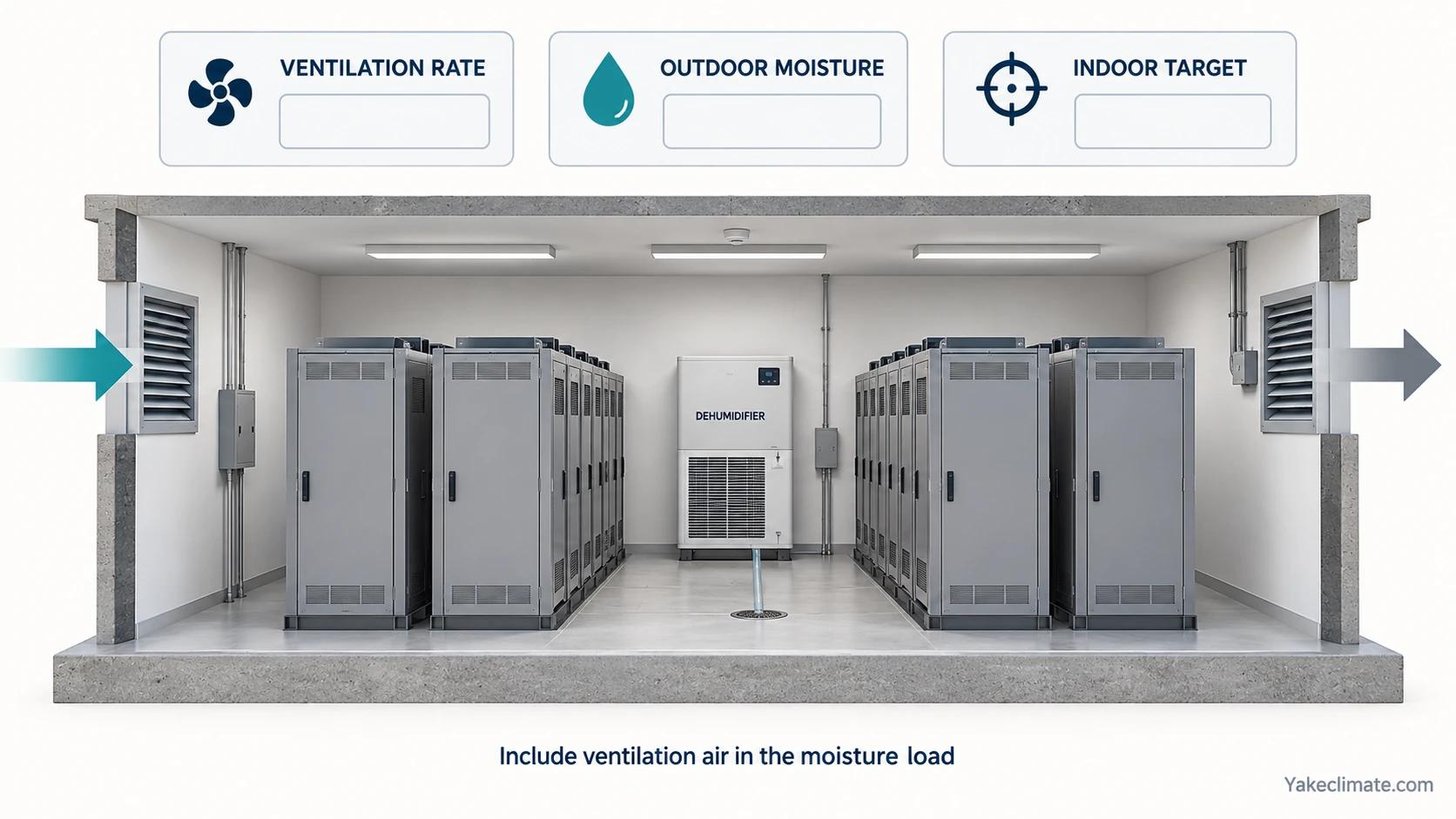
Illustrative moisture example, not a safety-ventilation prescription: assume a project engineer has already established 0.50 m³/s of continuous outdoor airflow (1,800 m³/h) for a room. At 101.325 kPa, outdoor air at 30 °C and 80% RH has a humidity ratio of about 21.5 g water/kg dry air. The airflow corresponds to about 2,025 kg dry air/h at those outdoor conditions.
If the room target is 20 °C and 60% RH (about 8.7 g/kg dry air), the ventilation-air moisture difference is about 12.8 g/kg. The illustrative load is therefore about 2,025 kg dry air/h × 0.0128 kg water/kg dry air ≈ 26 kg water/h while that airflow and those conditions persist. Add other moisture sources and recovery duty separately; do not select equipment from this single condition.
| Outdoor condition | Dew point | Humidity ratio | Removal needed to hold 20 °C / 60 % RH (per 1,000 kg/h ventilation air) |
|---|---|---|---|
| 25 °C / 70 % RH | about 19.2 °C | about 13.9 g/kg | about 5.2 kg/h |
| 30 °C / 80 % RH | about 26.2 °C | about 21.5 g/kg | about 12.8 kg/h |
| 35 °C / 85 % RH | about 32.1 °C | about 30.8 g/kg | about 22.1 kg/h |
Three consequences follow.
- The ventilation-air moisture load can dominate when its airflow is large and outdoor humidity exceeds the room target. Room volume alone does not represent this continuous load.
- Increasing the established outdoor-air ventilation rate increases the moisture load when incoming air is wetter than the target. If that rate changes after equipment selection, recalculate dehumidification duty.
- Intermittent safety ventilation changes the moisture load during each operating event. Record the event airflow, duration, outdoor state, and required recovery time rather than assuming continuous operation.
Practical sequence: first obtain the ventilation operating states from the project safety designer. Then calculate environmental moisture duty for each state and verify the recovery requirement.
6. Cabinet, Room, and Container
The three common boundaries handle the trade-off differently.
| Boundary | Volume | Dominant moisture load | Equipment implications |
|---|---|---|---|
| Cabinet or enclosure | Small, nominally sealed | Thermal cycling and measured or estimated leakage; no universal exchanged-volume fraction | Review the actual boundary, internal airflow, temperature envelope and service access |
| Dedicated room | Building-scale | Established outdoor-air ventilation may dominate when incoming air is wetter than the target | Use the project ventilation states, drainage and service requirements |
| Containerized system | Intermediate, densely packed | Outdoor-air exchange and surface-temperature cycles vary by configuration | Review the actual air paths, operating states and access plan |
7. Coordinating the Two Systems
Where both functions are present, decide the interface explicitly at design stage.
- Priority. Follow the approved fire-protection operating sequence, which may use continuous ventilation, charging interlocks, detection-triggered ventilation, or other project-specific measures. Environmental controls must not delay or impair the safety system. Whether dehumidification continues, stops, or resumes during an event must be defined in the approved controls sequence.
- Air paths. A ventilation intake next to a dehumidifier discharge produces short-circuiting: conditioned air leaves before it reaches the space. Treat intake, exhaust, and dehumidifier supply and return as one air-distribution problem.
- Sensors. The safety design defines what initiates and supervises ventilation, using the inputs required for the battery technology and installation. Moisture controls use project humidity criteria; when surface condensation is the concern, compare air dew point with the coldest relevant surface. Separate sensor duties and coordinate their interlocks.
- Reporting. Both systems should report into the same monitoring record. Knowing when ventilation ran, what outdoor conditions were, and how internal dew point responded is the data needed to diagnose an environmental problem later.
- Failure behavior. Define what each system does on failure and whether failure is annunciated. A dehumidifier that stops silently leaves the installation unprotected until corrosion produces a fault months later.
Related integration decisions are covered in BESS container dehumidifier sizing inputs, connecting dehumidifiers to BMS and EMS, and why BESS containers still condense with air conditioning.
8. Information to Prepare for Project Review
For an environmental equipment review on a battery room or containerized system:
- Battery chemistry and configuration, and the basis of the ventilation requirement: continuous, intermittent, or event-triggered.
- The established ventilation rate, or a statement that it is not yet determined. This is the single most important input because it usually dominates the moisture load.
- Boundary type and dimensions: cabinet, room, or container; floor area, volume, and construction.
- Site design conditions: summer and winter outdoor dry-bulb temperature with coincident humidity or dew point.
- Internal temperature range and heat sources, including whether active thermal management is present.
- The environmental target: relative humidity, dew point, or surface condition, and the coldest relevant surface.
- Interfaces: power supply, control and alarm signals, communication protocol, and the monitoring system.
- Physical constraints: mounting envelope, air paths, drainage or discharge route, and service access.
- Deployment model: single project or repeated standard design, and expected service interval.
- Applicable requirements: fire, electrical, and product safety codes in the destination market, plus any customer-specific standard.
If the ventilation rate is not yet established, resolve that first. It determines the moisture load, and therefore the equipment.
9. Discussing a Project
Industrial Dehumidification for Complex Climate Applications
Yakeclimate designs and manufactures industrial dehumidification equipment for complex climate applications, with a focus on agriculture and energy projects.
We co-develop application-specific dehumidification equipment around the operating conditions, interfaces, and integration requirements of the wider project or system.
Fire protection, gas detection, and explosion control design remain with the project's fire protection and electrical engineers. Our scope is the dehumidification equipment and its integration with the air, control, and monitoring arrangements those systems establish.
Explore energy-storage dehumidifiers, review the energy and electrical environments route, or contact Yakeclimate to review the operating conditions for your installation.
FAQ
Frequently Asked Questions
Can ventilation also control humidity in a battery room?
Ventilation may help dry a room when incoming air is drier, but by itself it cannot lower the steady indoor dew point below the source-air dew point. In humid weather it can increase moisture load. Ventilation addresses the project gas-management duty; dehumidification addresses moisture content.
Is battery room ventilation the same for lead-acid and lithium-ion?
No. Vented lead-acid batteries may generate hydrogen during charging; lithium-ion systems have different normal and abnormal gas-release scenarios. The applicable ventilation or explosion-control method depends on battery technology, product test results, installation configuration, adopted code, and the responsible fire-protection engineer. This article supplies no universal safety airflow rate.
How much dehumidification does a ventilated battery room need?
Use the ventilation airflow and schedule established by the project safety design. As an illustration only, 0.50 m³/s of outdoor air at 30 °C and 80% RH, with a room target of 20 °C and 60% RH at 101.325 kPa, creates about 26 kg water/h of ventilation-air moisture difference while those conditions persist. Add internal sources and recovery duty before selecting equipment.
What happens when gas-detection ventilation triggers?
The response follows the approved fire-protection operating sequence for the specific installation. Environmental controls must not delay or impair safety ventilation. Whether dehumidification continues, stops, or resumes during and after an event is defined by the project interlocks and verified during commissioning.
Should dehumidification be controlled by relative humidity?
If surface condensation is the concern, compare air dew point with the coldest relevant surface temperature. Relative humidity alone does not describe that margin across changing temperatures. Also retain any project RH limits set for materials, corrosion, insulation, or equipment; the controls strategy must satisfy both duties.
Who determines the ventilation and explosion-control requirements?
The project's fire protection and electrical engineers of record, working from the applicable code edition adopted in the jurisdiction, the battery product's test data (including UL 9540A results where applicable), and the requirements of the authority having jurisdiction. A general article describes the framework; it cannot determine what applies to a specific installation.
References
- NFPA 855, Standard for the Installation of Stationary Energy Storage Systems — review the edition adopted for the installation and the actual product test evidence. This article does not state a universal concentration or airflow threshold.
- NFPA 68, Standard on Explosion Protection by Deflagration Venting
- NFPA 69, Standard on Explosion Prevention Systems
- UL 9540A, Standard Test Method for Evaluating Thermal Runaway Fire Propagation in Battery Energy Storage Systems — UL Solutions explainer
- IEEE/ASHRAE 1635-2018, Guide for the Ventilation and Thermal Management of Batteries for Stationary Applications — method selection and gas-generation inputs must be checked against the applicable edition and battery/charger data.
- IEC 62485-2, Safety requirements for secondary batteries and battery installations — check its applicable edition, battery scope, units, and design clauses before using a ventilation calculation.
- Local fire and electrical requirements, the adopted code edition, and the authority having jurisdiction determine what applies to a particular battery installation.
- ASHRAE Handbook—Fundamentals, Chapter 1, Psychrometrics — humidity ratio is water mass per dry-air mass; state total pressure and air-mass basis when using an illustrative load calculation.
