
An aisle reading of 1,000 ppm describes the aisle at that location and time. It does not establish leaf exposure. CO₂ moves through boundary layers, canopy air, stomata and internal leaf diffusion, and the relative contribution depends on light, position, airflow, leaf area, water status and time. Treat the comparison as a measurement-design question.
Air distribution and humidity can influence CO₂ transport and stomatal behaviour, but they are only parts of a strategy that also depends on light, crop state, gas supply and the operating schedule.
CO₂ Has to Travel
A simplified transport path helps frame the measurements. It does not rank the controlling resistance in an individual crop:
1. Bulk air toward the leaf. Air distribution and the gas source affect CO₂ available near the canopy; check conditions during actual net-photosynthesis periods.
2. Across the leaf boundary layer. CO₂ crosses the low-velocity air layer next to the leaf by diffusion. Its effective resistance can change with leaf geometry and local airflow.
3. Through stomata and mesophyll. Stomatal aperture is influenced by light, CO₂, water status and environment. After the stomata, CO₂ also encounters internal mesophyll diffusion before reaching carboxylation sites. These cannot be diagnosed from an aisle sensor alone.
During net photosynthesis in a defined lit period, CO₂ concentration at the chloroplast can be lower than a sensor reading because CO₂ moves through several resistances. The difference depends on position, light, stomatal behaviour, boundary layers, airflow, leaf area and time; it is not an always-true relationship across dark periods or arbitrary sensor locations.
The Leaf Boundary Layer Is One Possible Resistance
A boundary layer is not measured directly by a standard room CO₂ sensor. Consider it alongside gas supply, canopy gradients, stomatal behaviour and internal diffusion when investigating weak response.
Airflow and leaf geometry can change transport near a leaf surface. A low-velocity zone may increase boundary-layer resistance, but the size and significance depend on the crop and operating conditions.
Two possible effects warrant checking rather than assuming:
CO₂ transfer may be constrained when local boundary-layer resistance is material relative to other resistances, even if the aisle sensor reads the target concentration.
Water-vapour transfer can also change near the leaf. Interpret a local humidity gradient with leaf temperature, transpiration, crop water status and airflow; do not infer leaf wetness from air movement alone.
A still or dense canopy may have lower local CO₂ and higher humidity than an aisle reading under some light and airflow conditions. That is a hypothesis to test, not proof that the crop is always carbon-starved or that the aisle never represents the crop.
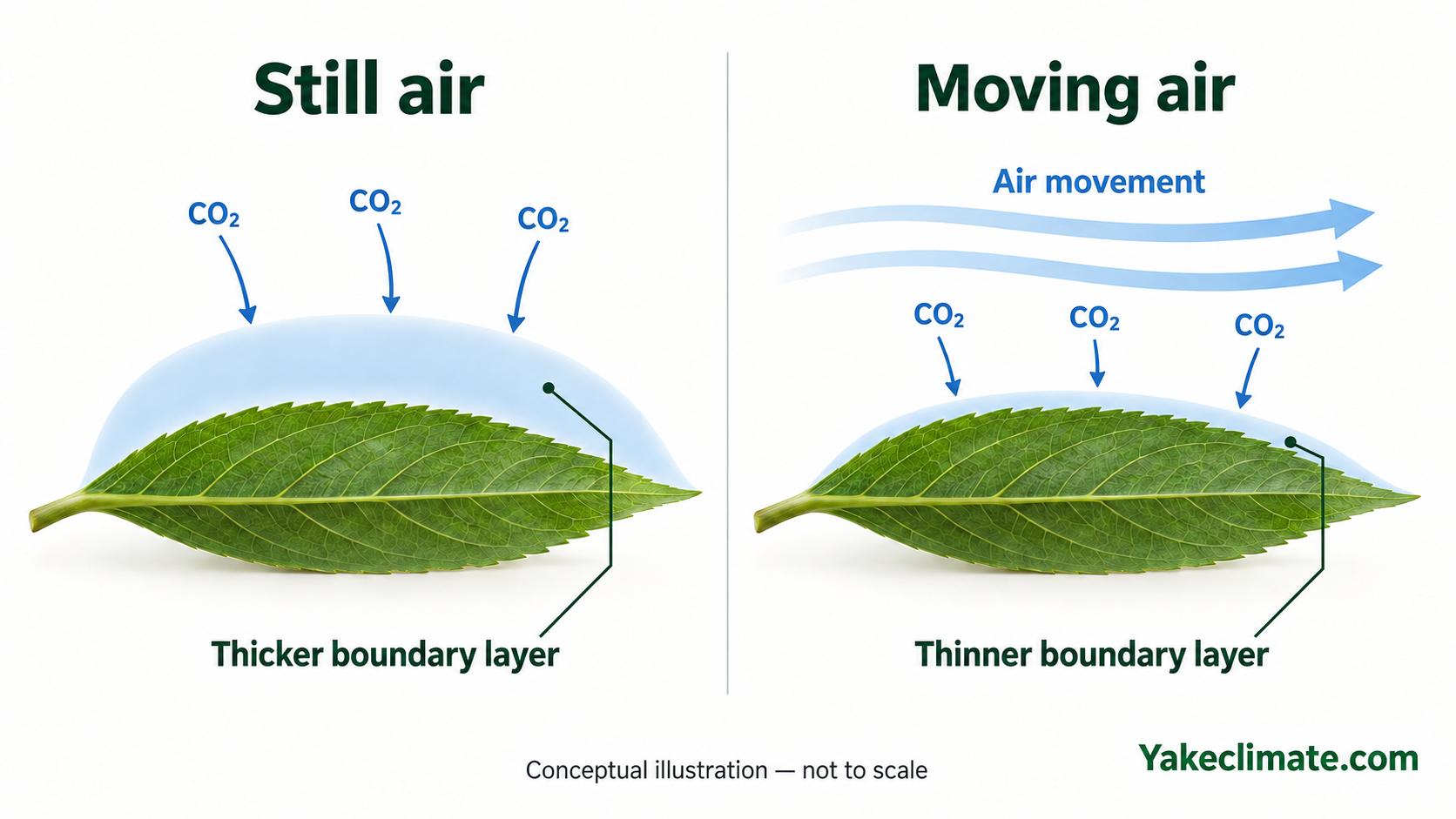
Canopy air movement should be selected for the crop, canopy structure, equipment and measured leaf response. Do not use a generic 0.2–0.5 m/s range as a universal no-damage requirement without a source and crop boundary.
Depletion Inside the Canopy
Under strong light, photosynthesis can consume CO₂ within a dense canopy faster than local air movement replenishes it. Check the light period, canopy density, source location and multiple readings before treating a gradient as a transport mechanism.
Sensor position determines which air volume the enrichment strategy observes. Compare aisle, above-canopy and canopy readings across relevant times, and check source location, airflow, calibration and crop response before concluding that the crop receives a lower concentration.
If a canopy gradient is confirmed, possible responses include air distribution, source placement, humidity control or gas supply changes depending on the evidence. Raising the setpoint is not automatically the correction; identify the limiting mechanism first.
Where enrichment is used, compare appropriately calibrated readings near the canopy with readings at the source and in the aisle over relevant light and ventilation periods. One sensor or one concentration difference cannot establish the strategy outcome.
Stomata Are Shared Between Water and Carbon
CO₂ uptake and transpiration are connected partly through stomata, but the size and direction of a response depend on crop physiology, water status, light and conditions.
VPD can affect stomatal behaviour and transpiration. High VPD may contribute to a limitation in some crops and water states; it is not proof that stomata are closed or that CO₂ uptake has stopped.
If enrichment costs rise without the expected crop response, compare gas supply, light, crop condition, canopy measurements, ventilation and the time of operation before changing VPD or enrichment targets.
Very low VPD can affect stomatal behaviour, transpiration and leaf-surface moisture, but the response depends on species, cultivar, leaf history, water status, temperature and airflow. Low VPD does not by itself prove condensation or leaf wetness; check surface temperature and the crop zone.
Choose physiological targets from crop- and stage-specific evidence, then compare the measured crop response, energy and gas costs under the same operating conditions.
Enrichment and Dehumidification Collide
CO₂ enrichment and humidity control can interact when their equipment shares an air path. The net effect depends on the ventilation, recirculation and regeneration configuration.
Ventilation can exhaust enriched CO₂ and admit outdoor air. Use the measured outdoor concentration for the site and period rather than an undated 400–420 ppm assumption, and compare enrichment runtime, lighting, humidity demand, airflow and gas cost before estimating the consequence.
During a lit period, opening vents or exhausting enriched air can reduce CO₂ available for net assimilation. A routine dark period has different gas-exchange conditions. Check whether enrichment is active, when it is being paid for, lighting state, humidity response and actual air path before describing a nightly loss.
Mechanical dehumidification can reduce moisture without exchanging air when it operates in a closed recirculating configuration. Separate exhaust, regeneration air, leakage, ventilation and other air paths may still remove enriched CO₂; verify the actual system configuration before making a retention claim.
The full comparison, including the conditions under which ventilation can and cannot dehumidify at all, is set out in ventilation vs. dehumidification.
Temperature Shifts the Optimum
Temperature, CO₂, light and water status can interact with photosynthetic response. Do not state a universal upward shift in optimum temperature from CO₂ enrichment without crop-, light- and condition-specific evidence; evaluate the variables together.
The appropriate temperature target for an enriched facility should be evaluated with the crop and lighting regime, water status and measured response. An enrichment setpoint alone does not justify a temperature change.
Temperature also changes saturation vapour pressure. Raising air temperature at constant water-vapour partial pressure lowers RH and increases air VPD; leaf-to-air VPD additionally requires representative leaf temperature. Crop response must be interpreted with light, root-zone water status, leaf temperature and species-specific evidence rather than inferred from air VPD alone.
Coordinate the temperature, humidity and enrichment controls so their schedules and air paths can be interpreted together. A simultaneous setpoint change does not by itself identify a cause.
Air Distribution Is the Delivery Mechanism
If measurements support a material distribution or canopy-supply limitation, review source position and air movement alongside crop and equipment constraints. Do not prescribe airflow from one concentration reading.
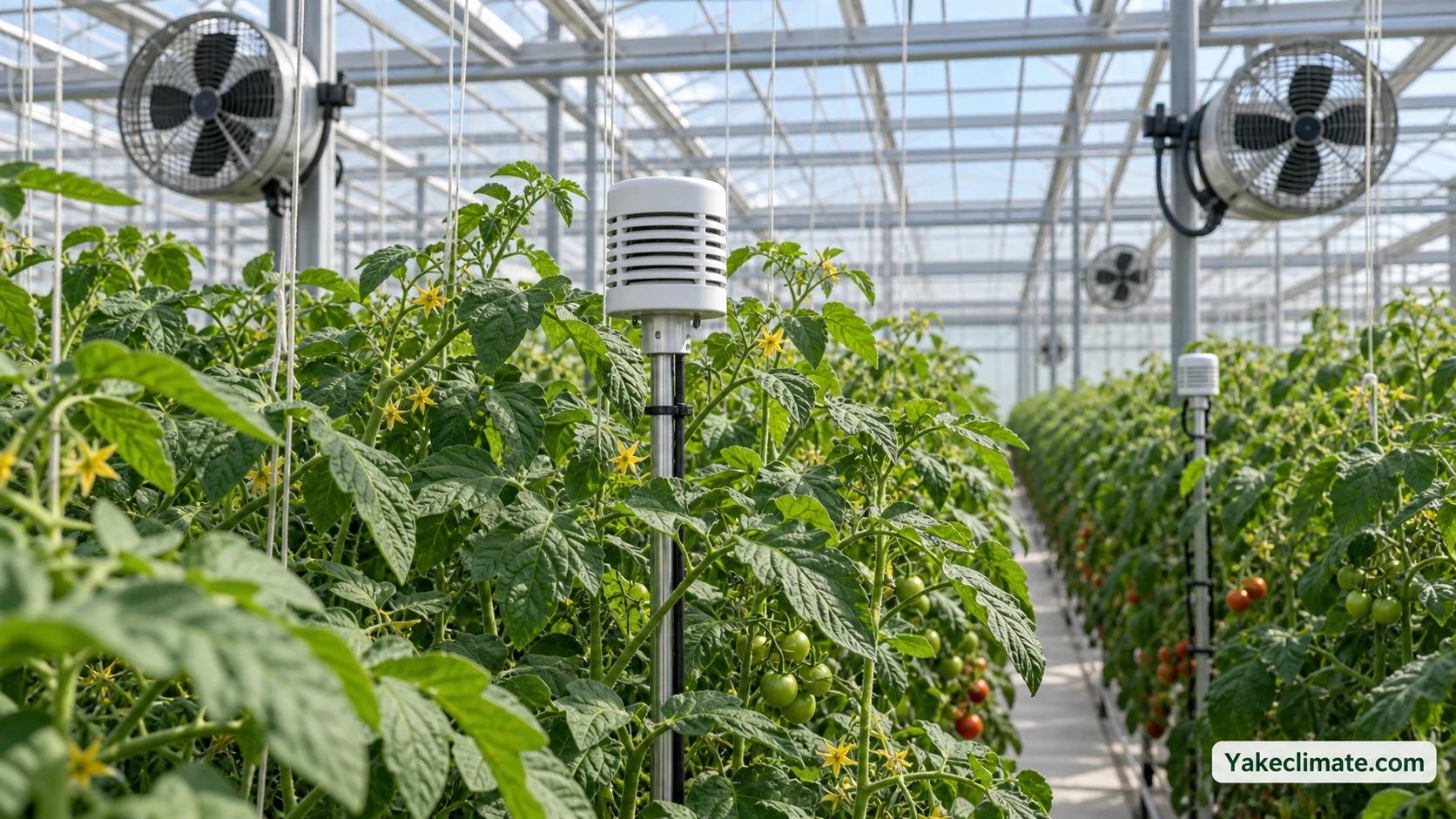
Horizontal fans may help mix air, but coverage depends on layout, obstacles and operating speed. Check canopy-level CO₂, temperature, humidity and crop response across locations.
Air-distribution tubing delivers air to defined positions, which is useful for reaching under or into canopies that horizontal fans cannot penetrate. Sizing, hole pattern and fan selection determine whether the delivered air actually reaches the canopy or simply exits near the fan. This is covered in greenhouse air-distribution tubes.
A recirculating dehumidifier may contribute to air movement as well as water removal. Its supply and return layout should be checked against the canopy measurement map; neither function proves a CO₂ benefit by itself.
CO₂ supply, humidity control and air distribution share operating conditions. Review them together while keeping their distinct performance endpoints.
Sensor Placement and Data Review
The measurements that describe this system are not the ones most facilities log by default.
A persistent CO₂ difference between canopy and above-canopy readings is an investigation clue, not direct proof of transport limitation. Check time period, light state, enrichment schedule, source location, airflow, sensor calibration and spatial placement before attributing the difference to gas transport.
Canopy-level air velocity can be measured at representative positions. Use it as one input to transport analysis rather than a direct measurement of boundary-layer thickness.
Leaf temperature helps distinguish air VPD from leaf-to-air evaporative demand and possible surface conditions. Interpret it with crop water status and light, not as standalone proof of CO₂ uptake. See how humidity affects plant growth for the related physiological context.
Temperature and humidity at canopy level, not at a convenient mounting height in the aisle.
Logs can screen possible limiting mechanisms, but environmental records alone cannot identify which physiological resistance is responsible. Use multiple positions and times, source and airflow records, crop observations and, where needed, agronomic or physiological measurements.
| Observed pattern | Questions to test, not a diagnosis | First checks |
|---|---|---|
| Aisle CO₂ reaches target while crop response is weak | Light, crop condition, supply, canopy transport or internal limitation may differ | Compare synchronized canopy and aisle readings, source operation, light and crop observations. |
| Enrichment use rises during humid periods | Ventilation loss is possible but not proven | Align vent and enrichment logs with measured outdoor and crop-zone CO₂. |
| Growth varies by bench or row | Air distribution, light, irrigation or crop differences may contribute | Map CO₂, airflow, light, water and growth across positions. |
| Enrichment runs in a high-VPD period | Stomatal limitation is one hypothesis among others | Review crop-specific VPD evidence, leaf temperature, water status and crop response. |
Information to Prepare for a Project Discussion
- Crop, cultivar, production system, planting density and canopy structure.
- CO₂ enrichment: whether used, target concentration, source, supply cost basis and control strategy.
- Sensor locations for CO₂, temperature and humidity, and whether any are at canopy level.
- Whether leaf temperature or canopy air velocity is measured.
- Lighting type, installed intensity and daily schedule.
- Existing air movement equipment: horizontal airflow fans, distribution tubing, screens and their control.
- Climate targets by growth stage, and which variables the facility controls on.
- Logged climate data covering a full production cycle.
- Observed problems, with location and timing: uneven growth, disease patches, condensation, or enrichment that does not produce the expected response.
- Facility layout, compartmentation and available mounting positions.
Discussing a Project
Yakeclimate designs and manufactures industrial dehumidification equipment for complex climate applications, with a focus on agriculture and energy projects.
We co-develop application-specific dehumidification equipment around the operating conditions, interfaces, and integration requirements of the wider project or system.
CO₂ enrichment strategy and crop targets remain with the grower and the agronomy team. Our scope is the dehumidification equipment and how it integrates with the facility's air distribution and control system.
Explore agriculture humidity control, review industrial ceiling dehumidifiers, or contact Yakeclimate to review the operating conditions for your facility.
FAQ
Frequently Asked Questions
Why doesn't my crop respond to CO₂ enrichment?
Possible causes include light or crop limitations, source supply, canopy distribution, stomatal response, internal diffusion and timing. Compare synchronized measurements and crop observations; a room reading alone does not identify the cause.
Where should the CO₂ sensor be placed?
Take canopy readings at more than one position and compare them with above-canopy or aisle readings over the same time. A difference is an investigation clue; check light, enrichment, source, airflow, calibration and placement before attributing it to transport rather than gas supply.
How much air movement does the canopy need?
Do not use a universal 0.2–0.5 m/s range as a guaranteed no-damage target. Select and verify air movement for the crop and canopy through source evidence, leaf response, temperature, humidity and actual distribution measurements.
Does ventilating for humidity waste my CO₂?
Ventilation can reduce enriched CO₂ during the periods when it is operating, but the magnitude depends on outdoor concentration, air exchange, enrichment timing, light, crop response, gas price and humidity need. Measure the timeline before comparing it with equipment energy.
How are humidity and CO₂ uptake connected?
High VPD can contribute to stomatal limitation under some crop and water-status conditions; low VPD can alter transpiration and surface moisture. Neither VPD state alone diagnoses stomatal closure, CO₂ uptake or condensation. Check crop, leaf temperature, surface condition and local environment.
Should the temperature setpoint change when CO₂ is enriched?
Temperature, humidity, light and CO₂ should be evaluated as a coordinated strategy. Any temperature response to enrichment depends on crop, light, water status and other conditions; do not apply a universal setpoint shift.


