

For a commercial mushroom grow room at 16°C (60.8°F) and 90% RH, the worked example requires 1.81 kg/h of additional moisture removal on average for two hours after watering. Size the dehumidifier for that operating window, check shorter peaks, and confirm humidity control at the normal fruiting load of 0.47 kg/h.
Quick answer
- Keep the fresh airflow required for the crop and calculate how much water that air adds or removes.
- Credit the existing cooling coil with the condensate it actually drains during each operating mode.
- Require the new unit to meet the recovery load at its entering-air conditions and control humidity during lighter loads.
For a commercial grow room equipment review, prepare the room's normal and recovery conditions before comparing equipment quotes.
Which operating modes set the dehumidifier size?
Use separate calculations for normal fruiting and recovery after watering. Add a washdown mode if the same equipment must dry the empty room before the next batch. Crop stage, room layout and production system affect how the air-handling system is operated. Start with the grower's setpoints and ventilation schedule for the crop in that room. Penn State Extension, Basic Procedures for Agaricus Mushroom Growing
| Record for each mode | What to enter |
|---|---|
| Crop and room target | Species, stage, target temperature and RH band, and the grower's fresh-air and CO₂ requirements |
| Air entering the room | Measured fresh airflow and the temperature and RH of the air as it enters, after any outdoor-air treatment |
| Water released inside | Evaporation from crop, beds and wet surfaces, plus any humidifier output that enters the room air |
| Water the system already removes | Condensate collected from the room's recirculating cooling coil during the same mode |
| Recovery requirement | Time allowed to return to the target band, starting temperature and RH, and any additional water expected to evaporate during that period |
Hold the required ventilation when checking a humid-weather mode. Fresh air entering the room brings in water when its humidity ratio is higher than the room's, and carries water out when it is lower. Relative humidity alone gives an incomplete comparison because the two air streams can be at different temperatures. ASHRAE Handbook, Psychrometrics
How do you calculate the remaining moisture load?
For a room with balanced fresh air and exhaust, multiply the dry-air mass flow by the difference between incoming and target humidity ratios. Add the water released inside and subtract the condensate drained by the existing recirculating coil.
| Part of the calculation | How to enter it |
|---|---|
| Fresh-air contribution | Fresh-air dry mass flow in kg/h × (incoming humidity ratio − room target humidity ratio) in kg water/kg dry air. Divide values in g/kg by 1,000 before multiplying. |
| Internal release | Use the water that enters the air in kg/h. Separate prompt drainage from the fraction of applied water that evaporates. |
| Existing recirculating coil | Subtract its average net condensate removal in kg/h over the relevant interval, including normal cycling. |
| Recovery allowance | Divide any additional water expected to evaporate by the allowed recovery time. Include each source once. If evaporation is concentrated early in the window, check the shorter peak interval too. If room air starts above target, also account for moisture stored in the air and use the changing room humidity ratio in the exhaust calculation. |
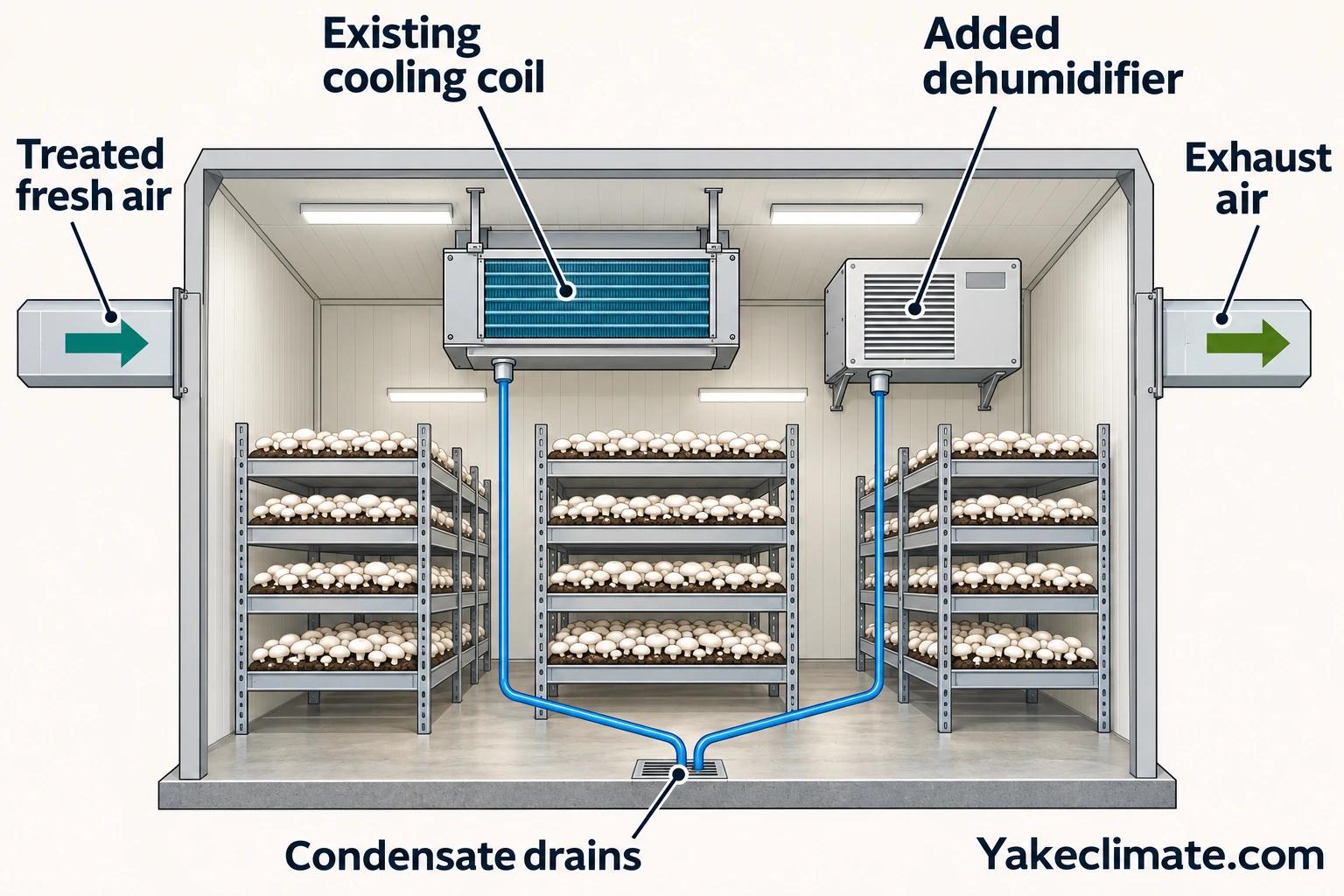
The room boundary matters. With a dedicated outdoor-air unit, use the humidity ratio of the treated supply air to calculate the fresh-air contribution. For the existing recirculating coil, count only the condensate removed inside that boundary. When one air handler mixes outdoor and return air, instead use outdoor air before the mixed-air coil and credit that coil's actual drainage once. Use the measured air paths and moisture levels for rooms with significant leakage or unbalanced airflow. ASHRAE Handbook, Psychrometrics · ASHRAE Handbook, Mechanical Dehumidifiers
Worked example for a commercial mushroom grow room
The recovery window sets capacity in this illustrative button mushroom fruiting room. Both modes use a target of 16°C (60.8°F) and 90% RH, or about 10.2 g water/kg dry air at 101.3 kPa. The room receives preconditioned fresh air and has a separate recirculating cooling coil. The room starts at target. After watering, an assumed extra 1.6 kg evaporates from beds and wet surfaces over two hours. That evaporation is separate from the ongoing 0.40 kg/h release during the same interval. Assume the air stays near the target band throughout both modes. ASHRAE Handbook, Psychrometrics
| Input or calculation | Normal fruiting | Two-hour recovery after watering |
|---|---|---|
| Fresh-air dry mass flow | 400 kg/h | 400 kg/h |
| Humidity ratio of incoming fresh air | 12.0 g/kg | 13.1 g/kg |
| Fresh-air contribution | 400 × (12.0 − 10.2) ÷ 1,000 = 0.72 kg/h | 400 × (13.1 − 10.2) ÷ 1,000 = 1.16 kg/h |
| Ongoing internal moisture release | 0.30 kg/h | 0.40 kg/h |
| Existing recirculating coil drainage | −0.55 kg/h | −0.55 kg/h |
| Additional evaporation during recovery | 0 kg/h | 1.6 kg ÷ 2 h = 0.80 kg/h |
| Additional dehumidification required | 0.47 kg/h (1.04 lb/h) | 1.81 kg/h (3.99 lb/h) |
If this day has 22 hours of normal fruiting and two hours of recovery, the added unit needs to remove about 14 kg over the day, an average of 0.58 kg/h. A unit that can deliver only that average would fall short during the two-hour window. For this example, request at least 1.81 kg/h of net removal averaged over the recovery window and a control sequence that also holds the band near the normal 0.47 kg/h load. Check both before choosing a unit. Use the grow room sizing calculator to organize your inputs and keep the short recovery load visible in the quote.
What capacity should the supplier confirm?
Request moisture removal at the entering-air condition of the proposed unit, with its actual airflow and any defrost included. For a room-mounted unit this typically starts with room air. For a ducted unit, use the condition at the inlet after any air streams mix. Check net removal and operating limits at the coldest expected inlet condition as well as at the recovery point. Confirm that the existing coil still delivers the drainage credited in the calculation when both units are under the proposed controls. ASHRAE Handbook, Mechanical Dehumidifiers
| If the room operates this way | Ask the supplier to confirm |
|---|---|
| The existing coil holds the temperature and humidity in every mode | Confirm measured drainage and how the air reaches the racks before adding equipment. |
| A room-mounted unit will handle the extra load | Confirm net water removal, part-load control and how much heat the unit rejects back into the room. Check that the existing cooling system can carry that heat. |
| The unit will supply several aisles through ducts | Confirm airflow at the design external static pressure and performance at the actual inlet temperature and RH. Check return locations, filter access and condensate drainage. |
| Cool operation brings frost or frequent defrost | Ask for average removal across full cycles. Compare refrigerant and desiccant options using removal rate, heat added to the room and installation requirements at the same conditions. |
For example, the RYDZ-90DM is listed at 90 L/day at 30°C (86°F) and 80% RH. That is the catalogue test point. For the illustrative room above, request the model's net removal and cycling behavior at the intended inlet condition, including 16°C and 90% RH if it draws air directly from the room at target. Use the industrial ceiling-mounted model table and the dehumidifier rating guide to compare supplier data on the same basis.
How do you check recovery after installation?
Time the return to the grower's target band after a representative watering cycle and check that low-load operation also holds the band. Log temperature and RH at more than one rack level, plus the temperature of the coldest surfaces. Record fresh airflow, cooling-coil and added-unit drainage, and equipment run times over the same interval. Research in commercial-design button mushroom rooms found different temperature and moisture conditions at different tray levels. ASABE, Environmental Conditions within Small-Scale Agaricus bisporus Mushroom Production Rooms
If the room reaches its humidity target but water still drips in one area, compare that surface temperature with the room-air dew point. A cold ceiling, pipe or door can need insulation or an airflow correction even when total water removal is adequate. Use the mushroom room humidity guide to check sensor placement and condensation. ASHRAE Handbook, Psychrometrics
FAQ
Frequently asked questions
Can I estimate capacity from the grow room's floor area?
No. Floor area helps lay out equipment and ducts. Estimate capacity from fresh airflow, the incoming air's moisture, evaporation inside the room and the water the cooling system already removes. Two rooms with the same footprint can have different rack loads, fresh-air rates and watering schedules.
Can the air conditioner cover the entire dehumidification load?
Yes, if its measured net drainage covers the load through the wettest operating and recovery modes while it holds the required room temperature. Check the periods when the thermostat calls for less cooling. Those periods can leave a moisture shortfall even when the coil drains plenty of water during longer runs.
Should I reduce fresh air after watering to make recovery faster?
No. Keep the crop's operating requirement for fresh air and CO₂ control. If incoming air is adding moisture, evaluate outdoor-air treatment or additional room dehumidification at that airflow. If drier outside air can remove moisture while the room stays on target, include that contribution in the calculation.
Send the room's crop stage, temperature and RH band, fresh airflow, measured coil drainage, recovery time and installation constraints for a commercial grow room equipment review.


