
Evaporative cooling efficiency is not a fixed equipment number. It describes how close a cooler can bring supply air to the entering wet-bulb temperature. That ceiling changes with every outdoor humidity condition. In dry climates, direct evaporative coolers can use about one-fourth as much energy as central air conditioners. They also add moisture to the air (PNNL Building America Solution Center, retrieved 2026-08-31). This article explains how to calculate that efficiency, where the technology works, and why it is the opposite tool from dehumidification.
What Evaporative Cooling Efficiency Means
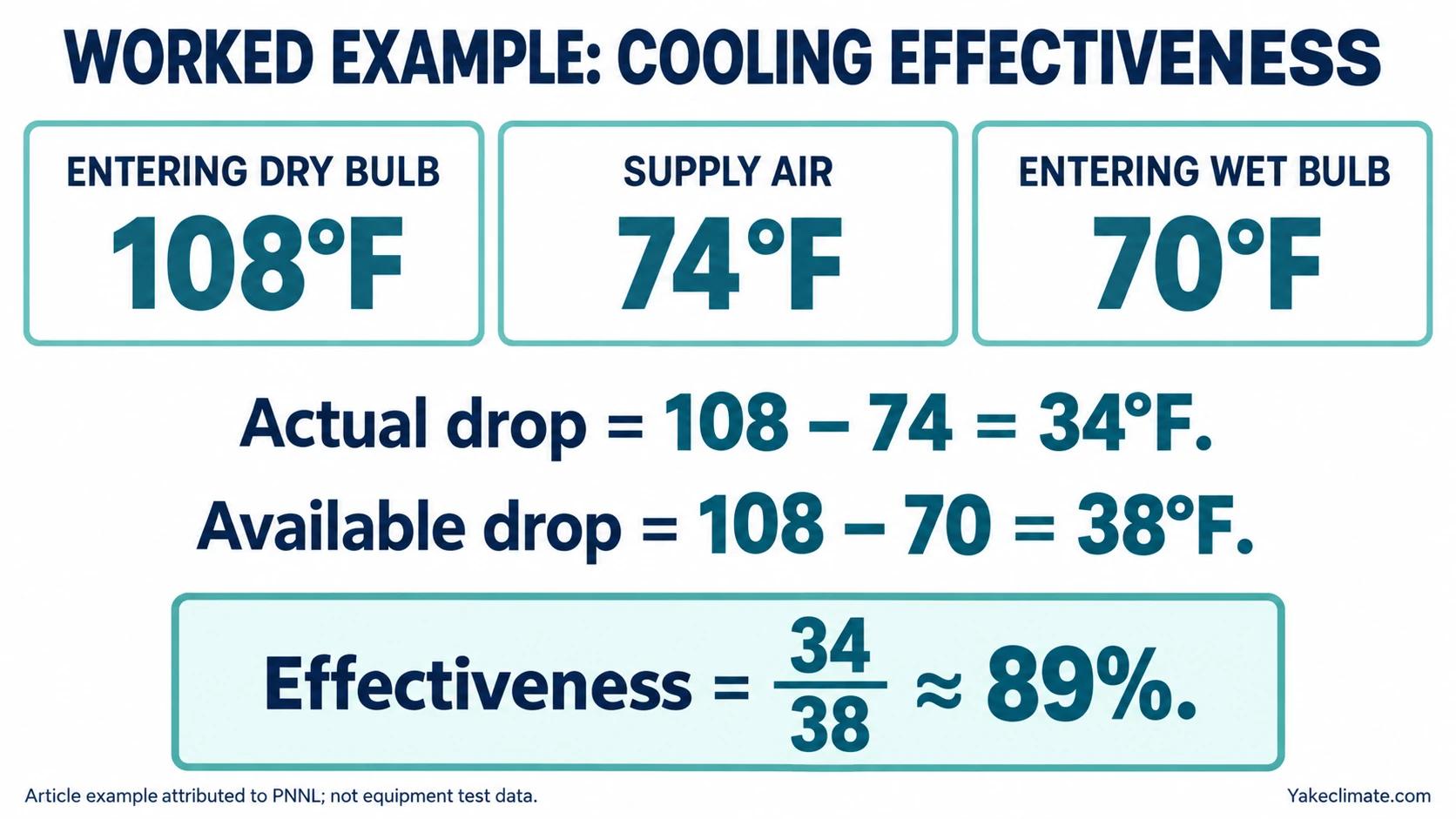
Evaporative cooling efficiency is the ratio of the temperature drop actually achieved to the maximum temperature drop available in the incoming air. PNNL defines cooling effectiveness with this formula (PNNL Building America Solution Center, retrieved 2026-08-31):
e = (Tdb - Tsupply) / (Tdb - Twb)
Where:
-
Tdbis the outdoor dry-bulb temperature. -
Twbis the outdoor wet-bulb temperature. -
Tsupplyis the supply air temperature leaving the evaporative cooler. -
Tdb - Twbis the wet-bulb depression.
If the supply air reached the wet-bulb temperature exactly, effectiveness would be 100%. In practice, direct evaporative media delivers less than that. PNNL's guide reports that newer single-inlet coolers with thick media typically achieve 75% to 93% effectiveness. It also says 12-inch media can reach 90% or better (PNNL Building America Solution Center, retrieved 2026-08-31). Two-stage indirect/direct designs can exceed 95%. The first stage pre-cools the air before the second stage adds direct evaporative cooling (PNNL Building America Solution Center, retrieved 2026-08-31).
The same formula works as a project check. PNNL uses a Phoenix example: 108°F dry bulb and 70°F wet bulb. That gives a 38°F wet-bulb depression. If a cooler delivers 74°F supply air, its effectiveness is (108 - 74) / (108 - 70) = 89% (PNNL Building America Solution Center, retrieved 2026-08-31). A separate example uses 105°F dry bulb, 60°F wet bulb, and a 90% effective medium. The predicted supply temperature is 105 - (45 x 0.9) = 64.5°F (PNNL Building America Solution Center, retrieved 2026-08-31).
Testing standards exist for this rating. ANSI/ASHRAE Standard 133 covers laboratory methods for rating the saturation effectiveness, airflow rate, and total power of direct evaporative air coolers. PNNL's guide references it as the available testing guidance for evaporative cooling effectiveness (PNNL Building America Solution Center, retrieved 2026-08-31).
Why Wet-Bulb Temperature Sets the Ceiling
Wet-bulb temperature is the lowest temperature that evaporation can reach for a given air condition. It is measured with a thermometer whose bulb is wrapped in a wet wick. As water evaporates from the wick, the thermometer cools until it reaches the wet-bulb temperature (PNNL Building America Solution Center, retrieved 2026-08-31).
The relationship is direct:
- At 100% RH at a stated inlet condition, wet-bulb and dry-bulb temperatures coincide, so an ideal direct adiabatic evaporative stage has no wet-bulb temperature drop available from that air.
- As relative humidity falls, the wet-bulb depression grows, and more cooling is available.
- The greater the wet-bulb depression, the better a direct evaporative cooler works.
PNNL uses a useful comparison. Phoenix has a 1% summer design dry-bulb temperature near 108°F. Its coincident wet-bulb temperature is near 70°F. The depression is 38°F, so evaporative cooling works very well. Sarasota, Florida, has a 92°F dry-bulb condition with a 79°F wet-bulb condition. The depression is only 13°F, where evaporative cooling would not work well (PNNL Building America Solution Center, retrieved 2026-08-31).
| Design check | Dry bulb | Wet bulb | Depression | Practical read |
|---|---|---|---|---|
| Phoenix, Arizona (PNNL example) | 108°F (42°C) | 70°F (21°C) | 38°F (21°C) | Direct evaporative cooling can work well |
| Sarasota, Florida (PNNL example) | 92°F (33°C) | 79°F (26°C) | 13°F (7°C) | Limited cooling; humid air reduces performance |
| General climate rule (PNNL) | Varies by location | 1% design wet bulb ≤ 70°F (21°C) | Varies | Most appropriate zone for evaporative cooling |
For greenhouse applications, NSW government guidance says evaporative cooling is most effective when the air entering the evaporative process has RH below about 60%. This describes available wet-bulb depression, not a universal crop-zone RH target. The same guidance explains the wet-bulb temperature limit (NSW Department of Primary Industries and Regional Development, retrieved 2026-08-31).
For a greenhouse project, evaluate the moisture and crop-zone limits alongside the cooling calculation. See agriculture applications for the broader controlled-environment context.
You can evaluate a project's ceiling without buying equipment. Use the wet-bulb temperature calculator or the moist-air property converter. These convert measured temperature and relative humidity into wet-bulb temperature, dew point, and moisture content. The relative humidity glossary entry and dew point glossary entry explain why RH alone is not enough for equipment decisions.
Direct, Indirect, and Two-Stage Systems: What Each Does to Moisture
The main engineering difference between evaporative cooling configurations is what happens to moisture content, not just how much cooling they produce.
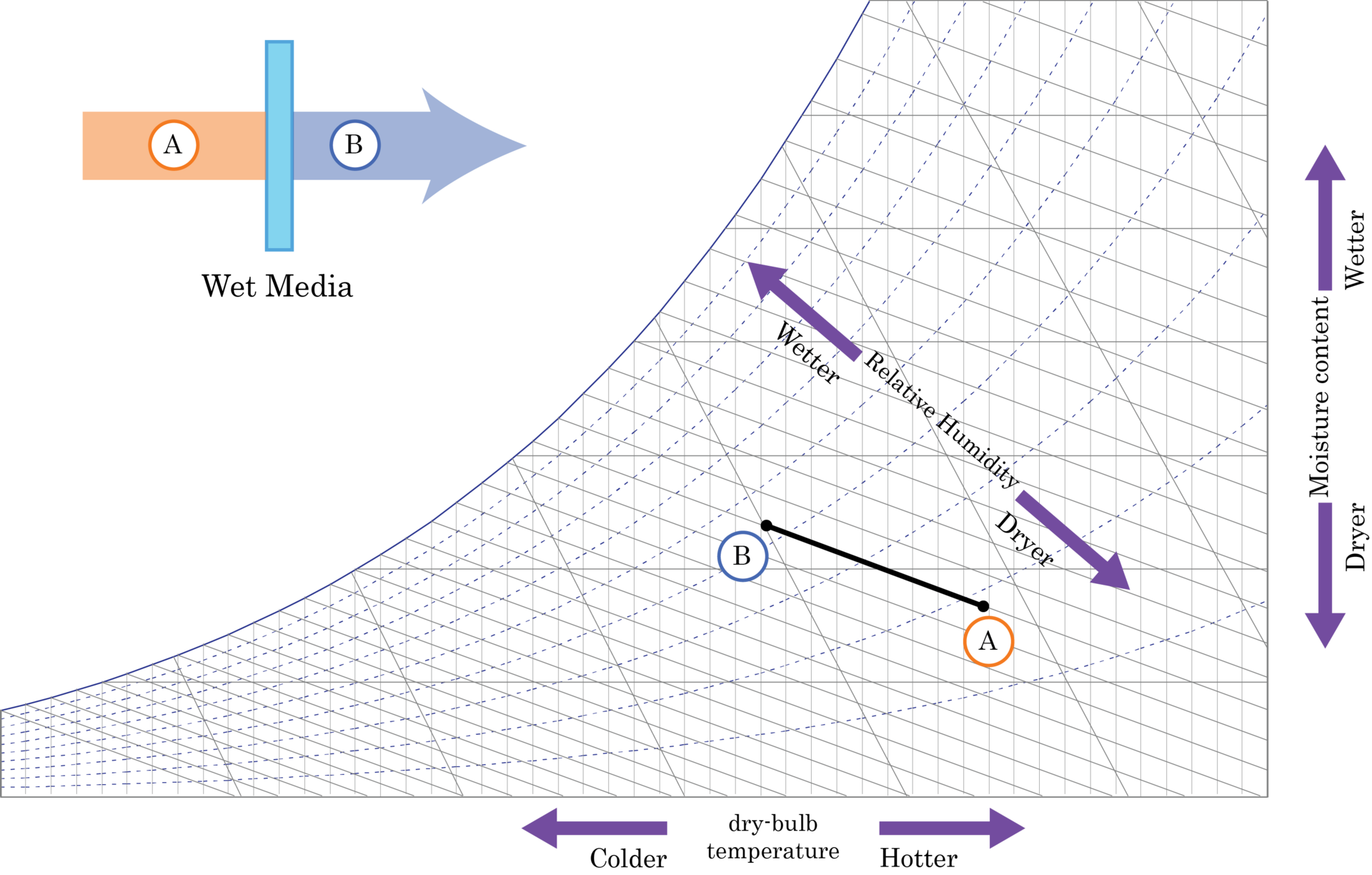
Direct evaporative coolers add humidity
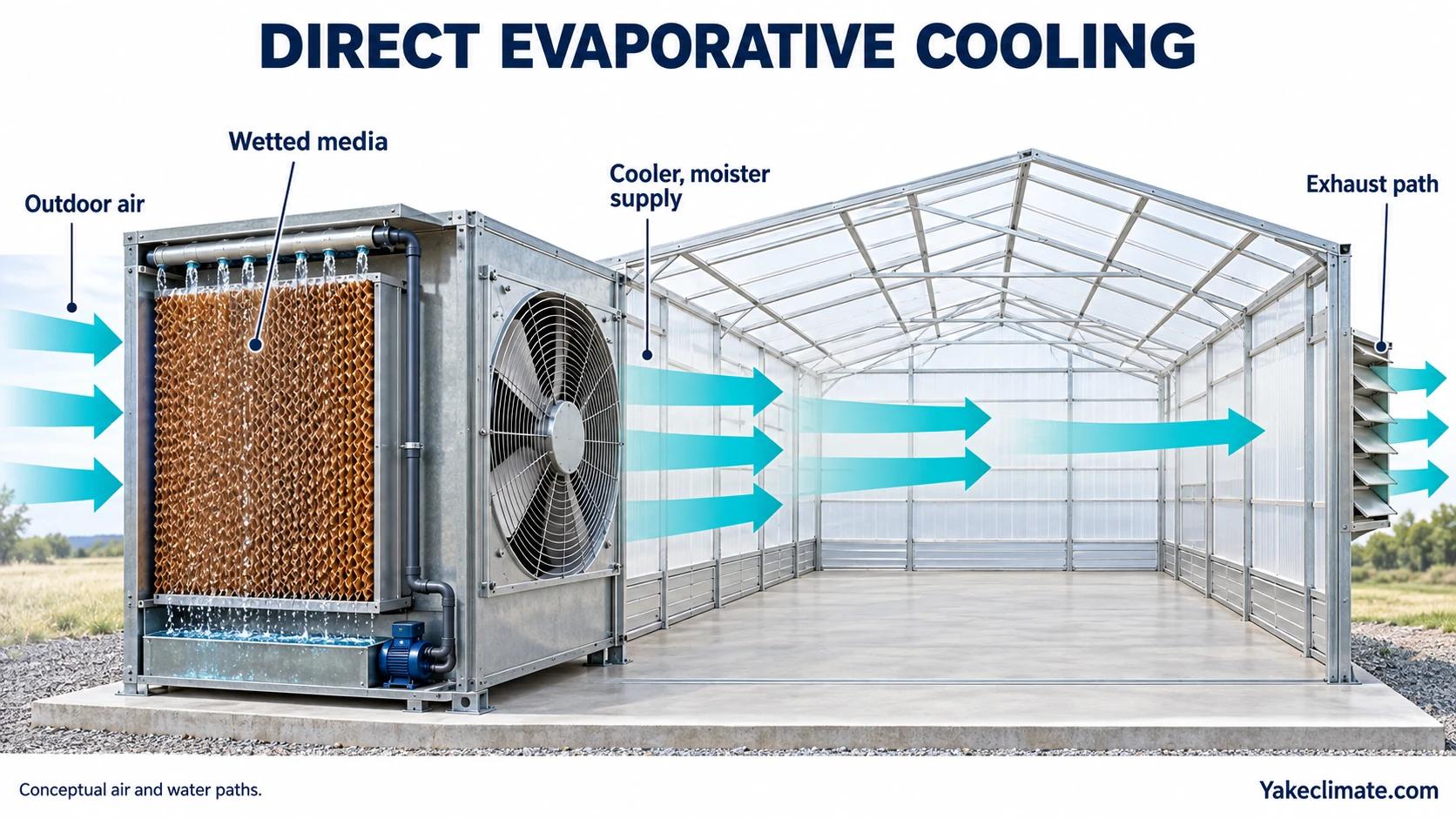
Direct coolers pull outdoor air through a wetted pad or media. The air is cooled as water evaporates, and the same air carries that water vapor into the space. PNNL states plainly that direct evaporative coolers increase rather than decrease the humidity in the air. This is different from standard air conditioning (PNNL Building America Solution Center, retrieved 2026-08-31). It makes them a fit for hot, dry climates with plenty of ventilation, not for spaces where low humidity is the goal.
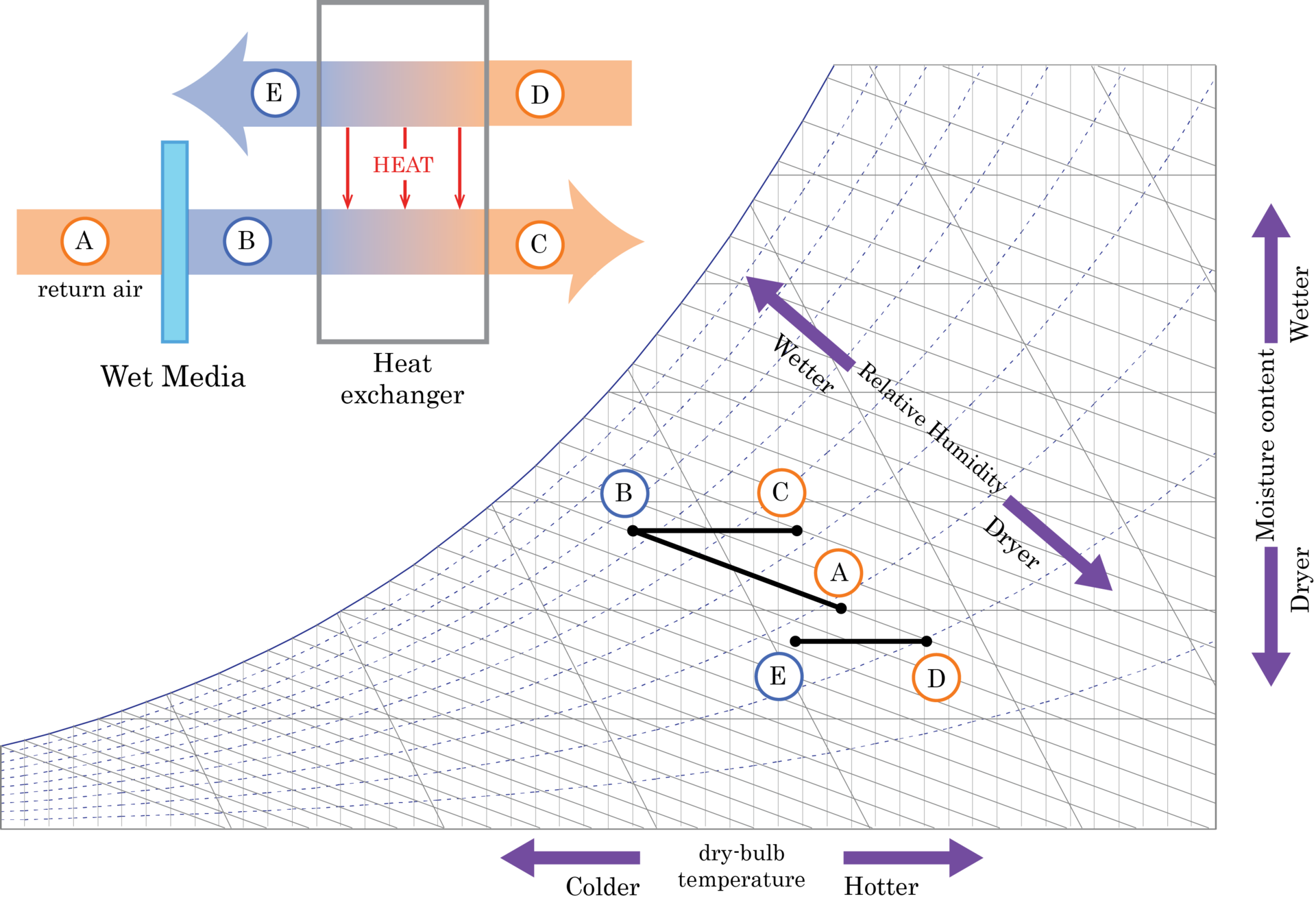
Indirect evaporative coolers cool without adding moisture to the supply air
Indirect systems use a heat exchanger. A primary airstream is sensibly cooled without contacting the water, while a secondary airstream evaporates water on the other side of the exchanger. The supply air temperature drops without the same humidity increase as a direct cooler.
GSA's High-Performance Building Clearinghouse reports that indirect evaporative coolers are up to 92% more efficient than code-compliant rooftop units. The finding is based on National Renewable Energy Laboratory analysis. GSA also notes they are best suited for high operating hours in dry climates (GSA High-Performance Building Clearinghouse, retrieved 2026-08-31).
Two-stage systems trade first cost for wider climate range
Two-stage indirect/direct systems pre-cool the air in an indirect stage, then pass it through a direct evaporative stage. The indirect stage cools without wetting supply air; the following direct stage adds moisture while providing further cooling. Its final temperature and humidity depend on entering conditions and both stages. PNNL reports that this configuration can achieve evaporative cooling effectiveness of 95% or greater under its stated conditions (PNNL Building America Solution Center, retrieved 2026-08-31).
| Configuration | How it cools | Moisture effect on supply air | Climate fit |
|---|---|---|---|
| Direct | Air passes through wetted media | Adds humidity | Hot, dry; low cooling-season RH |
| Indirect | Heat exchanger separates supply air from evaporating water | Does not add moisture to the supply air through the intact heat exchanger | Dry climates; high operating hours |
| Two-stage indirect/direct | Indirect pre-cool, then direct stage | Adds water vapour in its direct stage; final humidity depends on both stages and inlet conditions | Drier and mixed climates with wider operating range |
None of these configurations removes water vapor from the supply airstream. If the project target is lower absolute humidity, lower dew point, or night-time RH control, evaporative cooling is the wrong category of equipment.
Engineering boundary: For a near-adiabatic direct evaporative stage, sensible cooling is exchanged for added water vapour and air enthalpy stays approximately constant. A dehumidifier removes water vapour, but its air-state path depends on cooling, reheat and other system inputs; it is not a universal reverse constant-enthalpy process. If the failure mode is condensation, corrosion or crop wetness, specify a moisture or dew-point target before comparing equipment.
Measuring Performance: Effectiveness, Energy, and Water
Evaporative coolers are not rated with the same seasonal efficiency metric used for compressor-based air conditioners. PNNL notes that no national testing organization rates evaporative coolers in SEER. The practical performance measure is cooling effectiveness against wet-bulb temperature (PNNL Building America Solution Center, retrieved 2026-08-31).
Energy claims are climate-dependent, but the direction is consistent:
- Direct evaporative coolers can use about one-fourth as much energy as central air conditioners. They can also cost less than half as much to install and operate (PNNL Building America Solution Center, retrieved 2026-08-31).
- REHVA Guidebook No. 35 (published 2026) states that evaporative cooling can use up to 75% less energy than standard refrigerant-based air conditioning. It also flags water use, water treatment, and Legionella prevention as the counterbalancing responsibilities (REHVA Guidebook No. 35: Evaporative Cooling — official REHVA eShop listing, retrieved 2026-08-31).
Water is a real operating cost. PNNL's guide gives annual water-use examples for a 1,500 ft² home. The range runs from about 2,980 gallons in Santa Fe to 12,457 gallons in Las Cruces, New Mexico. A bleed-off valve can increase water use by 10% to 50% (PNNL Building America Solution Center, retrieved 2026-08-31). The same guide recommends maintenance at least twice a year. It warns that standing water in the pan can become a breeding ground for bacteria, including Legionella (PNNL Building America Solution Center, retrieved 2026-08-31).
| Performance question | What to ask |
|---|---|
| Cooling effectiveness | What is the rated media effectiveness, and at what face velocity and pad thickness? |
| Energy | What is the measured power at design airflow, and what is the local dry-bulb/wet-bulb design condition? |
| Water | What is the expected annual water consumption, bleed rate, and water-quality maintenance plan? |
| Maintenance | What is the pad replacement interval, drain-pan cleaning schedule, and Legionella control procedure? |
When Evaporative Cooling Is the Wrong Tool
Direct evaporative cooling adds water vapour to its supply air, whereas dehumidification removes water vapour from an airstream. They solve different tasks. Check the required supply temperature and moisture condition separately, rather than treating cooling alone as humidity control.
Choose a different technology when the real requirement is:
- A lower dew point or lower absolute humidity in the space.
- Night-time RH control to prevent condensation on crops, walls, or equipment.
- Moisture protection for electrical enclosures, stored products, or process materials.
- Stable humidity control during humid seasons or in coastal, monsoon, or high-RH climates.
Direct evaporative coolers are unsuitable in humid climates because they add humidity to the air in the space (PNNL Building America Solution Center, retrieved 2026-08-31). In greenhouses, the moisture added by fan-pad and fogging systems is part of their cooling mechanism, but it can create crop risks. NSW guidance notes that fogging raises humidity. A poorly maintained system can wet leaves and fruit, and misting systems with larger droplets can wet the crop and increase disease risk (NSW Department of Primary Industries and Regional Development, retrieved 2026-08-31).
If the cooling season has a large wet-bulb depression, evaporative cooling may be a legitimate first option. If the load is moisture removal rather than sensible cooling, the project should be scoped as dehumidification. The article on running air conditioning and a dehumidifier together explains how the two systems behave differently. The refrigerant vs desiccant selection guide covers the main dehumidification technology choices.
How to Estimate Whether Evaporative Cooling Will Work for Your Site
The estimate should start with design conditions and a ventilation path, not with the cooler's fan speed.
- Obtain the local summer 1% design dry-bulb and wet-bulb temperatures for the project location. PNNL's general rule is that areas with wet-bulb temperatures of 70°F (21°C) or lower are appropriate for evaporative cooling (PNNL Building America Solution Center, retrieved 2026-08-31).
- Calculate the wet-bulb depression. A large depression means more available cooling; a small depression means the technology has little room to work.
- Apply the media effectiveness rating to estimate supply air temperature using the formula in the first section.
- Check the ventilation path. Direct evaporative coolers push air through the space and need an exhaust route. PNNL notes that they can completely replace house air every 2 to 3 minutes and require open windows or vents, or a mechanical exhaust path (PNNL Building America Solution Center, retrieved 2026-08-31).
- Compare the predicted supply and crop-zone humidity with the process or crop limit. NSW greenhouse guidance says evaporative cooling is most effective when the air entering the evaporative process is below about 60% RH; this is an operating suitability observation, not a universal target RH for every crop (NSW Department of Primary Industries and Regional Development).
| Step | Input | Decision signal |
|---|---|---|
| 1. Design conditions | 1% summer design dry-bulb and wet-bulb | Wet bulb ≤ 70°F (21°C) is the general PNNL rule |
| 2. Wet-bulb depression | Dry bulb minus wet bulb | Larger depression = more available cooling |
| 3. Media effectiveness | Rated media value, pad thickness | Typical new media: 75% to 93%; 12-inch media can be 90%+ |
| 4. Ventilation | Exhaust area or open path | Direct coolers require relief for supply air |
| 5. Humidity check | Entering-air RH and predicted supply/crop-zone humidity | NSW below-60% RH observation concerns evaporative cooling effectiveness of incoming air; set crop-zone target separately |
For projects where the answer is dehumidification, prepare the project inputs before contacting suppliers. Include space boundary, operating temperature and humidity, target condition, moisture sources, airflow, power, drainage, controls, installation limits, and schedule. The same inputs that expose a small wet-bulb depression also expose why evaporative cooling cannot meet the requirement.
FAQ
Frequently Asked Questions
Is evaporative cooling efficiency the same as air conditioner efficiency?
No. Air conditioners are commonly compared with SEER or EER ratings for compressor-based cooling. Evaporative coolers are compared by cooling effectiveness, which measures how close supply air comes to the entering wet-bulb temperature (PNNL Building America Solution Center, retrieved 2026-08-31).
How much can an evaporative cooler lower the air temperature?
It depends on the wet-bulb depression, media effectiveness, and airflow. PNNL reports that direct evaporative coolers can reduce entering air temperature by 15°F to 40°F in suitable conditions. In one example, a 90% effective medium turns 105°F dry-bulb air with a 60°F wet-bulb into 64.5°F supply air (PNNL Building America Solution Center, retrieved 2026-08-31).
Do evaporative coolers dehumidify?
No. Direct evaporative coolers add water vapour to their supply air. Indirect systems keep the supply stream separate from the wetted stream, while indirect/direct two-stage systems add moisture in their direct stage. None removes water vapour from supply air as a dehumidifier does (PNNL Building America Solution Center, retrieved 2026-08-31).
Does evaporative cooling work in humid climates?
Usually less effectively. PNNL's general design rule uses a 1% summer design wet-bulb temperature of about 70°F (21°C) or lower. NSW greenhouse guidance says evaporative cooling is most effective when the air entering the process is below about 60% RH; that figure does not prescribe a crop-zone target (PNNL Building America Solution Center, retrieved 2026-08-31; NSW Department of Primary Industries and Regional Development, retrieved 2026-08-31).
What maintenance does an evaporative cooler need?
PNNL recommends maintenance at least twice a year, at start-up and shutdown, including replacing or cleaning media, inspecting the belt, cleaning the pan, and winterizing the water line. Standing water should not be left idle for days because it can become a breeding ground for bacteria, including Legionella (PNNL Building America Solution Center, retrieved 2026-08-31).
When should I choose dehumidification instead of evaporative cooling?
Choose dehumidification when the goal is lower moisture content, lower dew point, night-time RH control, condensation prevention, or stable humidity in humid climates. Evaporative cooling adds or preserves water vapor; dehumidification removes it. If the project brief is built around a dew-point or RH target, the equipment conversation should start with dehumidifiers, not evaporative coolers.
Conclusion
Evaporative cooling efficiency is a psychrometric relationship, not a fixed product spec. The wet-bulb depression sets the available temperature drop. Media effectiveness determines how much of that drop the equipment can deliver. The moisture added to the supply air defines the technology's real boundary. In dry climates with a large wet-bulb depression and a proper ventilation path, direct and indirect evaporative cooling can be energy-efficient options. When the project needs dehumidification, lower dew point, or humidity control through humid seasons, evaporative cooling is the wrong starting point.
Start with design conditions, calculate the wet-bulb depression, check the humidity target, and only then compare equipment categories. If the answer points to moisture removal, prepare a project brief with operating conditions and target dew point or RH, and review industrial dehumidifiers as the next step.
Image credits: direct and indirect evaporative cooling diagrams adapted from Tom Hootman, "Net Zero Energy Design," via Wikimedia Commons (CC BY-SA 3.0).


