
The cost of an industrial dehumidifier for a greenhouse depends on moisture load, technology choice, airflow distribution, corrosion protection, controls and installation scope. A price without those inputs is usually not a reliable project number.
Capacity is one cost factor, but a comparable greenhouse quote also depends on moisture-load assumptions, operating conditions, equipment, installation, ducting, controls, drainage, electrical work, corrosion protection, energy, maintenance and standby requirements. A useful RFQ separates those cost lines instead of asking for a generic model price.
Why Generic Price Ranges Mislead Buyers
Two greenhouses with the same area can require different dehumidification budgets. A young crop with frequent ventilation is not the same as a mature tomato crop with thermal curtains, CO2 retention and high night condensation risk.
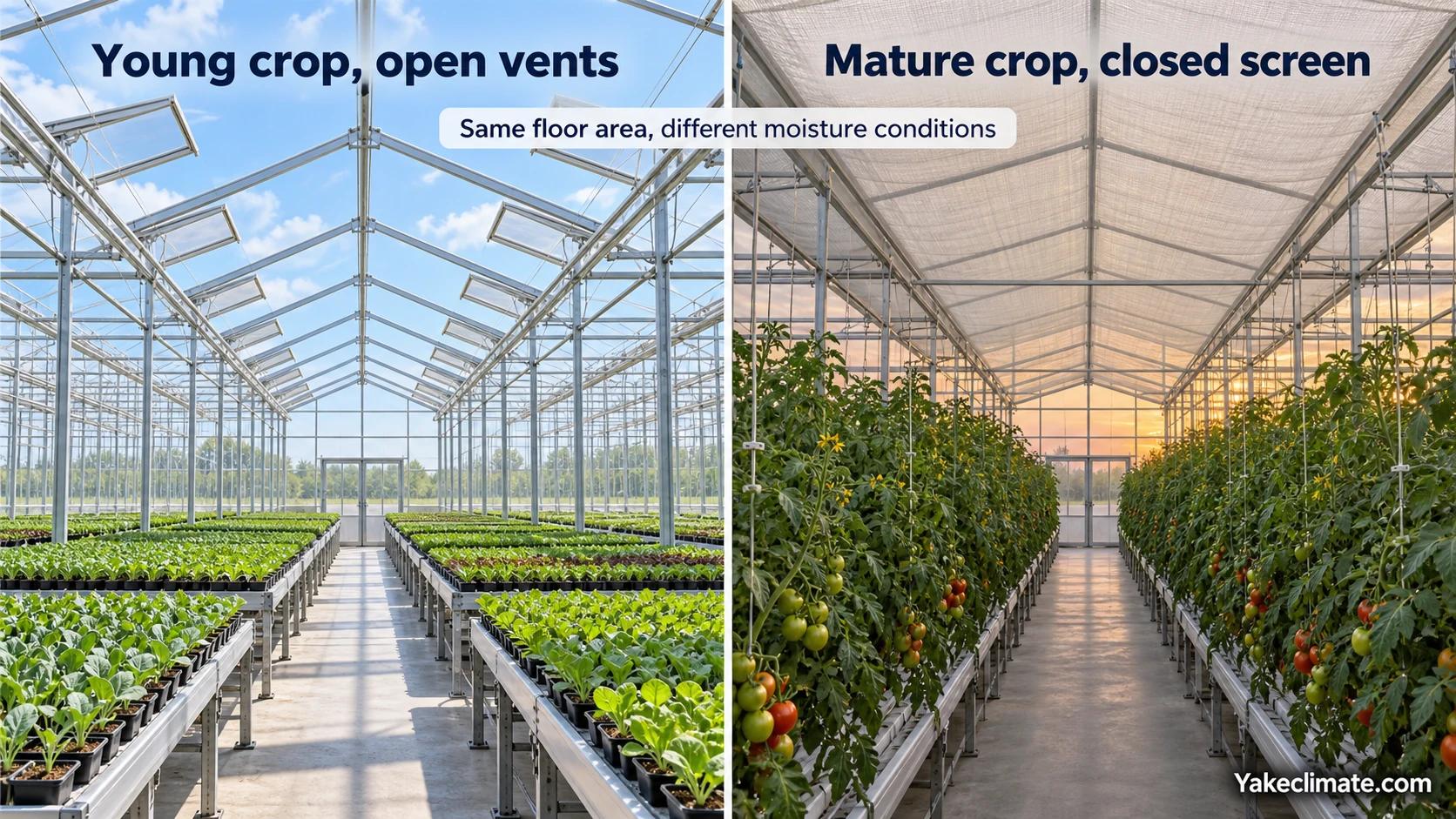
ASHRAE's HVAC design training treats psychrometrics, moist air properties, evaporation and air distribution as core design concepts (ASHRAE HVAC Design Pathway). That is the cost lesson too: price follows the air and moisture problem.
The Main Cost Drivers
| Cost driver | Why it changes price | What to define before requesting a quote |
|---|---|---|
| Moisture removal capacity | Larger latent load requires larger compressors, rotors, fans or heaters. | Daily and peak moisture load, not just floor area. |
| Technology choice | Refrigerant, desiccant and hybrid systems use different hardware. | Temperature range and required dew point. |
| Airflow and static pressure | Ducted systems need stronger fans and more installation work. | Duct length, air tubes, rack or crop layout. |
| Materials | Greenhouse chemicals and high humidity can require coated coils or stainless parts. | Corrosion exposure and cleaning practice. |
| Controls | Integration with greenhouse computers adds interfaces and commissioning. | Protocol, alarms, sensor locations and control ownership. |
| Drainage and placement | Condensate routing, hanging frames and service clearance affect installation. | Equipment location, drain route and maintenance access. |
Refrigerant, Desiccant and Hybrid Cost Logic
Refrigerant systems are often the starting point for warm greenhouses because they remove moisture by cooling air below its dew point and draining condensate. Desiccant systems are considered when low temperature, low dew point or dry-air supply makes cold-coil dehumidification less suitable.
| Technology | Cost tends to rise when | Useful fit |
|---|---|---|
| Refrigerant industrial dehumidifier | Required water removal, fan static pressure, corrosion package or control complexity rises. | Warm greenhouses with moderate dew point targets. |
| Desiccant rotor dehumidifier | Target dew point drops, reactivation heat demand rises or air seals/control needs become stricter. | Cold operation, low dew point or process-dry supply air. |
| Hybrid system | Both cooling-based and desiccant stages are needed. | Projects with strong seasonal changes or strict night control. |
Use the greenhouse dehumidifier selection criteria before comparing quotes. A cheaper unit is not cheaper if it cannot reach the target condition.
Installed Cost Is More Than the Unit
The installed system can include structural supports, ducting, drain lines, power supply, controls wiring, sensors and commissioning. Buyers often compare only the unit price and miss the parts that decide whether the unit will work in the greenhouse.
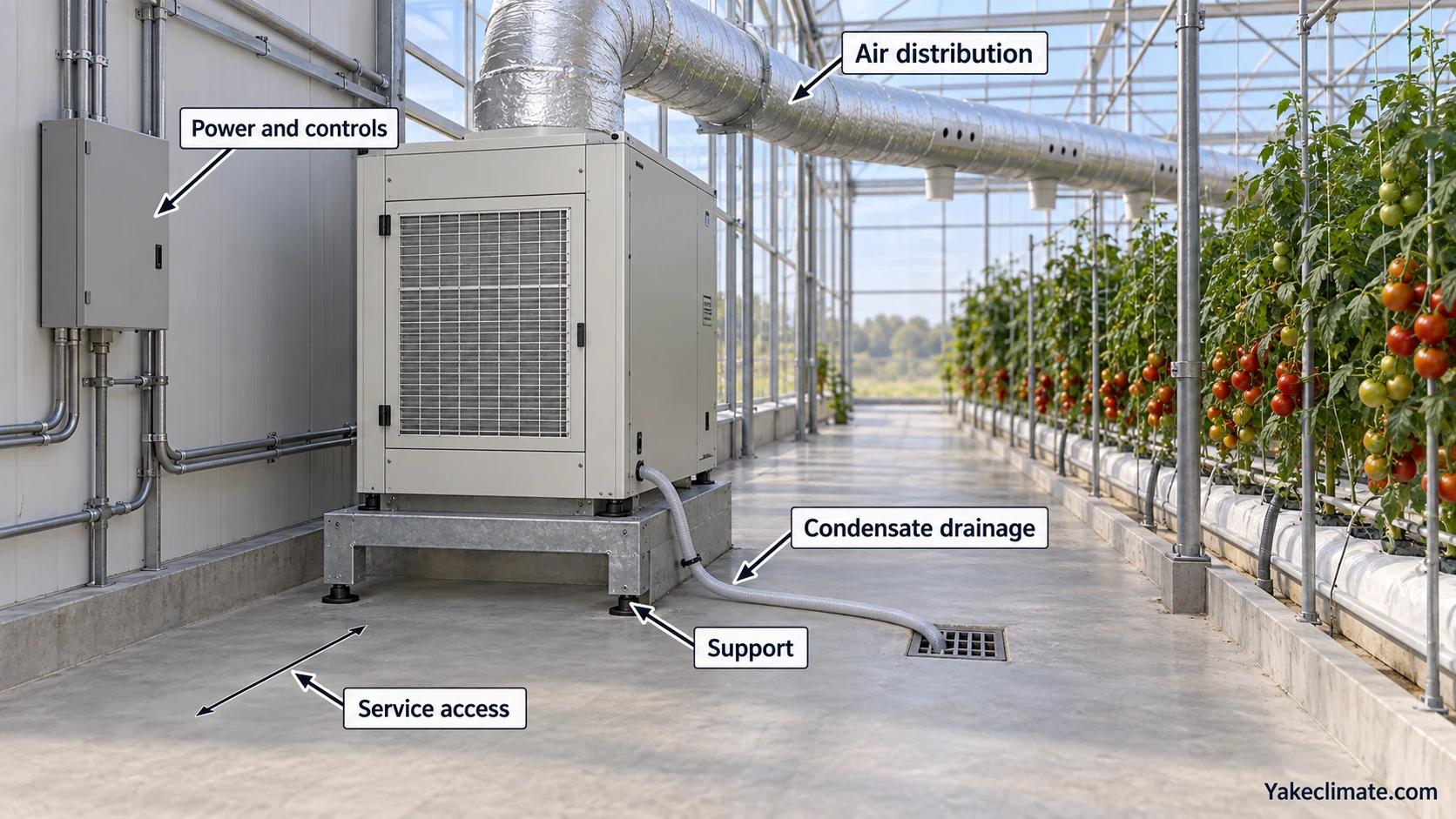
Typical scope questions:
- Is the unit inside the crop area, in a service corridor or outside the greenhouse?
- Does the supply air need ducts or air tubes?
- Can condensate drain by gravity?
- Who provides sensors: dehumidifier supplier, greenhouse computer supplier or project integrator?
- Are coated coils, stainless drain pans or special enclosures needed?
- Is there enough service clearance for filters, coils and electrical panels?
Operating Cost Comes From Runtime and Utility Type
Operating cost depends on moisture load, outdoor humidity, control strategy and utility rates. A greenhouse that vents freely when outdoor air is dry may run dehumidifiers less often. A greenhouse that keeps curtains closed and retains CO2 may need more mechanical removal.
For refrigerant units, ask for performance at the actual inlet temperature and humidity. For desiccant units, ask for reactivation energy as well as process fan power. For either technology, compare liters of water removed per kWh only at the same operating condition.
| Operating variable | Why it matters |
|---|---|
| Outdoor dew point | Determines whether ventilation helps or hurts. |
| Curtain schedule | Closed curtains reduce heat loss but can trap moisture. |
| CO2 strategy | Ventilation may have a crop-production penalty. |
| Night temperature | Cooling air raises RH and condensation risk. |
| Deadband and staging | Controls short-cycling and peak electrical demand. |
RFQ Inputs That Produce a Real Quote
Send these inputs when requesting greenhouse dehumidifier cost:
| Input | Minimum detail |
|---|---|
| Greenhouse layout | Area, height, compartments, curtains and equipment locations. |
| Crop and water use | Crop type, mature canopy assumption, irrigation or water balance if known. |
| Control targets | Day and night temperature, RH or VPD, dew point limits. |
| Climate strategy | Ventilation, heating, CO2 and curtain operation. |
| Utilities | Voltage, phase, available power, hot water, steam or gas if relevant. |
| Installation boundary | Unit only, unit plus ducting, or full installed package. |
| Controls boundary | Local controller only, BMS protocol, greenhouse computer integration or PLC logic. |
For a worked project-style example, compare this list with the 5-hectare greenhouse sizing walk-through.
FAQ
Frequently Asked Questions
Why not publish a fixed greenhouse dehumidifier price?
Because the same nominal unit can be wrong for a different temperature, moisture load, airflow path or control requirement. A fixed public price often hides the real installed scope.
What is the easiest way to reduce cost risk?
Define the moisture load, temperature range, controls boundary and installation boundary before requesting quotes. Those four items remove most ambiguity.
Does lower upfront cost mean lower total cost?
Not necessarily. Undersized equipment, poor ducting, weak corrosion protection or missing control integration can increase runtime, crop risk and rework.


