
Several different products are called moisture barriers for concrete floors. A below-slab vapor retarder, a surface-applied mitigation system and environmental drying solve different parts of the problem. Identify the moisture source and the flooring manufacturer’s acceptance criterion before choosing a route.
These approaches act at different stages and cannot simply substitute for one another. A dehumidifier removes moisture from the air and can support drying of an exposed slab; it does not block ongoing ground vapor. A surface mitigation system does not remove water already inside concrete. A below-slab vapor retarder continues to limit upward vapor after the pour, but cannot be installed beneath an intact existing slab without reconstruction.
Establishing which problem you have comes before choosing anything.
Three Functions, Not One
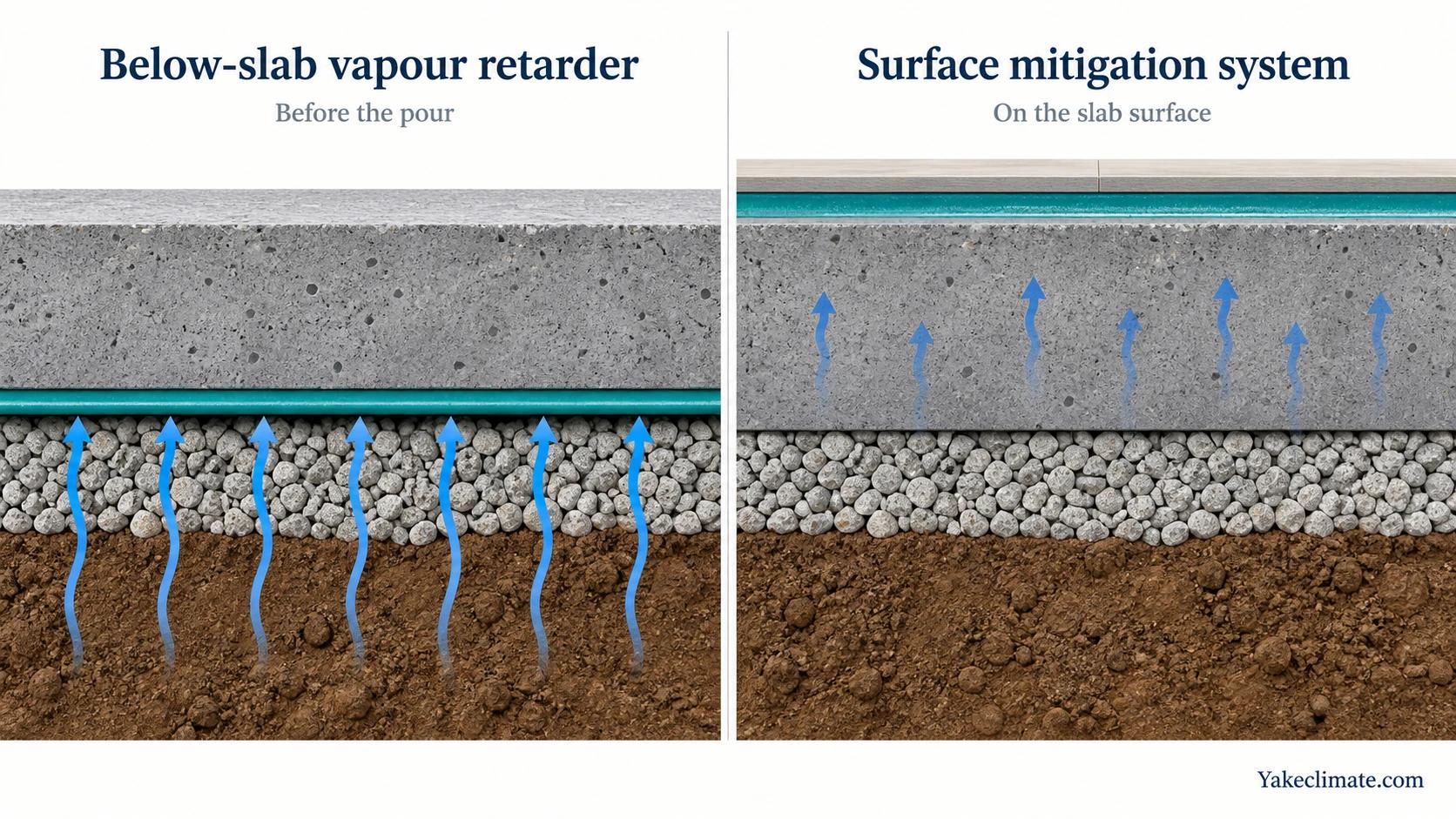
Below-slab vapor retarder. Installed under the slab before pouring, an intact and correctly detailed layer continues to limit upward vapor migration after the pour; it is not a zero-permeance guarantee. A new below-slab layer generally cannot be placed beneath an existing intact slab without reconstruction. Inspect the actual construction and drainage before choosing another remedy.
A slab cast on a vapor retarder generally dries mainly through its exposed face. The retarder reduces the downward moisture path, so construction and drying faces affect the schedule. Do not assume a universal multiplier or infer barrier failure from slow drying alone.
Surface-applied moisture mitigation system. A coating or membrane applied to the top of a cured slab, forming a barrier between the concrete and the flooring above. It is used where the slab's moisture condition exceeds what the flooring can tolerate and where waiting for it to dry is not viable. These are engineered systems with specific surface preparation, application and testing requirements, and their performance depends heavily on those being followed.
Environmental drying and dehumidification. Removing moisture from the air above the slab so the slab can release its own moisture faster. This addresses residual construction water — the mix water that was not consumed by hydration.
The critical distinction, stated plainly:
Dehumidification can help remove residual water from an exposed slab by controlling the air above it. It does not repair a ground-water source or replace a correctly detailed below-slab vapor retarder. Confirm the source before predicting a drying schedule.
A persistent or rising moisture reading under controlled test conditions is a reason to investigate an ongoing source. The trend alone cannot prove that the source is ground moisture; leaks, changing weather, unconditioned space or differences in test location and method can also affect readings.
Identify the Source First
| Source | Character | What addresses it |
|---|---|---|
| Residual mix water from construction | Often finite; trend depends on the test conditions | Time, environmental drying, or a surface mitigation system |
| Ground moisture / vapour drive | May be ongoing; confirm from construction and site evidence | Existing below-slab retarder, source repair or a compatible surface system after assessment |
| Hydrostatic pressure | Ongoing; may be seasonal | Drainage and waterproofing engineering — outside the scope of either |
| Water event or leak | Finite, once repaired | Repair, then drying — see desiccant dehumidifiers in water-damage restoration |
| Condensation on the slab surface | Recurring, seasonal | Lowering the room's dew point below slab temperature — see warehouse humidity control |
Repeat the specified test at documented locations under comparable service conditions, then investigate construction records, the below-slab retarder, drainage, plumbing and recent water events. A falling trend can support a residual-water hypothesis; a flat or rising trend does not by itself identify the source. Surface mitigation or waterproofing must be selected against the confirmed source and the manufacturer’s substrate limits.
Test Before You Select
Two standard test methods are in common use, and they measure different things.
ASTM F2170 uses in-situ relative humidity probes at the depth and conditions defined by the current test method. Record the test locations, slab construction, environmental conditions and probe results; follow the current procedure and the flooring manufacturer’s acceptance requirements.
F2170 measures in-situ RH at the specified depth and test conditions. It helps characterize the slab’s internal moisture state for a particular flooring decision, but a single result cannot identify the water source or guarantee future flooring performance. Follow the current test procedure and the selected flooring system’s method, limit, location and service-condition requirements.
ASTM F1869 uses anhydrous calcium chloride to measure the moisture vapor emission rate from a prepared slab surface over the test period. Follow the current method and the flooring manufacturer’s specified limits; it does not measure internal slab RH.
F1869 reports surface vapor emission during the test. A dry surface can coexist with greater moisture deeper in the slab, so a favorable surface result may not predict the state after a less permeable covering is installed. Use it only where the flooring system specifies that method and interpret the result within its test conditions.
They are not interchangeable. Where a flooring manufacturer specifies a method and a limit, that method must be used — a passing result by the other method does not satisfy the requirement.
Test conditions matter. Both methods require the slab and the space to be at service conditions for a defined period beforehand, because both temperature and the surrounding air condition affect the result. Testing a slab in an unconditioned building and applying the result to a conditioned one is not valid.
Why "How Long Until It's Dry?" Has No Answer
Concrete drying depends on air conditions; see the general evaporation guide, but use the flooring manufacturer’s specified test to decide readiness.
Early on, the surface stays wet and drying is fast and controlled by air conditions. Then the evaporation front retreats into the slab, and the rate becomes controlled by how quickly water can diffuse through a dense, low-permeability material. Concrete is very good at holding onto water, so this second phase is long — and it is the phase that determines the schedule.
The variables that move it:
- Thickness and permitted drying faces. A below-slab retarder limits downward drying, so the exposed face and slab construction affect the schedule; no universal multiplier applies.
- Water-cement ratio and mix design. More mix water, and less permeable concrete, both extend drying.
- Curing method and any curing compound, which may need removal before drying can proceed.
- Ambient conditions, which control the constant-rate phase and continue to set the equilibrium the slab is heading toward.
- Whether the building is enclosed and conditioned. An open building tracks outdoor conditions, which may be wetter than the target.
- Any ongoing moisture source, which as noted above changes the problem entirely.
General rules of thumb circulate widely and are unreliable, because they average across all of these. The defensible answer comes from testing the actual slab under the actual conditions and observing the trend.
Where Dehumidification Genuinely Helps
Within its limits, environmental control is effective and often the difference between meeting a programme and not.
It maintains the driving force. In an enclosed space, moisture evaporating from the slab raises the air's humidity, which reduces the gradient and slows further drying. Removing that moisture keeps the process running — without it, drying stalls regardless of how long it is left.
Lowering room humidity can maintain a vapor-pressure gradient while the slab dries. That may reduce the slab’s measured internal RH over time, but the rate and final flooring acceptance depend on slab construction, conditions and the specified test; no equipment alone guarantees a passing result.
Ventilation supports drying only when outdoor air has lower moisture content than indoor air and the incoming air can be conditioned for the project. Compare actual inlet and room conditions before treating outside air as a drying strategy.
Heat helps too, and is under-used. Raising the slab temperature raises the vapour pressure at its surface. The qualification is that the heat has to reach the slab, which has substantial thermal mass — heating the air alone achieves much less than it appears to.
Selection Checklist
- Identify plausible moisture sources using construction records, site inspection and comparable repeated tests; do not identify ground water from a trend alone.
- Establish the flooring manufacturer's requirement — the test method, the limit, and the conditions under which it must be met. This governs, and it varies between products.
- Test the slab by the specified method, under service conditions, at sufficient locations to represent the area.
- Compare the result against the requirement, and establish the gap.
- Assess the programme. How long until the slab would reach the limit by drying alone, at the achievable conditions?
- Choose a route from the confirmed source and the flooring system’s limits: controlled drying for residual water, source repair for leaks or drainage, and a compatible surface mitigation system only where its substrate and water-source requirements are met.
- Verify before installing flooring, by the specified method, and record the result.
Step 2 is the one most often skipped, and it is the one that determines everything downstream.
Common Failures
Testing by the wrong method. A calcium chloride result used where the flooring manufacturer specifies in-situ RH. The surface may pass while the interior does not.
Testing under the wrong conditions. Results obtained before the building was conditioned, then applied to the conditioned state.
Drying without investigating an ongoing water source. Repeated unfavorable results can reflect ground vapor, leaks, drainage or changing test conditions. Environmental drying may fail to meet a flooring limit until the relevant source is corrected; more equipment time cannot substitute for that investigation.
Assuming a rule of thumb. Programming a schedule against a general drying rate rather than a measured trend.
Installing to a deadline rather than a reading. The most expensive failure, since remediation means removing the flooring.
Assuming a surface system works on any wet slab. Review the chosen system’s substrate condition, water-pressure, preparation, compatibility and installation instructions before applying it.
Information to Prepare
- Slab construction: thickness, age, mix design if known, and whether a below-slab vapour retarder is present.
- Whether the slab is drying from one side or two.
- Building status: enclosed, conditioned, and current internal conditions.
- Flooring to be installed, and the manufacturer's moisture requirement including the specified test method.
- Test results to date: method, depth, locations, conditions at the time, and dates.
- The trend, if more than one round of testing has been done.
- Site conditions: ground water, drainage, and any known moisture ingress.
- Programme: the date the floor must be ready.
- Available power supply and access for equipment.
- Whether the space can be enclosed and conditioned for drying.
A series of comparable readings is more informative than one isolated result, but it cannot alone distinguish residual construction water from ground moisture, leakage or other ongoing sources.
Discussing a Project
Yakeclimate designs and manufactures industrial dehumidification equipment for complex climate applications, with a focus on agriculture and energy projects.
We co-develop application-specific dehumidification equipment around the operating conditions, interfaces, and integration requirements of the wider project or system.
Concrete moisture testing, flooring specification, vapour retarder design and surface mitigation systems remain with the project's flooring specialists, the material manufacturers and the design team. Our scope is the dehumidification equipment used to condition the space during drying.
Review desiccant rotor dehumidifiers, explore industrial dehumidifiers, or contact Yakeclimate to review your operating conditions.
FAQ
Frequently Asked Questions
Can a dehumidifier fix a slab with ground moisture underneath?
No. Dehumidification can support drying of exposed concrete but does not block vapor entering from below. Repeated comparable readings can show whether conditions are changing, but cannot by themselves establish ground moisture as the source. Review the slab construction, drainage, water events and specified tests. A below-slab retarder already installed continues to work after the pour; it generally cannot be added beneath an intact slab. A surface mitigation system is an option only within its manufacturer’s substrate and water-source limits.
What is the difference between ASTM F2170 and ASTM F1869?
F2170 uses in-situ probes at depths and conditions specified by the current test method to characterize internal RH. F1869 reports the moisture vapor emission rate from the surface during a defined test period. They measure different quantities and one result cannot substitute for the other when a flooring manufacturer specifies a method and limit. Follow the current procedure and the selected flooring system’s requirements.
How long does a concrete slab take to dry?
There is no universal drying time. Thickness, exposed drying faces, mix, curing, air conditions and any ongoing water source matter. A slab over a vapor retarder generally dries upward; do not apply a universal time multiplier. Test the actual slab under comparable service conditions and use the flooring system’s acceptance criterion.
Does drying faster damage the concrete?
Hydration and drying are different processes, and concrete needs adequate curing before aggressive drying begins. Drying conditions applied too early can affect the surface. The curing requirement comes from the concrete specification and the design team, and drying should follow it rather than override it. Once curing is complete, controlled environmental drying is a normal construction activity.
Should I use a surface mitigation system or wait for the slab to dry?
It depends on the confirmed moisture source, the flooring system and the available schedule. Environmental drying can help when the slab contains residual water. A surface mitigation system may be considered where testing exceeds the chosen flooring system’s limit, but it must be compatible with the substrate and any ongoing water pressure or leakage. Follow the mitigation and flooring manufacturers’ written requirements, including preparation and testing.
Why did my floor fail when the slab passed its moisture test?
A passing result reflects one method, location and time. A failure can follow if the wrong method was used, the space was not at service conditions, locations did not represent the floor, or water entered after testing. Investigate the cause and repeat the specified test; no single reading proves a future installation will remain dry.
References
- ASTM F2170, Standard Test Method for Determining Relative Humidity in Concrete Floor Slabs Using in situ Probes
- American Concrete Institute: below-slab vapor retarder placement and limits
- ASTM F3010: two-component resin surface mitigation under resilient flooring
- ASTM F1869: surface vapor-emission method and point-in-time limit

