
A small tent has little air volume and may have limited thermal buffering, but its moisture response depends on crop water release, irrigation, air exchange, room conditions, equipment and control. Do not infer a universal moisture load or response time from volume alone.
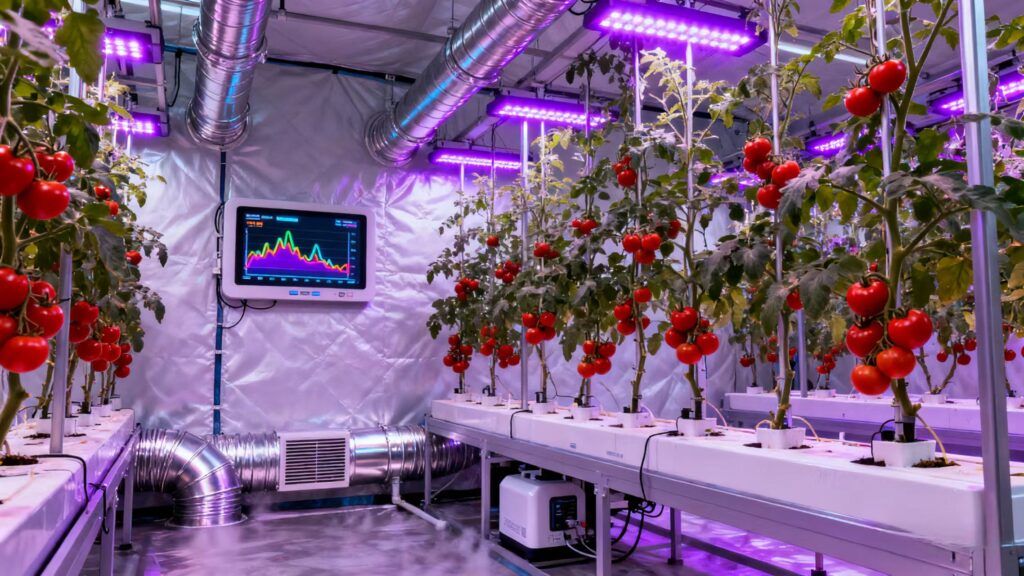
A small air volume makes temperature and RH responsive to disturbances, but a tent and a larger room cannot be ranked without comparing water input, ventilation, thermal mass, controls and the room supplying replacement air.
Small Volume, Large Load
A 1.2 × 1.2 × 2 m tent contains about 3 m³ of air. That volume can help estimate the water vapour present at a stated temperature and RH, but crop transpiration and substrate evaporation must be measured or bounded separately.
At 25 °C and 60 % RH, roughly 3 m³ of air contains about 42 g of water vapour under the stated calculation assumptions. If a hypothetical source adds 1.5 L/day, that source would add about 42 g in roughly 40 minutes; this is an illustrative mass-balance comparison, not a saturation, response or control time.
The tent’s current water content is not its moisture load. A rough air-volume calculation estimates vapour present at one condition, but drying time depends on new water entering, water leaving with exhaust or dehumidification, leaks and temperature changes. Track net moisture production and removal rather than describing the same 42 g inventory as repeatedly re-saturating the tent.
Lights, doors and fan operation can change a measured condition quickly in some tents. Log the response time at the canopy and in the source room instead of assuming a fixed number of minutes.
A dehumidifier selected by a rule of thumb may cycle frequently in a small space, but short cycling depends on capacity, latent load, control dead band, minimum run time, room exchange and equipment placement. Check those inputs rather than predicting it from volume alone.
Measurement position matters more, not less. Gradients across a small tent can be as large as across a greenhouse bay, because the load is concentrated and the mixing volume is tiny.
An extraction fan is one possible humidity-control path. Its effect depends on where replacement air originates and whether that air has a lower humidity ratio than the tent air.
The default humidity strategy in a tent is an extraction fan pulling air through and drawing replacement air from the room outside.
This works on exactly the same condition as greenhouse ventilation: it dehumidifies only if the incoming air holds less water per kilogram of dry air than the air being removed. Relative humidity comparisons between tent and room are misleading, because the two are at different temperatures.
The test is the same one used at commercial scale:
es(T) = 0.61094 × exp( 17.625 × T / (243.04 + T) )      [kPa]
e     = es × RH/100
w     = 0.622 × e / (p − e)                              [kg/kg dry air]

T is in °C, e and es are in kPa, and p is the local absolute pressure in kPa. If a calculation assumes p = 101.325 kPa, that is a reference pressure rather than every site condition; use local absolute pressure when relevant.
If incoming air has a lower humidity ratio, extraction can remove water vapour; whether it lowers tent humidity depends on airflow, crop and substrate water release, leakage, temperature and the room moisture balance. If incoming air is not drier in humidity-ratio terms, ventilation alone cannot provide net drying on that path.
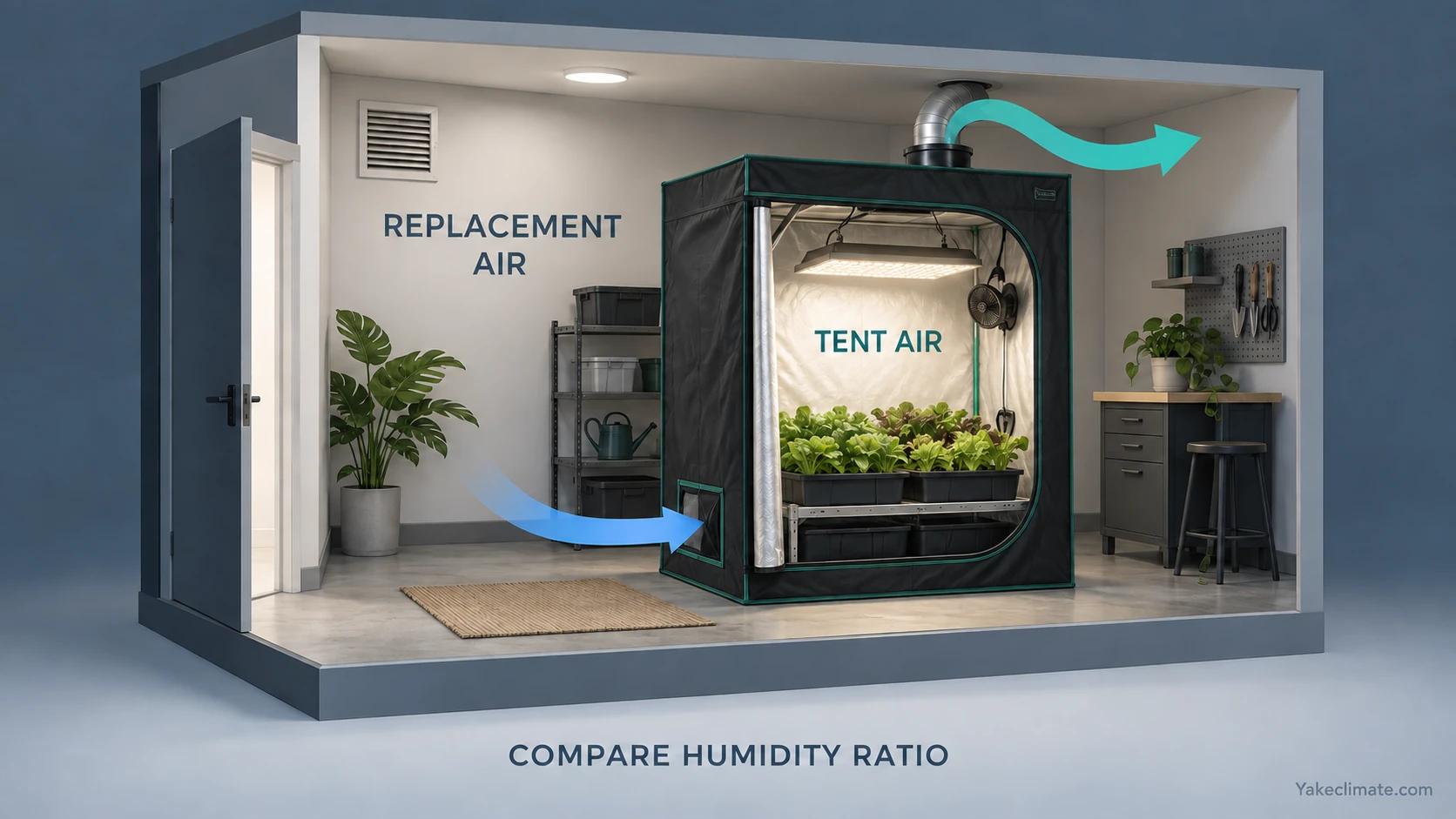
Compare the indoor and incoming-air humidity ratio and net moisture balance; see ventilation vs. dehumidification for the related method.
Extracted air must be replaced. Whether extraction dries the tent depends on the incoming air humidity ratio, temperature, leakage, room moisture load and any dehumidification already operating in the room. A closed room can become the limiting volume, but this is a mass-balance question rather than an absolute fan-size rule.
Check the Lights-Off Transition
Humidity risk may be greatest during the dark period in some setups, but the relevant period must be found from measured temperature, RH, crop water release, screen state, ventilation and control logs.
When lights go off, heat input may stop and air temperature may fall. RH can rise if moisture remains, while leaf temperature may differ from air temperature. Check the actual surface temperature and local dew point rather than inferring condensation from air temperature alone.
Condensation occurs when a surface reaches or falls below the local dew point, not simply because air temperature falls. Leaf temperature can differ from air temperature, and air movement changes heat and mass transfer without guaranteeing that condensation disappears. Measure or estimate surface temperature, dew point and local airflow.
Possible responses should be compared against the measured risk period and load: maintain suitable air movement, remove moisture, and manage the temperature/surface condition. Their order of effectiveness depends on the setup; no universal ranking is established here.
Managing the temperature transition can limit an RH rise when the water-vapour content stays similar, but the outcome depends on heating, surface temperature and continuing water release. Compare the logged day-to-night conditions before changing equipment capacity.
Keep air moving when the crop and equipment require it. Circulation can alter the leaf boundary layer, but it does not remove moisture or guarantee that condensation is prevented. For the related transport mechanism, see CO₂ uptake and airflow; check the actual surface temperature and dew point for wetness risk.
Dehumidify during the period when the measured moisture load and surface risk require it. A daytime-only schedule may miss a night risk, but the schedule should follow logs and the controller’s operating limits.
The Rating Condition Trap
The US DOE test procedure distinguishes portable dehumidifiers tested at 65 °F / 60 % RH from whole-home dehumidifiers tested at 73 °F / 60 % RH; these consumer categories are not a universal industrial rating condition. Compare the stated standard, test point and units with the project inlet condition and an applicable performance curve. See the DOE dehumidifier test procedure.
Two things follow for anyone buying equipment for a tent:
Do not compare figures across rating standards. A 70-pint legacy figure and a 50-pint current figure have a numerical ratio of 70/50 = 1.4, but that arithmetic is meaningful only if equipment, test conditions and units are comparable. A rating label alone does not establish project capacity.
Check the condition against the tent. A tent at lights-off at 20 °C and 70 % RH differs from either rating point. Do not infer a fixed capacity reduction from temperature and RH alone; use the performance curve or obtain data at actual entering condition, airflow and pressure.
Rating points vary by equipment category and test standard. An industrial unit may publish capacity at 30 °C / 80 % RH, but that condition cannot be substituted for the tent operating point. Obtain a capacity curve or project test at the actual inlet conditions.
The full explanation of rating conditions and how to compare across them is in what a daily water removal rating really means.
A Dehumidifier Is Also a Heater
In a small enclosure, include the dehumidifier heat balance along with moisture removal.
A recirculated refrigerant dehumidifier returns electrical and condensation heat to the treated air in that configuration. The heat amount depends on electrical input, moisture-removal rate and equipment configuration; do not use a 300 W to 500 W+ conversion without an explicit latent-heat assumption and heat-balance boundary.
Heat gain may affect a tent differently from its surrounding room. Estimate it from measured electrical input, the moisture removal and the equipment heat-rejection path, then check the cooling duty. Air volume alone does not determine the temperature response.
Three consequences:
- Dehumidification and cooling capacity have to be considered together, not sequentially.
- The dark period may be a useful operating window in some setups, but do not assume it is always the worst load or that one response is universally best. Compare water input, crop release, temperature, ventilation and control demand by period.
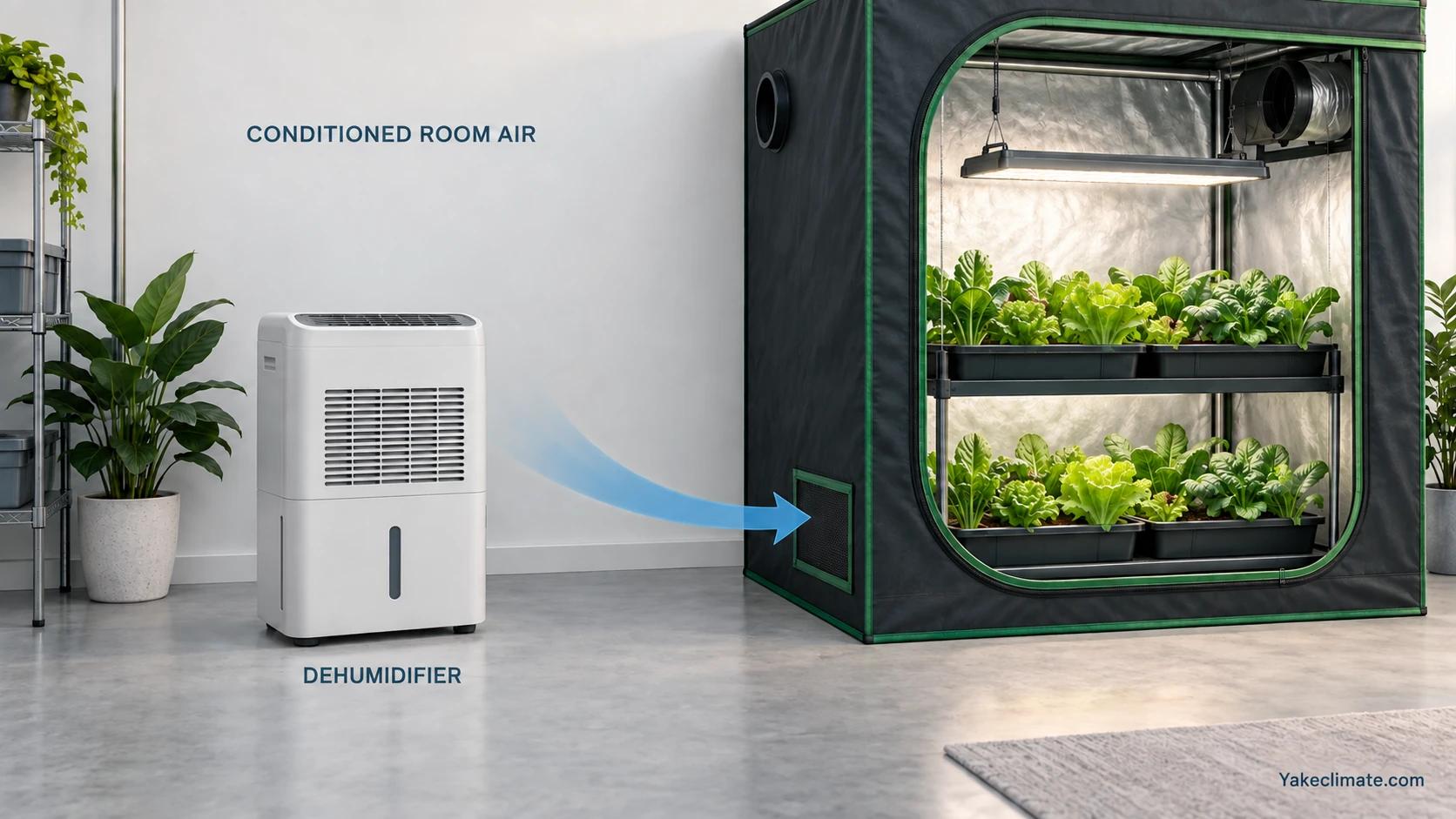
- Placing equipment outside the tent may change where heat is rejected, but the room supplying or receiving the air still requires a heat and moisture balance. Confirm airflow, ducting, leakage, room temperature and equipment configuration before choosing that arrangement.
VPD in a Tent
Vapour-pressure deficit is one useful indicator of atmospheric evaporative demand. Specify whether it is based on air or leaf temperature, then interpret it with crop stage, light, root-zone water and measured leaf response:
VPD_leaf = es(T_leaf) − es(T_air) × RH/100Two points specific to small spaces:
Leaf temperature can differ from air temperature because of radiation, transpiration and airflow. Compare measured canopy and air temperatures before using an air-temperature VPD as a leaf-level proxy.
Gradients are steep. The canopy directly under a fixture and the canopy at the tent edge can be at meaningfully different temperatures. A single sensor reports one of them.
Use crop-specific evidence; see how humidity affects plant growth for background.
Reduce the Load Before Adding Equipment
In a small space, source control is disproportionately effective because the load is concentrated.
- Check exposed water surfaces. Open reservoirs, wet media and standing runoff can contribute to evaporation; quantify their role under the operating conditions.
- Manage runoff promptly. Water sitting in trays evaporates into the tent rather than leaving it.
- Match irrigation to crop uptake and root-zone condition. Excess water can increase runoff, substrate evaporation or other moisture pathways; transpiration depends on crop, roots, water status and environment, so do not assign one uniform causal response.
- Check the seal. A tent drawing humid air from an adjacent damp space through gaps is importing load continuously.
Source-control steps may reduce the moisture load, but capacity and economics still depend on measured release, room exchange and the required operating point.
When Room-Level Conditioning Becomes Relevant
The following observations justify comparing tent-level controls with conditioning the shared room:
- The target condition repeatedly cannot be maintained in identified periods even after the current equipment and control sequence have been checked.
- Multiple tents exchange air with a common room, so the room condition may influence each tent.
- The room the tents draw from has itself become the limiting factor.
- Equipment heat rejection has become the constraint on how much dehumidification can be run.
- Batch-to-batch consistency matters commercially, and tent-scale variation is producing uneven results.
At that stage the problem changes from equipment selection to room design: conditioning the room rather than the tents, with capacity sized against the aggregate load and air distribution designed for the layout. The sizing approach is set out in greenhouse dehumidification, and applies equally to enclosed growing rooms.
Information to Prepare Before Selecting Equipment
- Tent dimensions and number of tents in the room; room dimensions.
- Crop, planting density, growth stages and cycle length.
- Lighting: fixture type, wattage, distance to canopy and photoperiod.
- Irrigation volume and runoff volume over a representative period.
- Measured temperature and relative humidity inside the tent and in the surrounding room, logged over at least one full light/dark cycle.
- Existing equipment: extraction fan capacity, circulation fans, any dehumidification or cooling.
- Where the replacement air comes from, and whether that space is conditioned.
- Observed problems: when they occur in the cycle, and where in the tent.
Logs across light and dark periods show the timing and magnitude of the problem more clearly than a single spot reading.
Discussing a Project
Yakeclimate designs and manufactures industrial dehumidification equipment for complex climate applications, with a focus on agriculture and energy projects.
We co-develop application-specific dehumidification equipment around the operating conditions, interfaces, and integration requirements of the wider project or system.
Our equipment range addresses commercial growing rooms and facilities rather than single-tent installations. For operations at that scale, explore agriculture humidity control or contact Yakeclimate to review the operating conditions for your facility.
FAQ
Frequently Asked Questions
Why is humidity harder to control in a small tent than in a large room?
A small air volume contains relatively little water vapour at a stated condition, but the tent also exchanges water with crops, media, room air and equipment. As an illustrative air-only calculation, roughly 3 m³ at 25 °C and 60 % RH contains about 42 g of vapour. A hypothetical 1.5 L/day source would release about that mass in 40 minutes at its assumed average rate; this is not a saturation or recovery time. Measure net sources and sinks before sizing.
Will a bigger extraction fan fix high humidity?
Only when the replacement-air route provides a useful humidity-ratio difference and the net moisture balance supports drying. Compare incoming and tent air at the same time, then account for airflow, crop release, leakage and any room dehumidification. A larger fan alone does not guarantee a lower tent RH.
Why does humidity spike when the lights go off?
A falling air temperature can raise RH when moisture remains, but condensation requires the relevant surface to reach the local dew point. Air circulation, temperature control and dehumidification should be evaluated against measured surface and air conditions.
How do I compare dehumidifier capacity ratings?
Check the rating condition before comparing numbers. US portable units may use a 65 °F / 60 % RH DOE condition, while other equipment categories use different standards. Reconcile standard, unit, airflow and test point before comparing. For lights-off conditions, use actual performance data rather than an automatic reduction factor.
Does a dehumidifier make the tent hotter?
A closed recirculating refrigerant dehumidifier can return electrical input and condensation heat to the treated air. The amount depends on electrical input, water-removal rate and heat-rejection configuration; split or exhausted equipment has a different boundary. Check the heat balance of both tent and source room before selection.
When should I move from tents to a conditioned growing room?
Consider room-level conditioning if shared-room conditions repeatedly limit several tents or the tent-level heat and moisture duties cannot be met reliably. Compare measured loads, air distribution, cooling and capital/operating constraints rather than using one universal threshold.
References
- AHAM DH-1, Dehumidifiers — capacity rating standard (US)
- Stanghellini, C. — Transpiration of Greenhouse Crops: An Aid to Climate Management, Wageningen


