A greenhouse can open a vent. A vertical farm cannot. That single difference changes almost everything about how humidity is handled, sized and paid for — and it is why climate equipment selected on greenhouse reasoning tends to disappoint in a closed facility.
In a sealed growing environment, every litre of water the crop transpires has to be removed by a machine. There is no weather-dependent fallback, no cheap night when outside air happens to be dry, and no partial credit. The dehumidification system is not an aid to the climate strategy; it is the climate strategy's moisture route.
A Closed System Has No Second Option
In a greenhouse, ventilation is available whenever outdoor air is drier in absolute terms than inside air, and mechanical dehumidification covers the gap. The economics of that trade-off are set out in ventilation vs. dehumidification.
A vertical farm removes that choice deliberately. The building is sealed to control pests, pathogens, light and CO₂, and to make the environment independent of location and season. The price of that independence is that the moisture route becomes 100 % mechanical.
Three consequences follow immediately:
Capacity cannot be under-specified. In a greenhouse, an undersized dehumidifier produces a facility that ventilates more than planned. In a closed farm, an undersized dehumidifier produces a facility where humidity rises until the crop is damaged. There is nothing else to fall back on.
Availability matters as much as capacity. Equipment down for service means the moisture load accumulates with no alternative path. Redundancy is a design requirement, not an upgrade.
The load is predictable. This is the compensating advantage. Without weather dependence, the moisture load is a function of crop, lighting and schedule — all of which are known and controlled. A closed farm can be sized more precisely than a greenhouse, because the inputs are not stochastic.
The Water Balance Closes
The single most useful property of a sealed facility is that its water balance is a closed accounting problem.
Water supplied = water in harvested biomass + water transpired + drain losses In a recirculating system where drain is returned to the nutrient tank, the drain term largely cancels, and the water in biomass is a small fraction. What remains is that net water consumption approximately equals transpiration, which approximately equals the dehumidification load.
This means a facility's water meter is also its dehumidification load meter. Where a greenhouse has to estimate transpiration from irrigation minus drain over a representative period, a closed farm can read it more directly, and can validate its equipment sizing against measured consumption after commissioning.
It also means the condensate stream is substantial and worth accounting for. Dehumidifier condensate in a closed farm is essentially distilled water produced continuously in proportion to crop activity. Recovering it back to the irrigation system reduces net water consumption significantly — a material advantage in water-constrained locations, and increasingly a permitting consideration. Whether recovered condensate is returned directly, treated first, or used elsewhere is a project decision involving the irrigation and food-safety requirements, but the volume is large enough that it should be designed for rather than drained away by default.
Lighting Drives the Load
In a closed farm, lighting is the dominant energy input and therefore the dominant driver of both heat and moisture.
The chain is direct: photosynthetic photon flux drives photosynthesis, photosynthesis is coupled to stomatal opening, and stomatal opening drives transpiration. Higher light intensity produces a larger crop and a larger moisture load, essentially in proportion.
The evidence from greenhouse research points the same way. In a study of Cannabis sativa, adding supplemental lighting raised cumulative crop evapotranspiration from 39.8 to 70.6 L/m² over the production cycle. A closed farm operating at high photon flux for 16–18 hours a day is at the demanding end of this relationship, continuously.
Two design implications:
Size against the lighting schedule, not a daily average. The moisture load follows the photoperiod closely. Equipment sized on a 24-hour average will be short during the lit period.
Revisit sizing when the lighting changes. Facilities that upgrade fixtures, raise intensity or extend photoperiod change their moisture load proportionally. This is one of the most common reasons a system that worked at commissioning stops holding target two years later.
The Sensible Heat Ratio Problem
This is where closed-farm climate design most often goes wrong, and it is worth stating precisely.
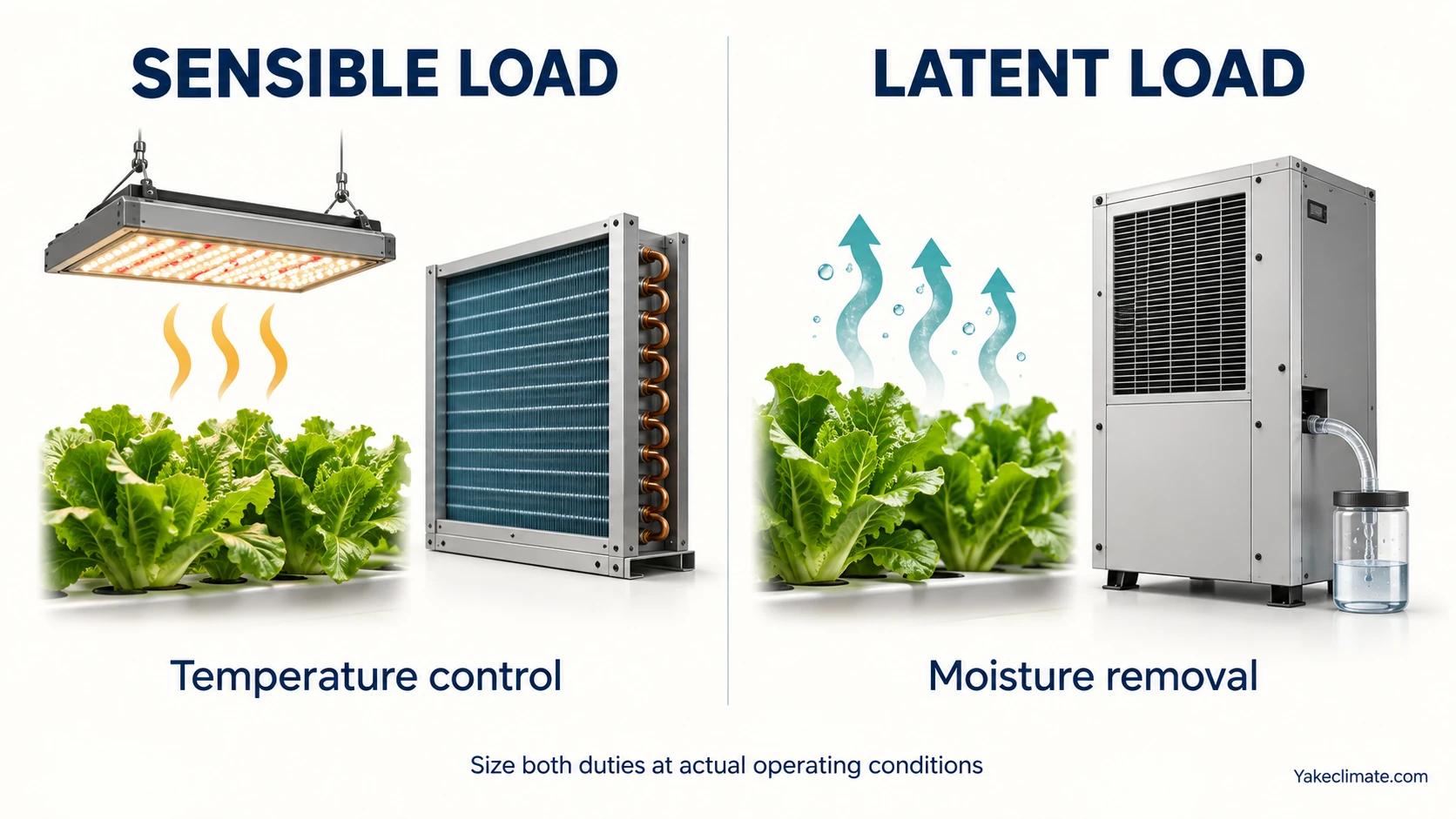
LED fixtures convert electrical input into light and heat. That heat is a sensible load — it raises air temperature. Crop transpiration is a latent load — it raises air moisture content. A closed farm has to remove both, and the ratio between them is fixed by the facility, not by the equipment.
A cooling coil removes both at once, but in a ratio determined by its surface temperature and the airflow across it. Sizing a coil to handle the sensible load from the lights produces a certain latent removal as a by-product — and there is no reason for that by-product to match the crop's actual latent load.
Two failure modes result:
The coil removes enough heat but not enough moisture. Temperature holds; humidity climbs. The usual response is to lower the coil temperature, which overcools the space, which then requires reheat — energy spent to remove heat and then put it back.
The coil removes enough moisture but overcools. Same reheat penalty, arrived at from the other direction.
The resolution is to treat temperature control and humidity control as two functions that can be sized independently, rather than expecting one coil to satisfy a ratio it does not control. Dedicated dehumidification handles the latent load at its own capacity, leaving the cooling system to handle sensible load without being distorted by moisture requirements.
The underlying sensible-and-latent distinction, and why cooling alone is often insufficient for humidity control, is developed in temperature and humidity control in HVAC.
Every Tier Is a Microclimate
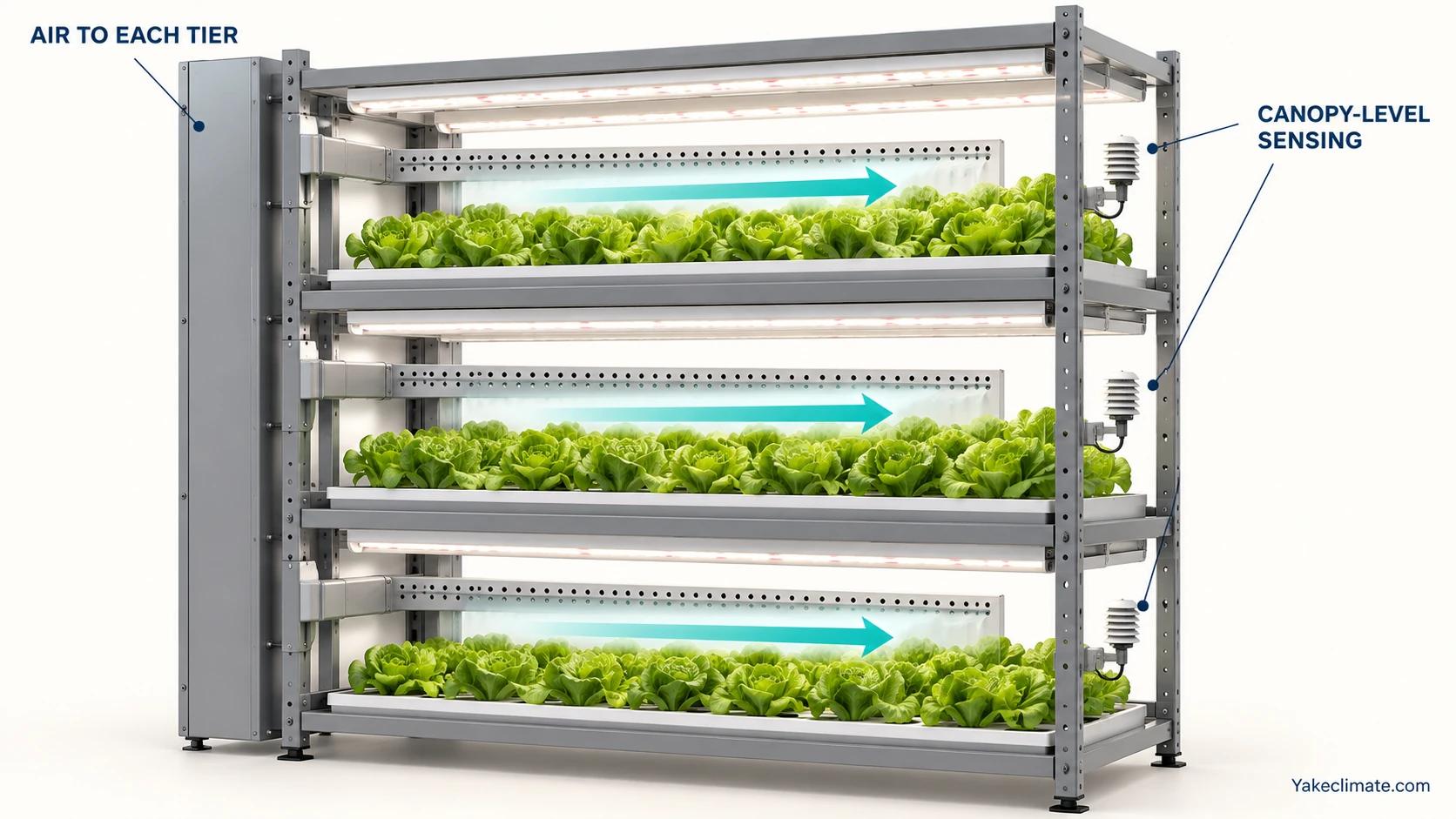
A multi-tier rack is not one environment. It is a stack of partially enclosed spaces, each with its own light source above it, its own canopy transpiring into it, and limited air exchange with the room.
Left alone, the result is stratification: upper tiers warmer, lower tiers cooler, and each tier's canopy sitting in a humid boundary layer of its own making. Room-level sensors report an average that describes no tier accurately.
Three design consequences:
Air has to be delivered to each tier, not to the room. Room-level air handling moves air around the racks, not through the growing zone. Inter-tier airflow — through plenums, perforated tier surfaces or dedicated distribution — is what actually reaches the canopy.
Canopy air velocity determines boundary layer thickness, which determines both CO₂ delivery and water vapour removal at the leaf. The mechanism is set out in CO₂ uptake in controlled environments. In tight tier spacings this is harder to achieve than in an open greenhouse and is often the limiting factor on how densely a facility can be racked.
Sensors need to reflect the tiers. A single room sensor cannot detect a wet lower tier. Facilities with persistent disease or uneven growth in specific rack positions are usually looking at an air distribution problem that the instrumentation cannot see.
Uniformity Is the Commercial Requirement
In a greenhouse, some spatial variation is tolerated because the facility is large and the crop is harvested over a period. A vertical farm's economics usually depend on uniform, predictable, repeatable batches — that is the premise of the production model.
Climate uniformity across tiers and across the room is therefore not a refinement. It is what allows a facility to plan harvest dates, guarantee volumes and price contracts. A farm with a 3 K spread between top and bottom tiers has crops at different development stages in the same batch.
This raises the importance of air distribution relative to raw capacity. Adding capacity to a system with poor distribution improves the average and not the spread. The design question is where the air goes, not only how much moisture the machine can remove.
Redundancy and Failure Behaviour
Because there is no ventilation fallback, the consequences of equipment failure are different from a greenhouse.
Time to damage is short. With a substantial continuous latent load and no alternative removal path, humidity in a sealed room rises quickly once dehumidification stops. The facility should know how long it has, because that determines the required response time.
Multiple smaller units usually beat one large unit. Beyond the distribution benefits, N+1 arrangements mean a single failure degrades capacity rather than eliminating it.
Failure has to be annunciated. Equipment that stops silently is discovered when the crop shows symptoms, by which point the batch is affected. Alarm on failure, and on failure to reach setpoint, should be part of the specification.
Service has to be possible without shutting the room. In a facility running continuous production, taking the growing room offline for maintenance has direct revenue cost. Access arrangements and isolation capability belong in the layout design.
Integration With the Rest of the Facility
Controls. The dehumidification equipment should be sequenced by the facility control system alongside cooling, lighting and CO₂ — not run on an independent humidistat that has no knowledge of the photoperiod. Available signals, protocol and control granularity should be established at design stage.
CO₂. A sealed facility retains enriched CO₂, which is one of its advantages. Mechanical dehumidification preserves this; any strategy involving air exchange does not.
Condensate. Volume, routing, and whether it is recovered to irrigation. In a closed farm this is a designed water stream, not a nuisance drain.
Irrigation. Since net water consumption tracks transpiration, irrigation data provides an independent check on whether the dehumidification system is removing what the crop is producing.
Hygiene and materials. Food-contact-adjacent environments place requirements on surfaces, drainage and cleanability. Equipment materials, drain pan design and access for cleaning should match the facility's hygiene regime.
Room pressure. Sealed facilities usually maintain a pressure relationship to adjacent spaces for pest and contamination control. Equipment that moves air across the boundary affects that relationship and needs to be coordinated with it.
Information to Prepare for Equipment Selection
- Facility: growing room dimensions, rack configuration, number of tiers, tier spacing, and total growing area.
- Crop: species, cultivar, production system, planting density and cycle length.
- Lighting: fixture type, installed power, photosynthetic photon flux density at canopy, and photoperiod schedule.
- Water data: net water consumption, or irrigation and drain volumes, over a representative period.
- Climate targets: temperature, humidity or VPD targets by growth stage and by lit/dark period, and whether targets refer to air or leaf VPD.
- CO₂: target concentration and control strategy.
- Existing systems: cooling, air handling, air distribution to tiers, and the control system with its available interfaces.
- Condensate: intended routing, and whether recovery to irrigation is planned.
- Constraints: available mounting positions, ceiling height, plenum space, structural capacity, power supply, and service access.
- Operational requirements: hygiene regime, room pressure relationships, acceptable downtime, and redundancy expectations.
- Growth plans: whether the facility will expand, re-rack, or change lighting intensity.
New-build projects should bring climate equipment into the layout before the rack configuration is fixed, because tier spacing and plenum provision are difficult to change afterwards. Retrofits usually work in the opposite direction, and the achievable air distribution constrains what the climate system can deliver.
Discussing a Project
Yakeclimate designs and manufactures industrial dehumidification equipment for complex climate applications, with a focus on agriculture and energy projects.
We co-develop application-specific dehumidification equipment around the operating conditions, interfaces, and integration requirements of the wider project or system.
Rack systems, lighting, irrigation and the facility control platform remain with their respective suppliers. Our scope is the dehumidification equipment and its integration with the air distribution, control and condensate arrangements those systems establish.
Explore agriculture humidity control, review industrial ceiling dehumidifiers, or contact Yakeclimate to review the operating conditions for your facility.
FAQ
Frequently Asked Questions
How is humidity control in a vertical farm different from a greenhouse?
A greenhouse can ventilate whenever outdoor air is drier in absolute terms, so mechanical dehumidification covers a gap. A sealed vertical farm has no ventilation route, so the entire transpiration load must be removed mechanically. This makes capacity and availability critical, but also makes the load predictable — it depends on crop, lighting and schedule rather than on weather.
How do I calculate the dehumidification load for a closed farm?
In a recirculating system, net water consumption approximately equals transpiration, which approximately equals the dehumidification load. The facility's water meter therefore provides a direct measurement rather than an estimate. Size against the lit period rather than a 24-hour average, since the moisture load follows the photoperiod, and re-check whenever lighting intensity or photoperiod changes.
Can the cooling system handle humidity as well?
Only by coincidence. A cooling coil removes sensible and latent heat in a ratio set by its surface temperature and airflow, while the facility's actual ratio is set by lighting heat and crop transpiration. When they do not match, the usual outcome is overcooling followed by reheat — energy spent removing heat and then replacing it. Sizing dedicated latent capacity separately allows the cooling system to address the lighting heat load without being distorted by humidity requirements.
Why do lower tiers have more disease than upper tiers?
Almost always air distribution. Each tier is a partially enclosed space with limited exchange with the room, so room-level air handling moves air around the racks rather than through the growing zone. Canopies in low-velocity zones sit in a humid boundary layer of their own making, which room-level sensors cannot detect. The corrective action is inter-tier airflow, not additional room capacity.
Can dehumidifier condensate be reused for irrigation?
The volume is substantial — in a closed farm it corresponds closely to net water consumption — and it is produced continuously in proportion to crop activity. Many facilities recover it to reduce net water use, which matters in water-constrained locations and can be a permitting consideration. Whether it is returned directly or treated first depends on the irrigation system and the facility's food-safety requirements, and should be resolved with those specialists. The point for equipment design is that the condensate route should be designed as a water stream rather than treated as a drain.
What redundancy does a sealed growing room need?
More than a greenhouse, because there is no fallback. With a continuous latent load and no alternative removal path, humidity rises quickly once dehumidification stops, so the facility should establish how long it has before crop damage occurs — that determines the required response time. Multiple smaller units in an N+1 arrangement degrade rather than fail, failure should be annunciated including failure to reach setpoint, and service should be possible without taking the growing room offline.