
Ventilation can remove greenhouse moisture when outdoor air has a lower humidity ratio than the indoor air at the operating pressure, but that difference establishes direction, not whether enough moisture can be removed. Check available airflow against the crop and infiltration moisture load, the attainable humidity target and the required response time. Then compare heating and CO2 losses with a dehumidification layout for the actual risk period. A recirculating indoor dehumidifier may return much of its electrical input and condensed-water latent heat to the greenhouse; exhaust or external heat rejection changes that balance.
Key Takeaways
- Compare indoor and outdoor humidity ratio, then check available ventilation airflow and moisture load before choosing a route.
- Ventilation saves capital but can cost energy or CO2 in cold seasons.
- Indoor recirculating dehumidification can retain or recover heat; the result depends on the equipment and heat-rejection layout.
- Compare the risk period, not a single design point.
- Combinations that switch by season or time of day are common and can fit different conditions.
The Physical Test: Can Outdoor Air Remove Water?
A lower outdoor humidity ratio than the greenhouse air at the same atmospheric pressure gives ventilation a moisture-removal direction. The required dry-air mass flow, humidity-ratio difference and moisture generation determine whether it can meet the target in time. A positive gradient alone is insufficient; warm or humid outdoor conditions may narrow or reverse it.
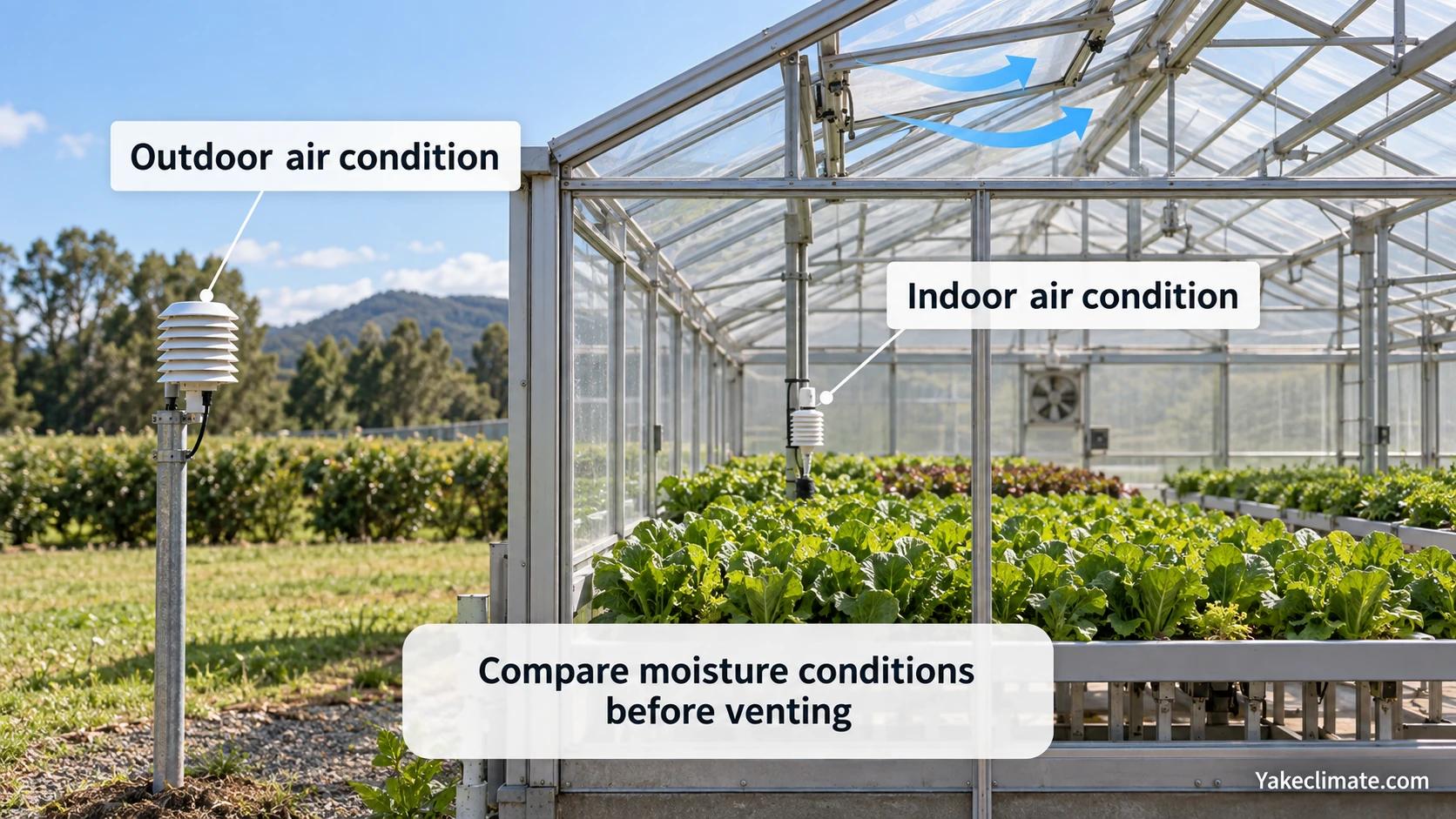
Use the actual risk period, not an annual average. A favorable morning gradient can still leave too little vent capacity to handle crop transpiration before condensation forms. If the gradient, available flow or heat and CO2 constraints fail during the risk period, ventilation alone cannot be assumed to meet that period's target.
When the comparison uses humidity ratio rather than vapor pressure, state the atmospheric pressure used for the conversion. The mass of water vapor per mass of dry air depends on total pressure as well as vapor pressure, so the same relative humidity means different moisture content at different altitudes.
Why an Effective Moisture Route May Still Be Unacceptable
Even when outdoor air can remove moisture, ventilation has costs:
- heating cost: cold outdoor air must be reheated;
- CO2 constraint: in enriched greenhouses, venting removes the CO2 you paid to add;
- humidity control limits: at high outdoor humidity, ventilation alone cannot reach the target.
Research on greenhouses at northern latitudes reports that ventilation-based humidity control increased energy consumption by 12.6–18.4% compared with no dehumidification, and that proportional ventilation was more effective than on–off ventilation in that comparison (Energy Consumption Due to Dehumidification of Greenhouses under Northern Latitudes, ScienceDirect). These numbers come from a specific research scenario; the scale will differ by climate and greenhouse, but the direction is consistent: ventilation-based dehumidification carries energy cost.
What Mechanical Dehumidification Changes
Mechanical dehumidification removes water from recirculated or supplied air. In an indoor recirculating unit, much of the electrical input and condensation heat may remain in the greenhouse; exhaust-air systems and externally rejected heat have different balances. Compare the actual layout, condensate route, fan and compressor power, and any heat recovery rather than assuming all energy stays indoors.
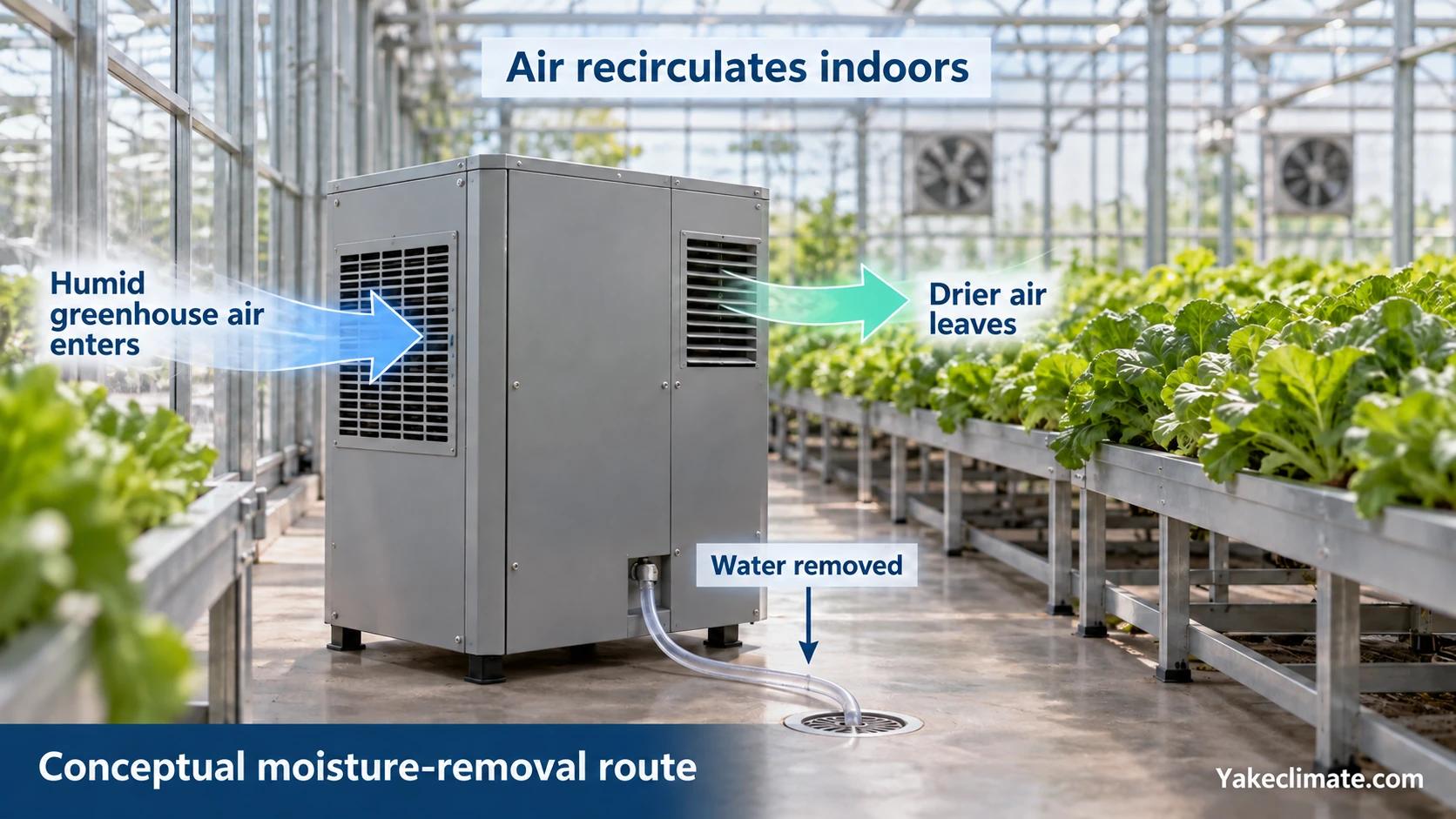
The trade-off is capital cost and maintenance. The decision framework used in greenhouse research is direct: dehumidification can conserve energy that would otherwise leave the greenhouse through ventilation, but it adds capital cost, and its relative advantage grows as the ventilation requirement increases.
A Direct Comparison
| Condition | Ventilation | Mechanical Dehumidification |
|---|---|---|
| Outdoor air drier than greenhouse air at the risk period | Can remove moisture if airflow meets the load; also check heating and CO2 cost | Still evaluate if available airflow or response time is insufficient |
| Cold or high-latitude risk period; heating cost high | Energy cost rises; verify envelope | Compare full system heat and electric balance |
| CO2-enriched greenhouse | Venting removes paid CO2 | Can reduce vent-related CO2 loss when air is recirculated |
| Nighttime or humid-season risk period | Often cannot reach target | More controllable |
| Combination strategy | Use when conditions allow | Use when ventilation cannot meet the target |
This table screens possible routes, not equipment necessity. Confirm ventilation dry-air flow × indoor–outdoor humidity-ratio difference against moisture load, then compare heating, CO2, fan power and target response time.
A Combination May Fit Different Operating Conditions
Many greenhouses use both routes in different periods: ventilation during the day when outdoor air is dry and temperatures allow, mechanical dehumidification at night or in humid seasons when outdoor air cannot do the job. The combination is designed around the risk calendar, not added as a default.
Compare the Risk Period, Not a Single Design Point
A single design point can mislead. A greenhouse sized for a mild afternoon may fail at the worst night of the season. Compare the risk period: the coldest or most humid weeks, the nighttime conditions, and the crop stage with the highest humidity sensitivity.
For a route comparison, provide:
- Define the risk period, crop-zone humidity target and time allowed to reach it.
- Measure indoor and outdoor temperature and humidity during that period; convert to humidity ratio using site pressure.
- Estimate crop and infiltration moisture load, available dry-air ventilation flow and the resulting net removal rate from the humidity-ratio difference.
- Check whether ventilation can reach the target in time within heating and CO2 limits; if not, evaluate mechanical dehumidification.
- Size the selected or combined routes by operating period, then verify controls, equipment ratings and commissioning measurements.
Information Needed for a Project Comparison
- greenhouse dimensions and covering type;
- crop-zone humidity target, crop moisture load and target response time;
- indoor and outdoor temperature and humidity during the risk period, plus site pressure;
- available ventilation airflow, heating system and CO2 enrichment strategy;
- available electric power, equipment heat-rejection layout and maintenance access.
FAQ
Frequently Asked Questions
When is ventilation enough for greenhouse humidity?
Only when outdoor air is drier, available ventilation airflow removes the expected moisture load in time, and heating and CO2 costs are acceptable.
Does mechanical dehumidification save energy?
Possibly. An indoor recirculating unit may retain heat that venting would lose, but compressor, fan, heat rejection and auxiliary equipment change the whole-system result. Compare the same operating period and boundary.
Can I use both ventilation and dehumidification?
Yes. Many projects combine daytime ventilation with nighttime or seasonal mechanical dehumidification.
What should I measure first?
Measure indoor and outdoor temperature and humidity during the risk period, then determine airflow, moisture load and the target response time.
Sources
- Technion CRIS, Night-time use of dehumidifiers in greenhouses: an analysis. Accessed 2026-08-27.
- ScienceDirect, Energy Consumption Due to Dehumidification of Greenhouses under Northern Latitudes. Accessed 2026-08-27.
- ScienceDirect, Dehumidification of Greenhouses at Northern Latitudes. Accessed 2026-08-27.
Select the Route from the Condition
Share the greenhouse operating conditions, the risk-period measurements, and the heating or CO2 constraints with the Yakeclimate engineering team. The project review starts from the measured conditions and confirms the equipment interface and validation steps before any selection is finalized. For the broader greenhouse application context, see Yakeclimate agriculture applications.
Submit the risk-period conditions for a project review: Contact Yakeclimate


