
Tomato greenhouse dehumidification should be sized around transpiration, night cooling and canopy airflow. RH alone is not enough because disease risk and plant water movement depend on temperature, leaf wetness and vapor pressure deficit.
- Tomato canopies can create humid microclimates, so room RH may not represent leaf conditions.
- VPD adds temperature context, but leaf temperature and crop stage must be stated before using it as a target.
- Disease-risk discussion should connect leaf wetness, airflow and duration rather than promise a result.
- Sizing review needs water inputs, crop area and stage, lighting or solar pattern, ventilation strategy, night condition and airflow layout.
Why Tomato Greenhouses Build Moisture Quickly
Tomato crops transpire water through the canopy during active growth. In a dense greenhouse, that moisture does not instantly mix with the room air. It can remain in the leaf boundary layer, around pruning wounds and near cold glazing or curtains.
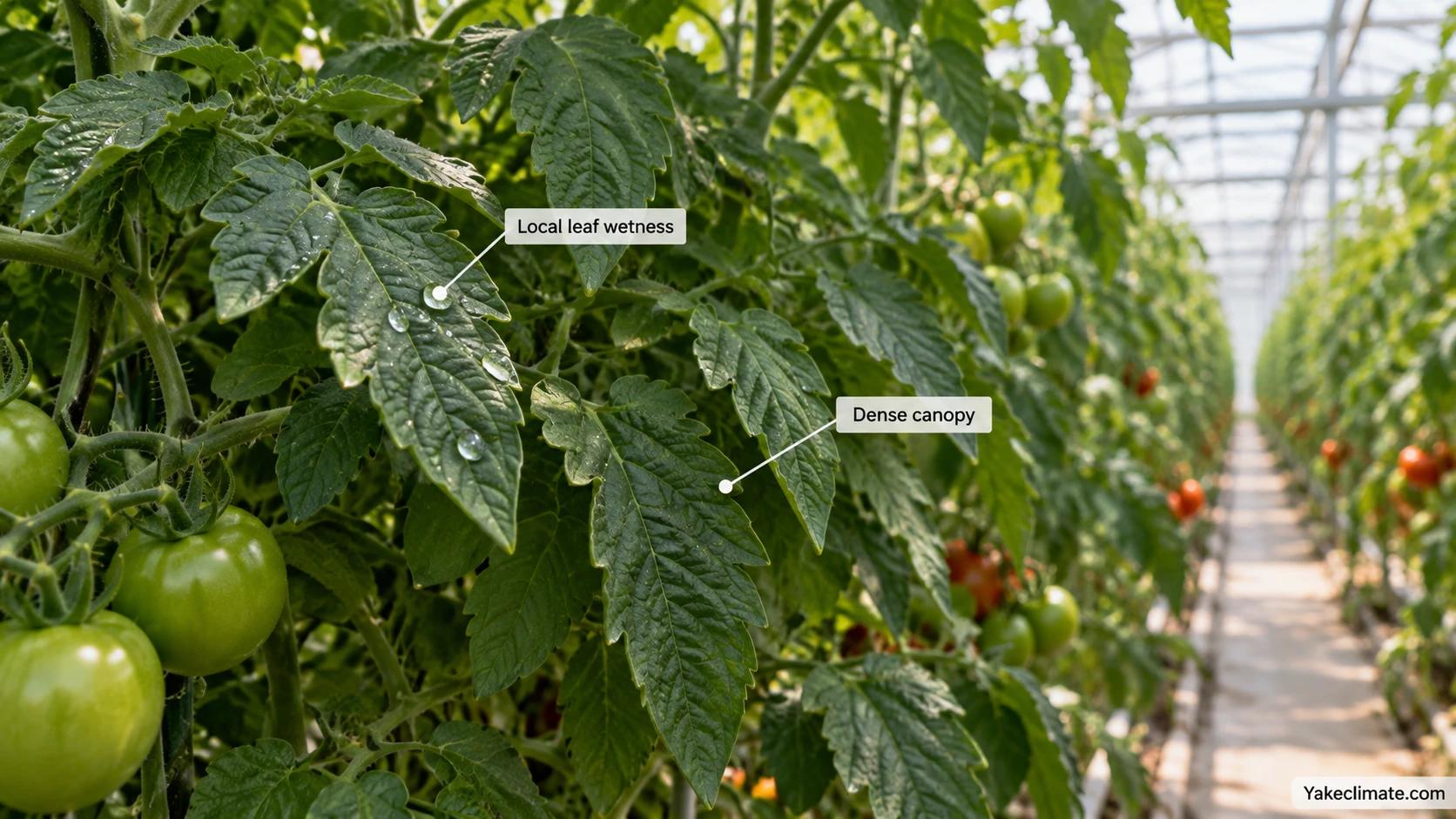
Michigan State University Extension explains that vapor pressure deficit is a more accurate way to predict plant transpiration and water loss than relative humidity alone (MSU Extension). For tomato projects, that means the control target should connect air temperature, humidity and plant response rather than treating RH as a single isolated number.
Disease Risk Is About Leaf Wetness, Not Only Room RH
High humidity becomes a crop problem when it causes condensation, guttation or slow leaf drying. NC State Extension's Botrytis guidance for tomato recommends greenhouse ventilation to keep RH below 90%, avoiding overhead irrigation, keeping leaves dry and maintaining air movement (NC State Extension).
Dehumidification helps when ventilation cannot remove enough moisture without losing too much heat, CO2 or climate stability. It does not replace crop spacing, pruning hygiene, irrigation timing or horizontal airflow.
| Risk signal | What it usually means | Control response |
|---|---|---|
| Condensation on leaves or glazing | Air or surface temperature is close to dew point. | Lower dew point before night cooling or improve air movement. |
| RH rises after curtain closure | Moisture is trapped when the thermal screen closes. | Add a curtain-period dehumidification strategy. |
| Wet pruning wounds | Local canopy air is not drying fast enough. | Improve airflow and avoid work on wet plants. |
| RH looks fine at the sensor but leaves stay wet | Sensor location does not represent the canopy. | Add canopy-level checks or relocate sensors. |
Size Around Transpiration and Night Transition
The moisture load is not flat across 24 hours. It follows crop activity, irrigation, solar or lighting schedule, curtain operation and ventilation limits. A simple room-volume calculation can understate the peak load.
Use these inputs before selecting industrial dehumidifiers:
| Input | Why it matters |
|---|---|
| Crop area and stage | Defines zone, canopy and changing source conditions |
| Water use or irrigation balance | Provides a moisture-source basis with its boundary and period |
| Day/night temperature and humidity targets | Sets dew-point and crop-response conditions |
| Curtain and ventilation schedule | Defines moisture retention, heat and CO2 trade-offs |
| CO2 strategy and airflow layout | Separates ventilation permission from canopy distribution and control |
For the selection method and condition-dependent quantity discussion, see the greenhouse sizing method and confirm the missing inputs before treating any number as a proposal.
Refrigerant, Desiccant or Ventilation?
Most warm tomato greenhouses start by comparing ventilation and refrigerant dehumidification. Desiccant systems become relevant when the greenhouse has low-temperature operation, strict dew point targets or a process zone that needs very dry supply air.
| Option | Best fit | Limitation |
|---|---|---|
| Ventilation | Outdoor air is drier in absolute terms and heat loss is acceptable. | May waste heat, CO2 and climate stability. |
| Refrigerant dehumidifier | Warm greenhouse with moderate dew point target. | Coil performance depends on temperature and drainage. |
| Desiccant dehumidifier | Low-temperature or low dew point operation. | Needs reactivation heat and careful ducting. |
| Hybrid strategy | Seasonal greenhouse with changing outdoor conditions. | Needs controls that decide which mode should run. |
The decision method in ventilation vs dehumidification in controlled agriculture is a better starting point than choosing equipment by product name.
Air Distribution Through the Canopy
Dry supply air has to reach the crop zone. If air short-circuits above the crop, the dehumidifier can remove water while disease risk remains high at leaf level.
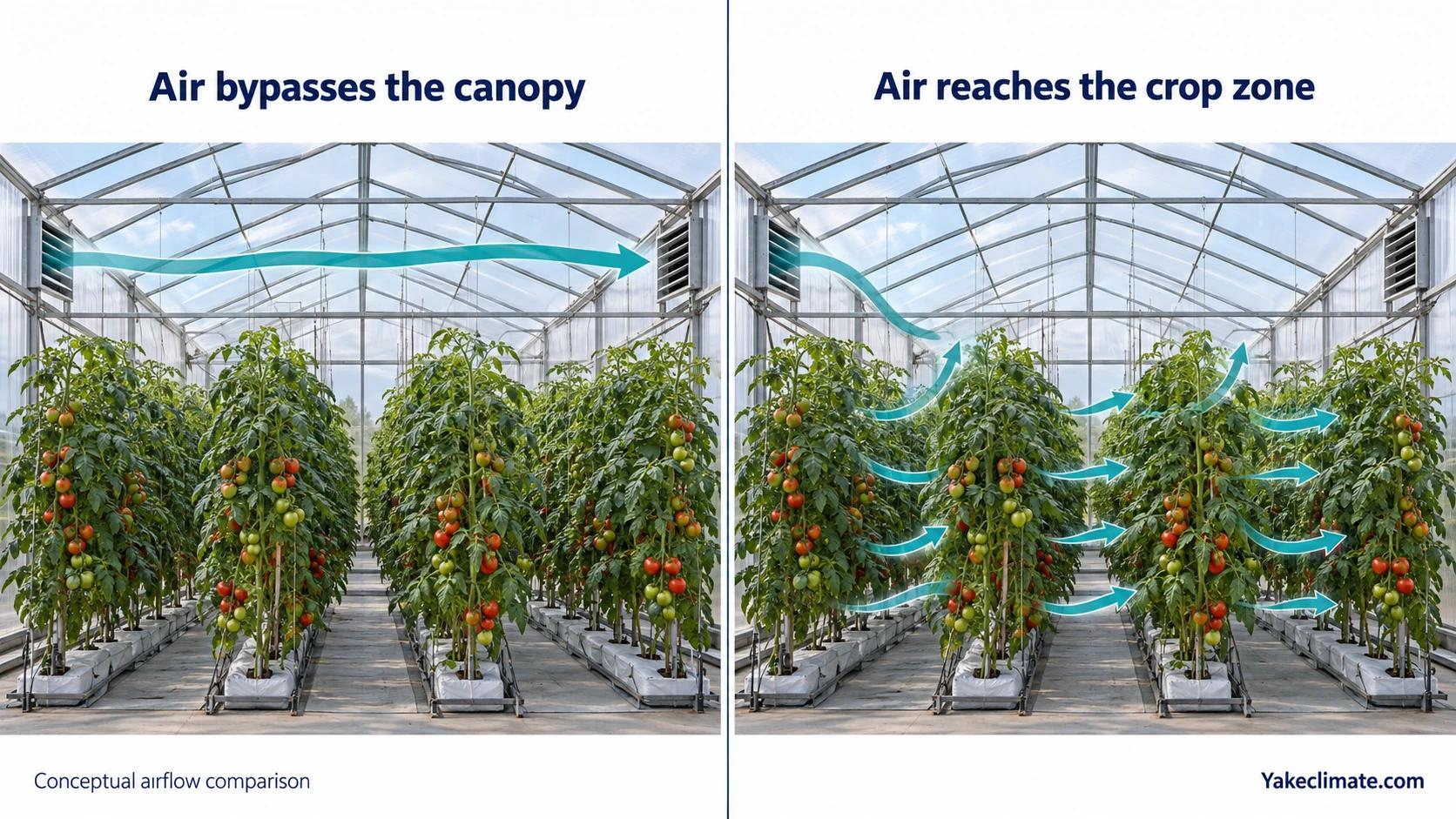
Practical checks:
- Place humidity or dew point sensing where it represents the crop zone.
- Confirm air movement along rows and under dense canopy areas.
- Avoid blowing cold dry air directly onto plants without mixing.
- Review curtain pockets, gable ends and corners where moisture stagnates.
- Coordinate dehumidifier operation with fans, vents, curtains and heating pipes.
RFQ Inputs for a Tomato Greenhouse
Before asking for unit quantity, send the project data in this order:
| Input | Example format |
|---|---|
| Greenhouse area and compartment layout | Area, height, bay count and screen zones. |
| Crop and stage | Tomato, crop density, mature or young crop assumptions. |
| Temperature and RH or VPD targets | Day, night and transition periods. |
| Water use estimate | Daily and peak-period water use when available. |
| Ventilation constraints | Outdoor design conditions, CO2 retention and heat-loss limits. |
| Control interface | Greenhouse computer, Modbus, dry contact or analog signal. |
| Equipment placement limits | Service corridors, hanging constraints, ducts and drainage. |
For broader crop applications, use the agriculture dehumidification overview as the project-entry page.
FAQ
Frequently Asked Questions
Why can leaves be wet when the RH sensor looks acceptable?
The sensor may be outside the canopy microclimate. Leaves, fruit clusters, curtains and cold surfaces can be closer to dew point than the sensor location.
Is VPD always better than RH?
VPD is usually more useful for crop response because it includes temperature. RH still matters for equipment control and alarms, but it should not be the only design input.
Can ventilation replace dehumidification?
Yes, when outdoor air is drier in absolute terms and the energy or CO2 penalty is acceptable. When ventilation conflicts with heat retention, CO2 retention or night stability, mechanical dehumidification becomes part of the control strategy.


