
The best industrial dehumidifier for a greenhouse is the one that can remove the crop's real moisture load while matching the greenhouse temperature range, airflow path, drainage, corrosion exposure and control strategy. A brand list is less useful than a clear selection checklist.
Define the Greenhouse Moisture Problem First
A greenhouse is not a static storage room. Crop transpiration, irrigation schedule, sunlight or lighting, ventilation, curtains and night cooling all change the moisture load across the day.
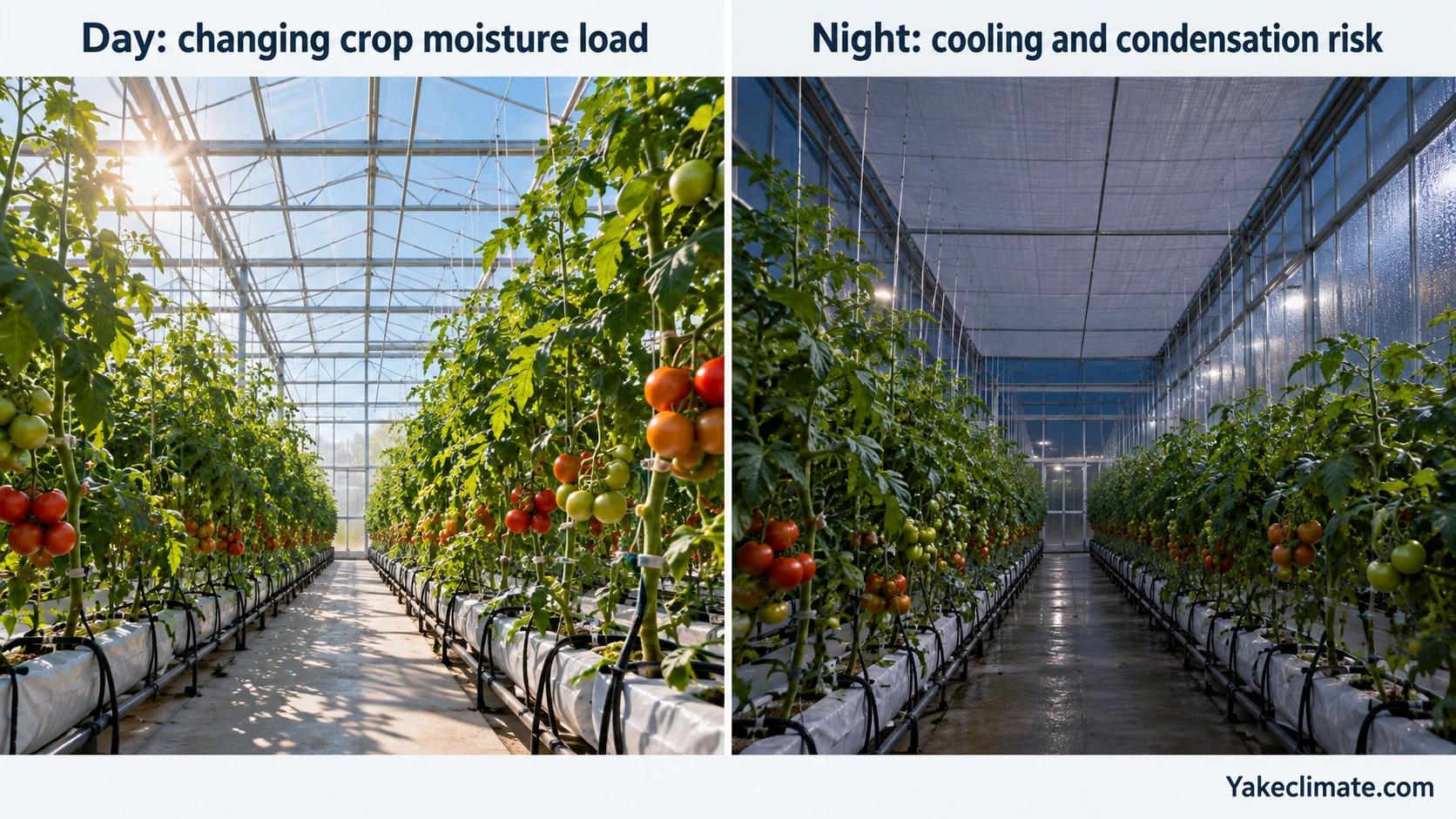
Michigan State University Extension explains that vapor pressure deficit is a better predictor of plant transpiration and water loss than RH alone (MSU Extension). That is why greenhouse dehumidifier selection should begin with VPD and dew point behavior, not just a target like "60% RH."
Selection Criteria
| Criterion | What to ask | Why it matters |
|---|---|---|
| Moisture load | What is the water input, crop area and peak removal window? | Prevents undersizing from room-volume rules. |
| Temperature range | What are day, night and winter operating temperatures? | Determines whether refrigerant coils can operate reliably. |
| Dew point target | What supply or room dew point prevents condensation? | Separates moderate RH control from low dew point control. |
| Airflow path | How will dry air reach the canopy? | Prevents dry corridors and wet leaf zones. |
| Drainage | Where does condensate go? | Avoids maintenance and hygiene problems. |
| Corrosion exposure | Are fertilizers, sprays or saline conditions present? | Defines coil coating, casing and drain-pan materials. |
| Controls | What greenhouse computer or PLC must coordinate operation? | Avoids isolated equipment that fights vents, curtains or heating. |
Refrigerant or Desiccant?
For many warm commercial greenhouses, industrial refrigerant dehumidifiers are the first technology to evaluate. They condense water on a cold coil and can be efficient at moderate humidity targets.
For cold operation, strict dew point control or hybrid dry-air supply, desiccant rotor dehumidifiers may fit better. ASHRAE's technical resources treat mechanical dehumidification and desiccant equipment as separate technical categories, which is a useful reminder that the two technologies should not be selected by the same rule of thumb (2025 ASHRAE Handbook - Fundamentals).
| Greenhouse condition | Better starting point |
|---|---|
| Warm greenhouse, moderate RH target | Refrigerant dehumidifier |
| Low night temperature, frost risk or strict dew point target | Desiccant or hybrid |
| High outdoor humidity and limited ventilation | Mechanical dehumidification with airflow plan |
| Outdoor air often drier than indoor air | Ventilation-first strategy may be cheaper |
| CO2 retention or heat retention is important | Compare ventilation penalty against dehumidification energy |
Capacity Ratings Need Context
For condensing equipment, a warmer and more humid entering condition will often support greater water removal than a cooler or drier condition, but this is a technology- and control-dependent trend. Do not transfer it to desiccant or other systems by rule of thumb: compare the actual performance curve at the project temperature, humidity, airflow and pressure conditions.
Ask suppliers for:
- Rated water removal at your expected inlet temperature and RH.
- Airflow and external static pressure at the actual duct condition.
- Power input or liters per kWh at the same condition.
- Condensate drainage requirement.
- Control range, alarms and sensor placement.
- Service clearance and filter access.
For a detailed crop-specific moisture discussion, use the tomato greenhouse dehumidification guide. For a numerical project example, use the 5-hectare greenhouse sizing walk-through.
Air Distribution Is a Selection Requirement
The equipment cannot protect the crop if dry air never reaches the canopy. In dense crops, the most humid air can sit inside the leaf zone while wall sensors show acceptable RH.
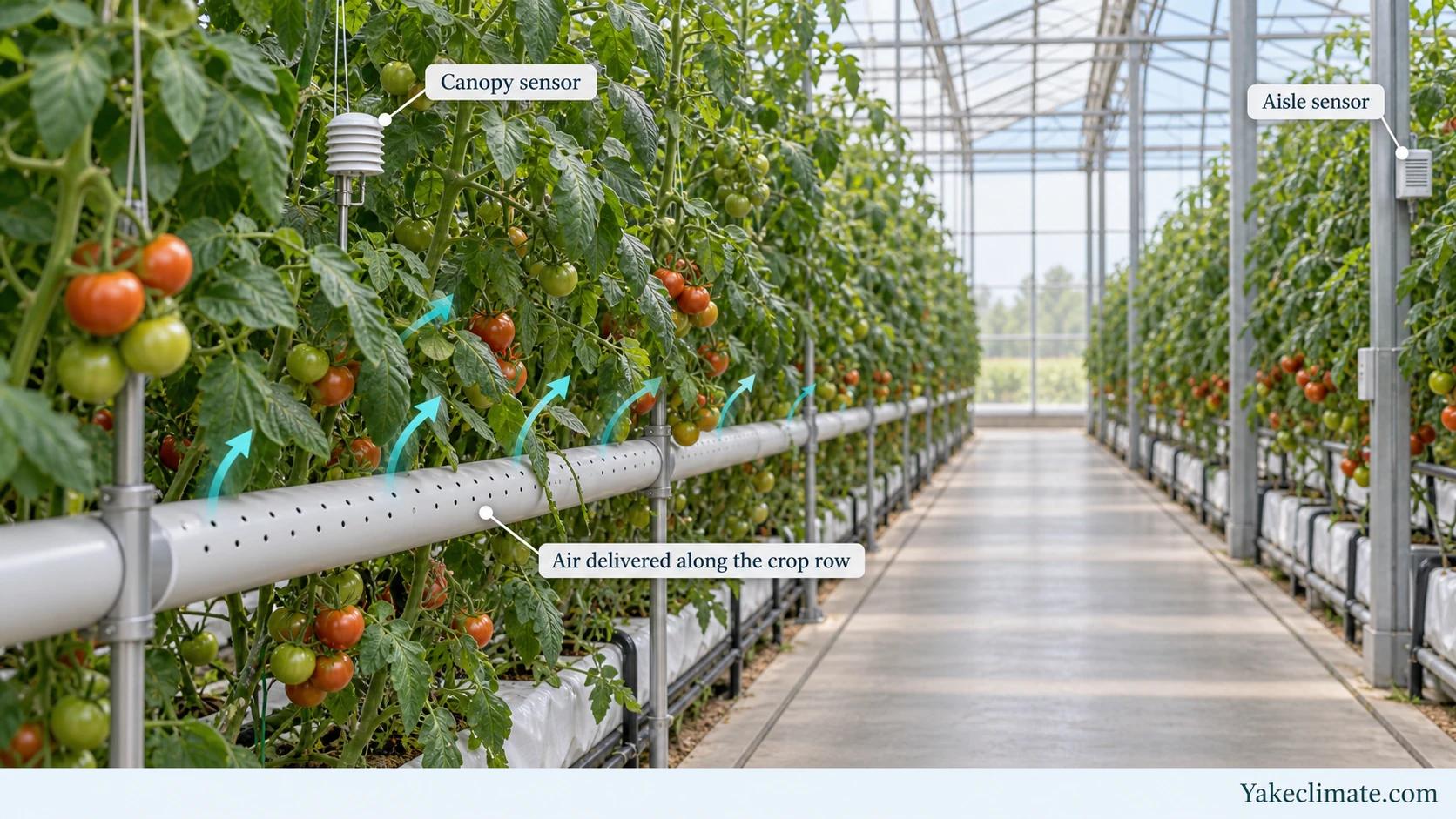
A good greenhouse dehumidifier package should therefore include one of these air strategies:
| Strategy | Fit |
|---|---|
| Local recirculation | Small compartments with open air paths. |
| Ducted supply | Larger houses, long bays or equipment rooms outside the crop area. |
| Air tubes | Even distribution over rows or benches. |
| Multiple smaller units | Zoned houses where one large unit cannot reach every area. |
| Hybrid with horizontal airflow fans | Canopy mixing where dehumidifier discharge needs help. |
NC State Extension's Botrytis tomato guidance includes keeping leaves dry and moving air in the greenhouse as part of disease prevention (NC State Extension). Equipment selection should support that operating goal.
RFQ Checklist
Before asking which model is "best," send this information:
| Required input | Example |
|---|---|
| Crop and stage | Tomato, strawberry, leafy greens, mature canopy or young crop. |
| Greenhouse layout | Area, height, bay length, screen zones and equipment placement limits. |
| Temperature and humidity targets | Day, night and transition periods. |
| Water input or transpiration estimate | Irrigation balance, crop area or measured condensate target. |
| Ventilation and CO2 strategy | When venting is allowed and when it is restricted. |
| Electrical supply and drainage | Voltage, phase, available power and condensate route. |
| Controls | Greenhouse computer, Modbus, dry contact or local controller. |
FAQ
Frequently Asked Questions
Is the highest-capacity unit always the best greenhouse dehumidifier?
No. Oversized equipment can short-cycle, miss canopy distribution and create uneven conditions. Capacity has to match moisture load, airflow and controls.
Should I size by square meters?
Square meters help define the project, but they are not enough. Crop type, water use, ventilation, curtains and night temperature determine the actual moisture load.
Can one equipment type work all year?
Sometimes. In seasonal climates, the best answer may be refrigerant dehumidification for warm periods and a different control mode, ventilation strategy or desiccant support for cold periods.


