
Greenhouse humidity control commissioning proves whether the installed system can maintain the agreed crop condition under real operating constraints. It should verify sensors, airflow, staging logic, ventilation interaction, drainage, alarms and trend data before the project is handed over.
The greenhouse climate-control interface guide sets out the responsibilities to confirm before point-to-point and sequence testing.
Use this checklist with agriculture applications and greenhouse dehumidification guidance. Bring the design inputs and monitoring data into the commissioning review.
Start With an Acceptance Condition
A commissioning plan needs a measurable target. "Keep the greenhouse dry" is not enough. Define the condition, the measurement point and the operating scenario.
| Acceptance item | Practical format |
|---|---|
| Target condition | temperature and RH, dew point limit, or crop-stage VPD range |
| Measurement zone | canopy height, return air, representative aisle or multiple zones |
| Time window | night, pre-dawn, after irrigation, screen-closed period or full day |
| Allowed variation | normal range, warning range and alarm range |
| Exclusions | open doors, maintenance mode, abnormal irrigation event or power interruption |
An agreed project requirement states what condition is required; a decision rule states how the measurement result, including its uncertainty, will support a conformity statement. ILAC G8:09/2019 offers this as laboratory guidance, not a greenhouse standard or mandatory project acceptance method (ILAC G8:09/2019). JCGM 106:2012 likewise treats conformity as an inference from measured data and uncertainty, so a result near a limit should be interpreted under the rule chosen before testing, rather than declared automatically passed or failed (JCGM 106:2012). Before testing, the authorized project lead should identify the applicable requirement and rule, and ensure the report links each decision to its result, requirement and rule.
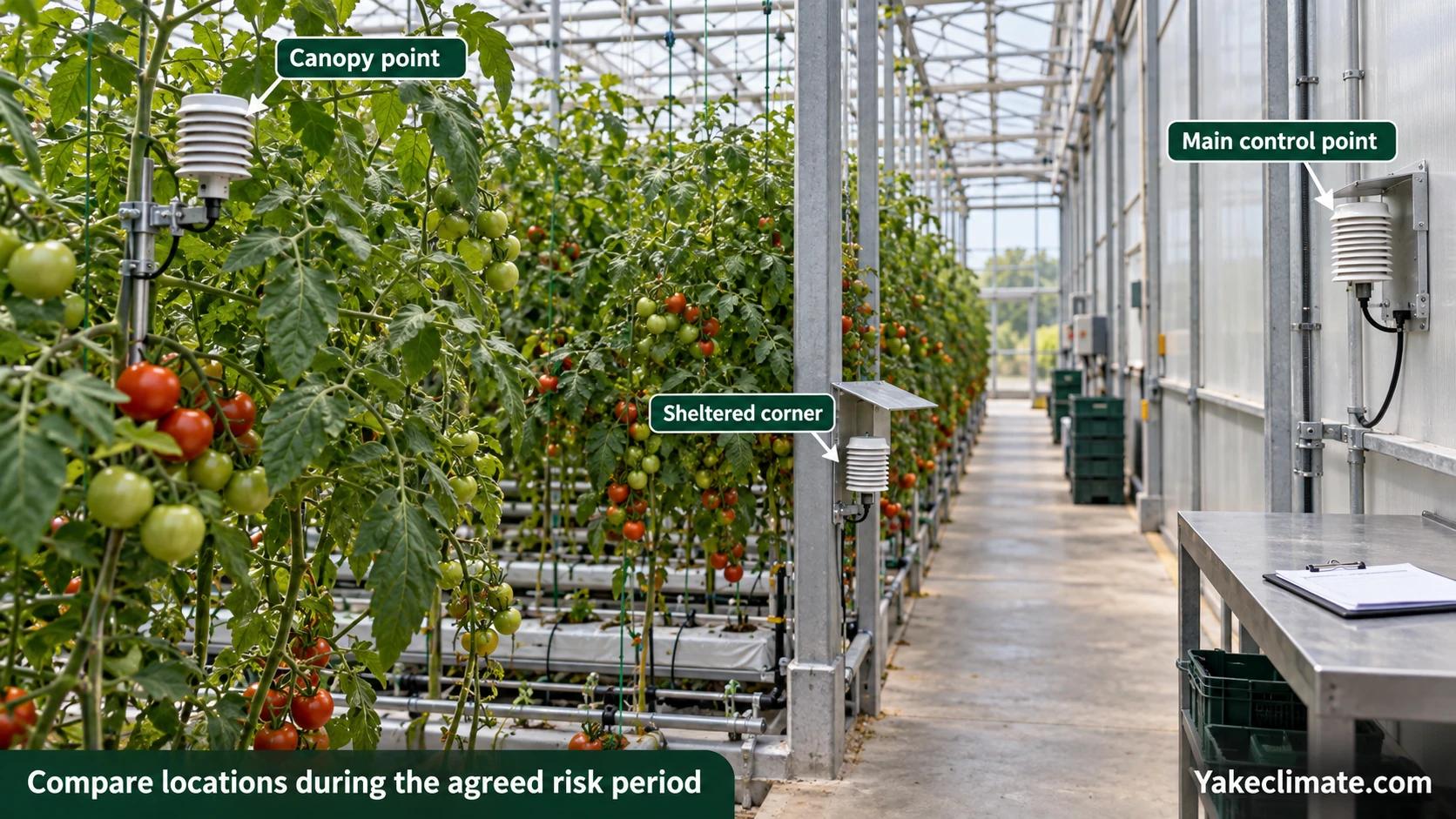
If acceptance is based only on one wall-mounted sensor, the project can pass on paper while the canopy still experiences leaf wetness. For disease-sensitive crops, commissioning should include the locations where air movement is weakest and condensation is most likely.
Confirm Sensor Placement and Data Quality
Humidity control depends on measurement. A wrong sensor location can make a good system behave badly.
Check these items before tuning the equipment:
- sensor height relative to the crop canopy,
- distance from supply air, return air, heating pipes, fogging lines and doors,
- shielding from direct radiation and local water spray,
- agreement between room sensors, handheld spot checks and outdoor reference data,
- data-logging interval and timestamp consistency,
- calibration plan for the sensors that decide control action.
NIST's humidity program supports calibration and humidity measurement traceability for industrial applications. A greenhouse does not need laboratory-level instrumentation for every sensor, but it does need a practical calibration and replacement routine so trend data remains believable.
For sensor placement details, use the greenhouse humidity monitoring guide. If the acceptance target is still unclear, return to the greenhouse project data checklist.
Verify the Equipment Sequence
Humidity control in a greenhouse is rarely a single-device problem. Dehumidifiers, ventilation fans, vents, heating pipes, circulation fans, energy screens and irrigation schedules all affect the air state.
The commissioning sequence should state which device acts first under each condition.
| Scenario | Question against the approved sequence |
|---|---|
| Outdoor air is drier | Does the permitted ventilation action follow the project’s moisture and energy strategy? |
| Outdoor air becomes humid or cold | Does the sequence respond within the agreed moisture and temperature constraints? |
| Screen closes | Does the specified circulation or other response occur, and do representative crop-zone conditions remain within the agreed criteria? |
| Lights or sun load drops | Does the specified transition sequence occur, and how do local air and surface conditions change? |
| Irrigation event ends | Does the observed recovery meet the agreed criterion for that crop and period? |
| Alarm condition | Does the tested indication and response match the approved fault sequence? |
The goal is not to run every device all the time. The goal is a staged sequence that fits the weather, crop schedule and equipment limits.
Test Night and Transition Periods
Many greenhouse humidity complaints appear at night or during transitions. During the day, solar gain and ventilation may hide the problem. At night, the crop may continue adding moisture while air temperature falls, surfaces cool and screens reduce air exchange.
Commissioning should include:
| Test period | What to observe |
|---|---|
| Late afternoon | whether the system lowers humidity before temperature drops |
| Screen-closing period | whether air becomes stratified or stagnant |
| After irrigation | recovery time and local wet spots |
| Pre-dawn | peak RH, dew point margin and condensation on surfaces |
| Weather change | response when outdoor air becomes wetter than expected |
NC State Extension highlights that Botrytis risk is associated with high humidity, cool conditions, prolonged leaf wetness and dead-air spots. That is why commissioning should not stop at a daytime reading.
Check Air Distribution
Capacity is useless if air does not move through the crop-risk zone. During commissioning, walk the greenhouse and look for rows or corners that behave differently from the average.
Practical checks include:
- smoke or ribbon checks for local air movement,
- temperature and RH comparison at several canopy points,
- supply-air throw and return-air path,
- fan direction and obstruction from benches, gutters or crop rows,
- screen position and curtain gaps,
- condensate or water droplets on structure, leaves or glazing.
If one area stays wet while the main sensor looks normal, the fix may be air distribution rather than larger dehumidification capacity.
Verify Drainage, Power and Fault Handling
For a condensing mechanical dehumidifier, verify condensate collection, trap, pump, overflow alarm and discharge route. For a desiccant system, verify the specified regeneration air path, exhaust or purge route, heat source and safety interlocks instead. Do not assume every dehumidifier produces the same drain stream.
| Item | Verification |
|---|---|
| Condensate drainage | slope, trap, pump, overflow alarm and discharge route |
| Electrical supply | voltage, phase, breaker sizing and startup behavior |
| Filters and coils | clean condition and service access |
| Low-temperature protection | defrost or operating limit behavior where relevant |
| Alarm outputs | high humidity, drain fault, fan fault, compressor fault and communication fault |
| Manual override | safe procedure for testing and maintenance |
The installer, greenhouse operator and equipment supplier should agree who responds to each alarm and what data must be collected before changing settings.
Handover Package
A complete handover should include:
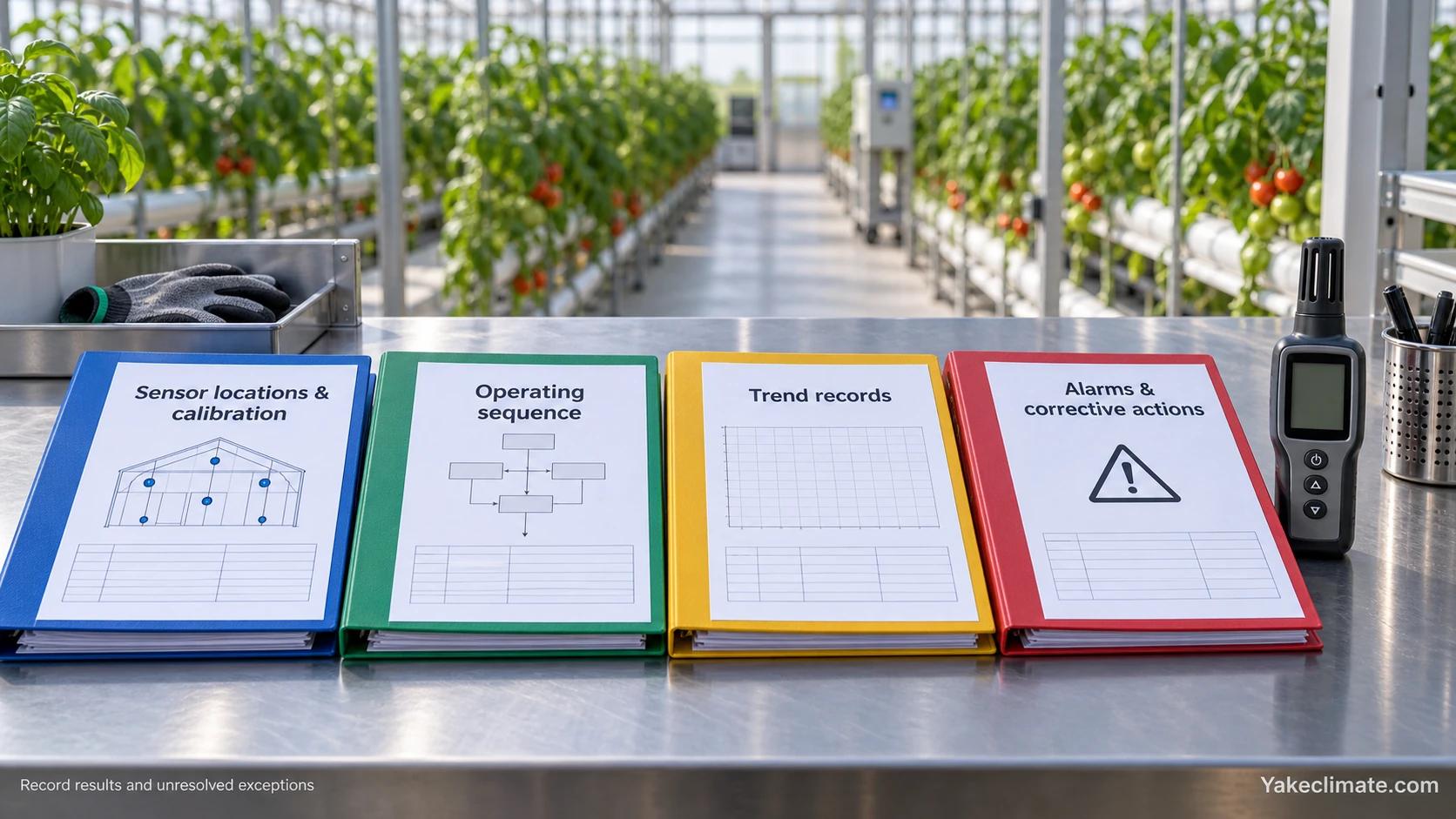
- final control setpoints and deadbands,
- sensor locations and calibration notes,
- equipment sequence by operating mode,
- trend charts for representative test periods,
- list of unresolved exceptions and corrective actions,
- alarm list and response procedure,
- maintenance checklist and spare filter information,
- owner training record and contact path for support.
Keep untested conditions and open issues visible
At handover, record each commissioning scenario against the project requirement or design document, then label the result as performed and met the agreed criterion, performed and did not meet it, or not tested/deferred. State the conditions, measured result, source record, responsible party, corrective action, retest trigger, and reviewed outcome. Keep an unavailable weather window or equipment constraint visible rather than folding it into a completed checklist. Link every open issue to its resolution evidence. When a later test becomes possible, add that result to the same record so the handover history remains traceable and the greenhouse team can see what still needs attention.
| Record | What to enter | Evidence link |
|---|---|---|
| Scenario and agreed criterion | condition and requirement | design or test plan |
| Test status and reason | status and reason | test record |
| Measured result and source record | result | trend or measurement |
| Responsible party and corrective action | owner and action | issue log |
| Retest trigger and reviewed outcome | trigger, later result, reviewer | retest record |
Yakeclimate designs and manufactures industrial dehumidification equipment for complex climate applications. Share the commissioning conditions, equipment interfaces and unresolved observations when discussing the equipment duty.
FAQ
Frequently Asked Questions
How long should greenhouse humidity commissioning take?
It should include at least the operating periods that create the risk: night, pre-dawn, after irrigation and screen-closed operation. A short daytime check is usually not enough.
What data should be trended during commissioning?
Trend temperature, RH, dew point if available, equipment run status, alarm status, screen position, ventilation status and irrigation timing. Outdoor temperature and humidity are also useful.
What if the installed dehumidifier has enough capacity but humidity is still high?
Check airflow, sensor location, staging logic, ventilation interaction and drainage first. The problem may be that moisture is not reaching the unit or the control sequence starts too late.
Should commissioning use RH or dew point?
Use both when possible. RH is familiar for growers, while dew point helps explain condensation risk when air or surface temperature changes.
References
- NC State Extension: Botrytis Blight of Greenhouse Ornamentals
- NIST: Humidity
- ASHRAE Fundamentals of Psychrometrics
Source support
WBDG: Building Commissioning: The Process supports requirements based testing, issue evidence, and deferred test records. These are suggested record labels.


