
Automated greenhouse humidity control works when sensors, setpoints, ventilation, curtains, heating and dehumidifiers follow the same logic. A dehumidifier that only switches on at a fixed RH threshold may fight the greenhouse computer instead of supporting it.
Control the Condition, Not Just the Device
The control objective is not "turn on the dehumidifier." The objective is to keep the crop and greenhouse surfaces away from condensation while preserving the climate strategy for heat, CO2, irrigation and ventilation.
Michigan State University Extension notes that VPD is a stronger indicator of plant transpiration and water loss than RH alone (MSU Extension). In automation terms, RH is a useful signal, but VPD and dew point often explain why the same RH value can be safe in one condition and risky in another.
The Signals Each Sensor Provides
| Signal | What it tells the controller | Common mistake |
|---|---|---|
| RH | Percentage saturation at current air temperature. | Treating one RH value as safe at every temperature. |
| Dry-bulb temperature | Heat condition for crop and air capacity. | Ignoring night cooling when RH is rising. |
| Dew point | Temperature where condensation begins. | Not comparing dew point with glazing, curtain or leaf-surface temperature. |
| VPD | Vapor pressure gap that drives transpiration. | Using VPD for crop response but not coordinating equipment capacity. |
| Equipment status | Compressor, fan, heater, alarm or drain condition. | Missing alarms when the greenhouse computer assumes the unit is running. |
A Practical Staging Sequence
Simple on/off control can create hunting: RH rises, the dehumidifier starts, air changes quickly near the sensor, the unit stops, and the canopy stays humid. Staging gives the system a smoother response.
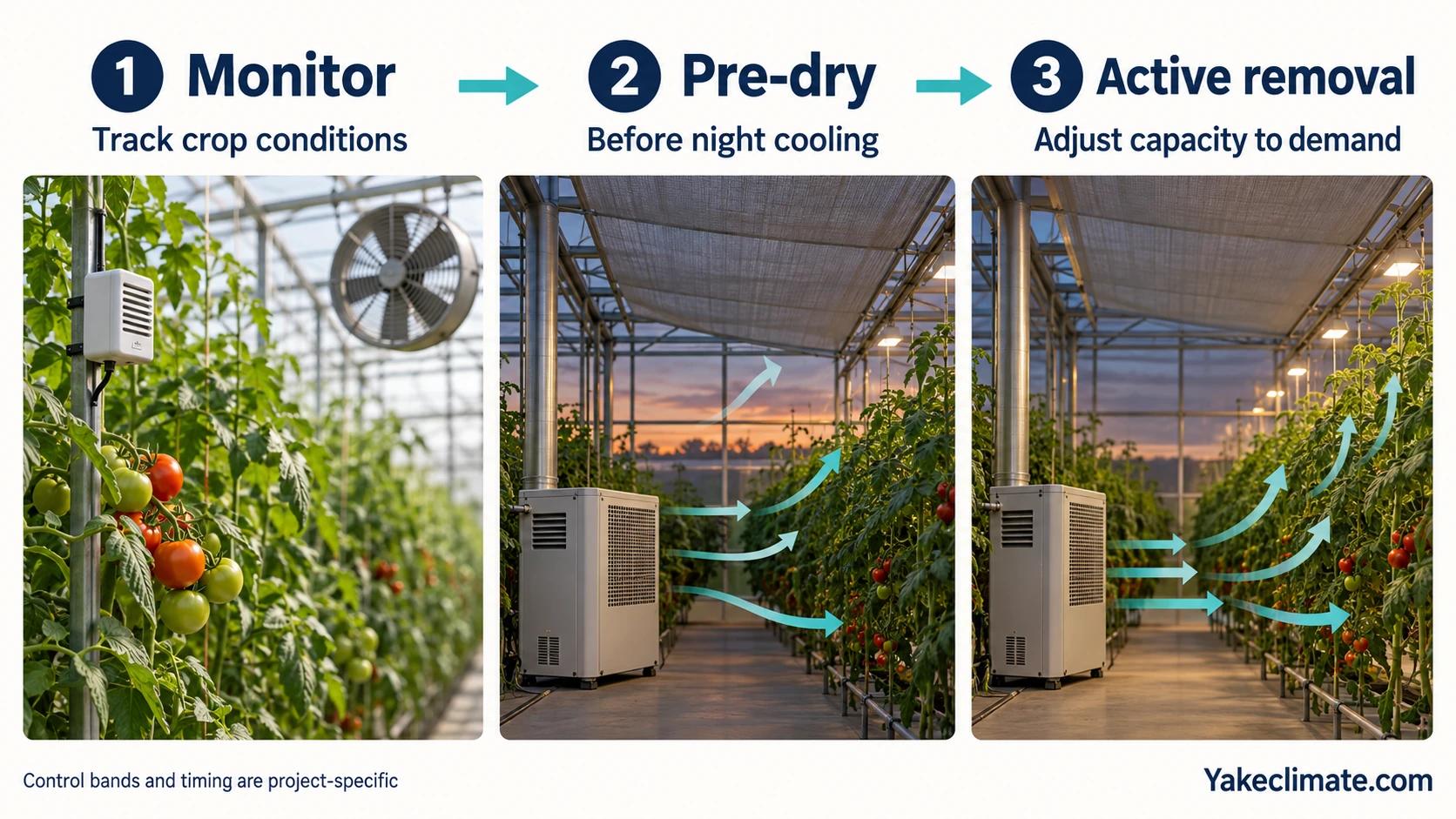
| Stage | Trigger example | Action |
|---|---|---|
| Monitor | Conditions are near target. | Keep circulation active and record trend. |
| Pre-dry | Dew point approaches expected night surface temperature. | Start low-capacity dehumidification before condensation appears. |
| Active removal | Confirmed excessive moisture or condensation risk calls for removal under the approved crop and temperature strategy. | Increase available moisture-removal duty only in that direction. High VPD alone is not a dehumidification trigger; removing water can increase VPD further. |
| Vent assist | Outdoor air has lower humidity ratio at the stated pressure and temperature; heat, flow, CO2 and contamination limits are acceptable. | Coordinate vents with the control sequence; RH alone is insufficient. |
| Alarm | Target cannot be recovered in the allowed time. | Report fault, sensor issue, drain issue or insufficient capacity. |
For the strategic decision between ventilation and mechanical removal, see ventilation vs dehumidification in controlled agriculture.
Sensor Placement Rules
One sensor near a wall or service corridor cannot represent the entire crop zone. Dense canopy areas, curtain pockets and gable ends can behave differently from the central aisle.
Use these rules:
- Place control sensors where they represent the crop climate, not direct discharge air.
- Keep a separate safety signal for condensation-prone surfaces when needed.
- Avoid sensor locations affected by sun patches, heaters, fogging nozzles or open doors.
- Compare canopy readings with room readings during commissioning.
- Calibrate or replace sensors on a schedule that matches the control band.
NC State Extension's Botrytis guidance for tomato emphasizes keeping leaves dry and air moving in greenhouses (NC State Extension). Automation should make those conditions repeatable, not merely produce a clean dashboard number.
Equipment Interfaces to Define
Different projects require different control boundaries. Some only need a local humidistat and alarm contact. Others need the greenhouse computer or PLC to coordinate the dehumidifier with curtains, vents, fans and heating.
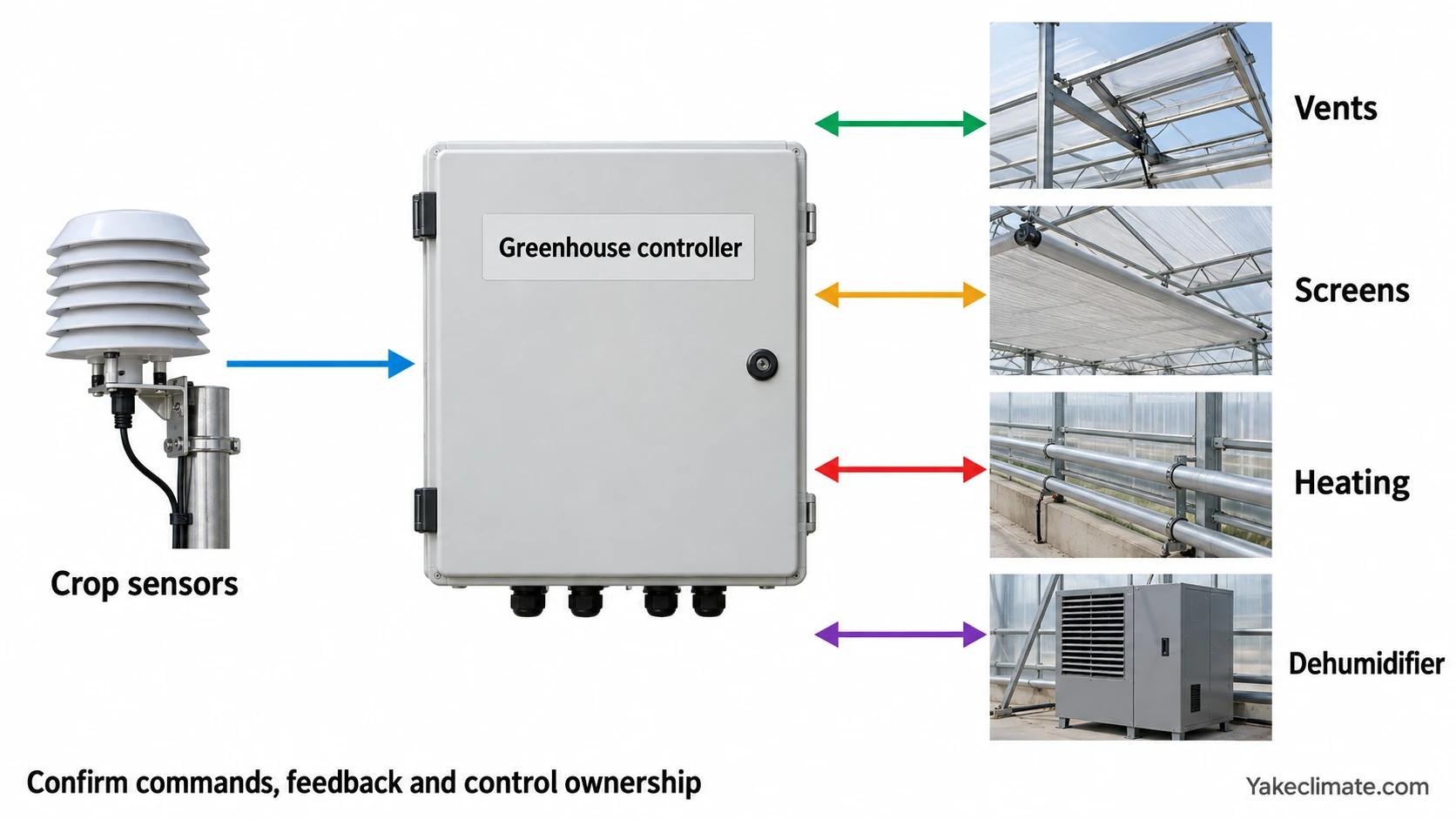
| Interface | What it can do | When it fits |
|---|---|---|
| Local controller | Runs the unit from local RH or dew point logic. | Small or independent compartments. |
| Dry contact | Allows enable/disable or alarm feedback. | Simple greenhouse computer coordination. |
| Analog signal | Allows capacity request or setpoint signal. | Modulating equipment or staged capacity control. |
| Modbus or similar protocol | Exposes status, alarms and setpoints. | Projects that need detailed BMS or PLC visibility. |
| Custom PLC panel | Coordinates several devices in one panel. | Larger projects with defined sequence of operations. |
Do not assume a protocol is standard. Confirm it in the equipment submittal, including register list, alarm mapping and control ownership.
Sequence of Operations for an RFQ
A useful automated-control RFQ should describe the sequence of operations, not only the model count.
| Sequence item | Question to answer |
|---|---|
| Normal mode | Which signal controls capacity during stable conditions? |
| Night transition | Should the system pre-dry before curtains close or temperature drops? |
| Ventilation priority | When should venting run before mechanical dehumidification? |
| CO2 retention | When is venting restricted? |
| Heating interaction | Does reheat or dry-air supply affect heating control? |
| Alarm behavior | What happens if humidity does not recover? |
| Manual override | Who can force operation during service or crop events? |
For broader climate-system boundaries, compare this article with smart greenhouse climate control responsibilities.
FAQ
Frequently Asked Questions
Should automated control use RH or VPD?
Use both when crop response matters. RH is familiar and useful for equipment alarms, while VPD connects humidity and temperature to transpiration.
How do controls prevent short-cycling?
They use deadband, minimum run time, minimum rest time and staged capacity. The exact values should be selected for the equipment and greenhouse response, not copied from a generic template.
Can a dehumidifier connect to any greenhouse computer?
Only if the interface is defined and supported. Confirm the protocol, wiring, signal ownership, alarms and commissioning responsibilities before ordering.


