
Air purification in a commercial grow room is part of a larger environmental-control system. Filtration can reduce airborne particles, while airflow, pressure, temperature, humidity, sanitation, and maintenance determine whether the room remains stable in daily operation.
The correct system depends on what must be controlled: outdoor dust, process particles, spores, odors, equipment contamination, worker activity, or cross-transfer between rooms. A useful design brief defines the contaminant, the required removal efficiency, the room airflow, the pressure relationship, and the acceptable maintenance interval.
Key Takeaways
- Define the air-quality objective before choosing filter technology.
- Calculate pressure drop and fan duty across clean and loaded filters.
- Coordinate purification with humidity control and cooling loads.
- Use room pressure and airflow direction to limit cross-transfer.
- Provide safe filter access, differential-pressure monitoring, and maintenance records.
Start with the Contaminant and the Control Objective
A filter specification is meaningful only when the particle size, concentration, source, and required outcome are known. Coarse pre-filters protect downstream equipment. Finer filters can capture smaller particles but add pressure drop. Gas-phase media may be considered for specific vapors or odors, while microbial-control technologies require careful safety, exposure, and validation review.
Avoid selecting a device from a marketing label alone. Ask for rated airflow, initial and final pressure drop, filter classification, leakage control, housing construction, replacement method, electrical data, and evidence for any claimed treatment performance.
Airflow Determines What the Filter Can Reach
Even a high-efficiency filter cannot treat air that never reaches it. Supply and return locations, rack geometry, crop density, doors, curtains, and equipment can create short circuits or stagnant zones. Map the airflow path and confirm that circulation reaches the occupied and crop zones without excessive local velocity.
Where rooms require directional airflow, the pressure cascade should be measurable. Door opening, exhaust operation, filter loading, and fan-speed changes can all disturb the intended relationship. Commissioning should verify airflow and pressure in the operating states that matter.
Humidity Control and Filtration Affect Each Other
Dense crops and irrigation create a continuous latent load. If humidity is not controlled, condensation can develop on coils, ducts, panels, and other cool surfaces. Wet filters or housings increase pressure drop and can become maintenance risks. The purification and dehumidification systems therefore need a shared operating sequence.
Added filtration raises fan power and may reduce delivered airflow. Cooling coils remove some moisture when their surface temperature is below the air dew point, but sensible cooling alone does not guarantee the required humidity. Independent dehumidification may be needed when the room has a high moisture load or when temperature control limits compressor runtime.
Select the Filtration Stages
A common arrangement uses a serviceable pre-filter followed by a finer final filter selected for the actual cleanliness requirement. Multi-stage filtration can extend final-filter life, but every stage adds resistance. Size the fan for the loaded condition and include differential-pressure measurement so replacement is based on performance rather than calendar dates alone.
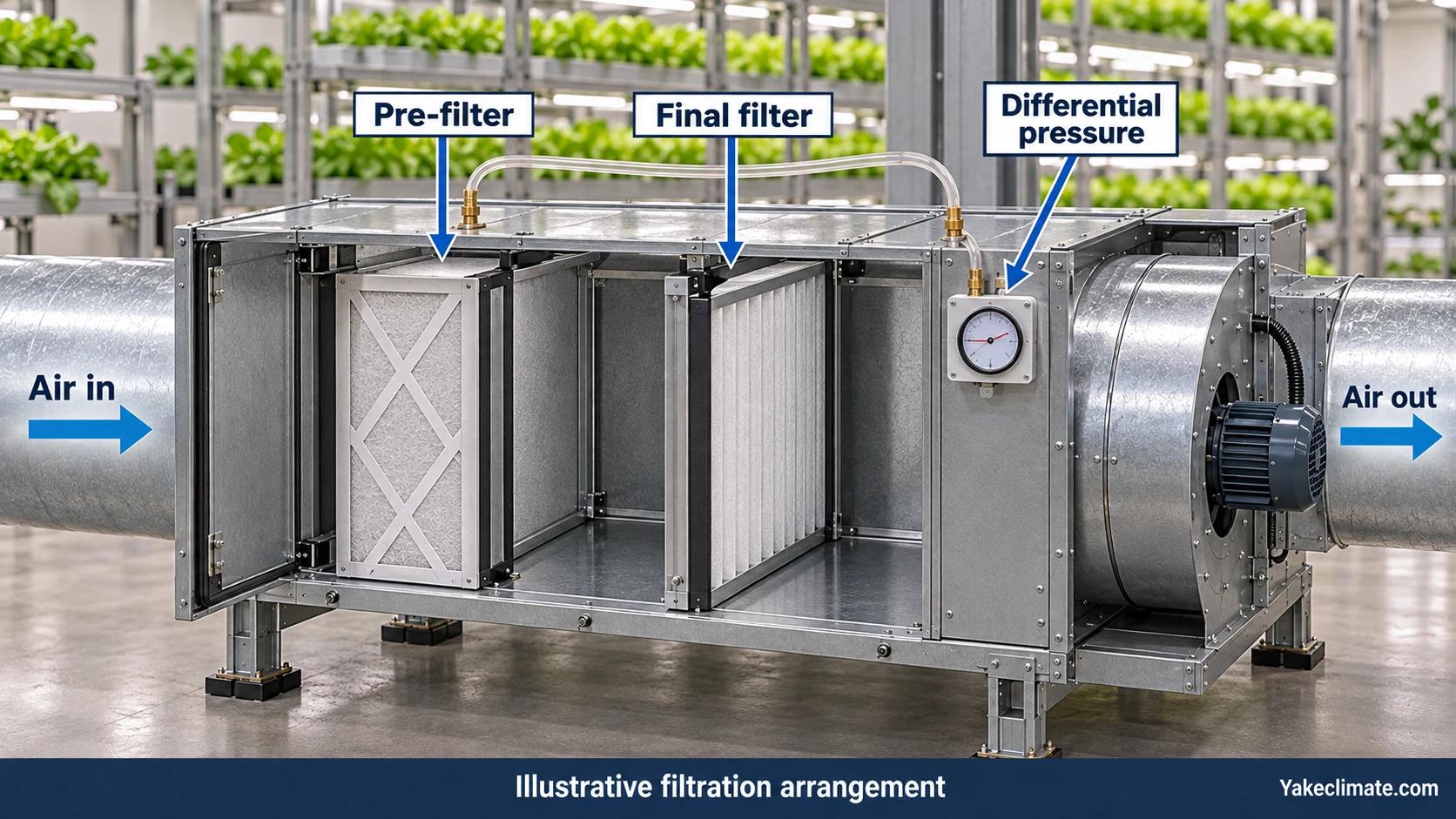
Activated-carbon or other gas-phase media should be matched to the target compound, contact time, humidity, and replacement capacity. UV-based systems require shielding, access controls, lamp maintenance, and validation for the intended location. No single technology replaces source control, sanitation, and correct airflow.
Design for Cleaning and Maintenance
Place filters where technicians can isolate, inspect, and replace them without contaminating the room or working around live equipment. Provide access clearance, safe lifting space, labels, spare-filter storage, drain and washdown boundaries where applicable, and a documented change procedure.
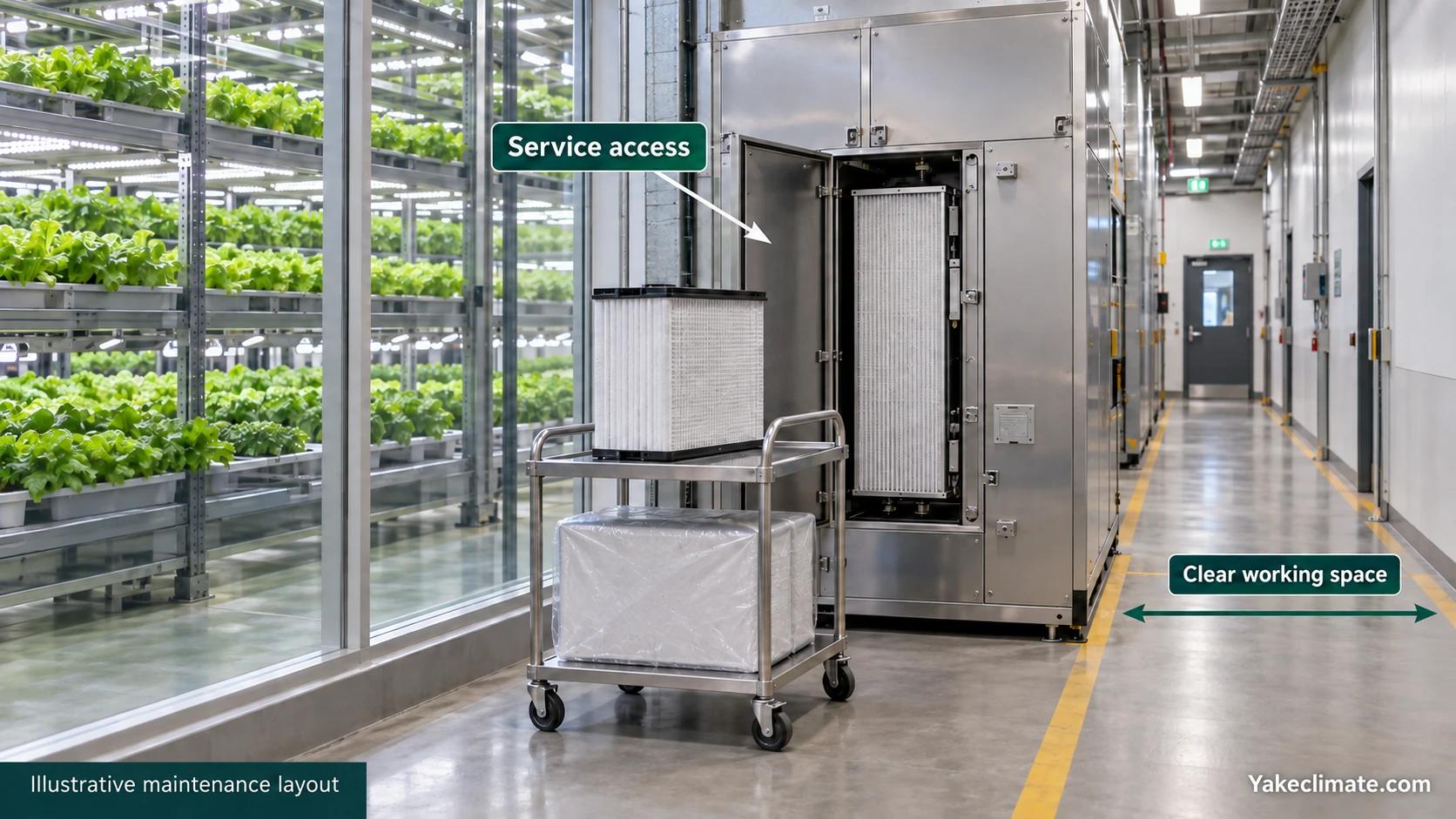
Maintenance records should track filter pressure drop, fan speed, room pressure, humidity, alarms, visible leakage, and replacement dates. A rising pressure drop may indicate normal loading, a wet filter, a blocked intake, or a fan problem; the trend helps distinguish them.
Commission the Complete Room
Before handover, verify airflow volume, room pressure, filter installation, leakage, alarm points, control logic, sensor calibration, humidity recovery, and operation with doors and exhaust systems in their normal states. Repeat critical checks after filters have accumulated a representative load.
Project Information to Prepare
Room volume and layout, crop density, contaminant sources, cleanliness objective, outdoor-air rate, supply and return arrangement, temperature and humidity targets, pressure relationship, maintenance access, power, controls, and required test records are the minimum inputs for a useful system review.
Conclusion
Commercial grow-room air purification works when the filter, fan, airflow path, pressure strategy, humidity control, and maintenance plan are treated as one system. This approach produces a design that can be checked and serviced instead of relying on a filter rating in isolation.


