
Solar-powered greenhouse dehumidification is possible only after the moisture load and operating schedule are known. The key question is not whether a solar panel can run a dehumidifier for a few hours. The key question is whether power is available when the greenhouse needs moisture removal.
For the greenhouse project route, treat the solar question as part of the agriculture applications and the greenhouse humidity-control guide before making the power plan.
Start With Moisture Load, Not Panel Size
A greenhouse dehumidifier is selected by moisture-removal requirement. Solar power is selected by electrical load and available energy. These are connected, but they are not the same calculation.
Start with the greenhouse data:
| Input | Why it matters |
|---|---|
| crop and canopy area | drives transpiration load |
| irrigation and drainage data | estimates net water entering the air |
| target temperature and RH or dew point | defines the controlled air state |
| day and night schedule | separates different moisture and power periods |
| ventilation strategy | may remove or add moisture depending on outdoor air |
| dehumidifier type | changes power input, heat balance and operating limit |
| control sequence | decides when the unit runs |
For sizing inputs, use the greenhouse dehumidification design data checklist. The solar calculation comes after that.
Compare the Solar Window With the Humidity Window
PV output follows sun availability. Greenhouse humidity risk often follows crop transpiration, irrigation timing, screen operation, outside weather and nighttime cooling. These curves do not automatically line up.
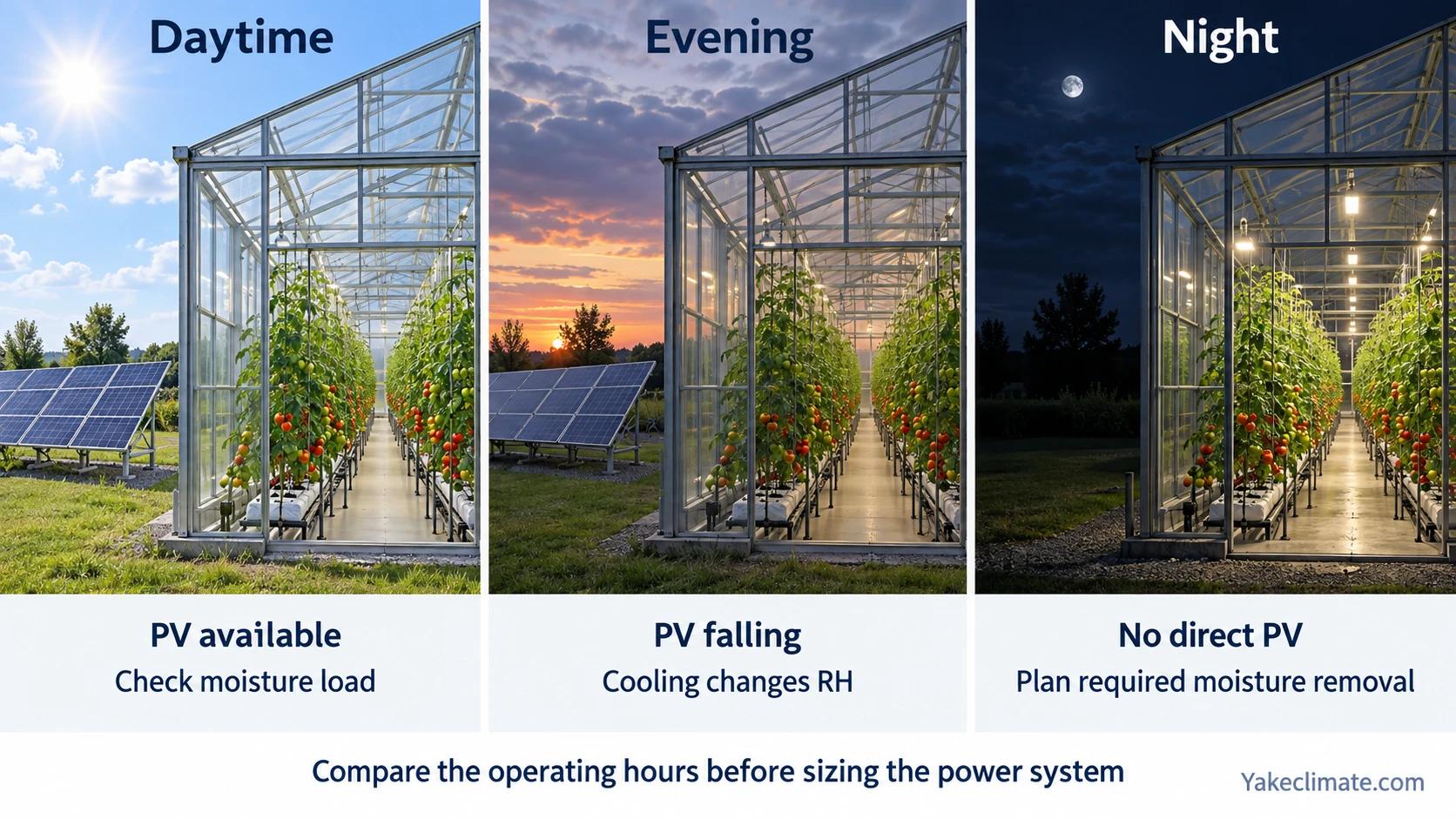
| Period | Humidity-control issue | Solar-power issue |
|---|---|---|
| sunny daytime | transpiration can be high, but ventilation may help | PV output may be strong |
| cloudy daytime | ventilation may be limited and transpiration may continue | PV output drops |
| evening transition | RH can rise as temperature falls | PV output falls quickly |
| night | condensation and leaf wetness risk often increase | direct PV output is absent |
| pre-dawn | surfaces may be cold and RH high | direct PV output is absent |
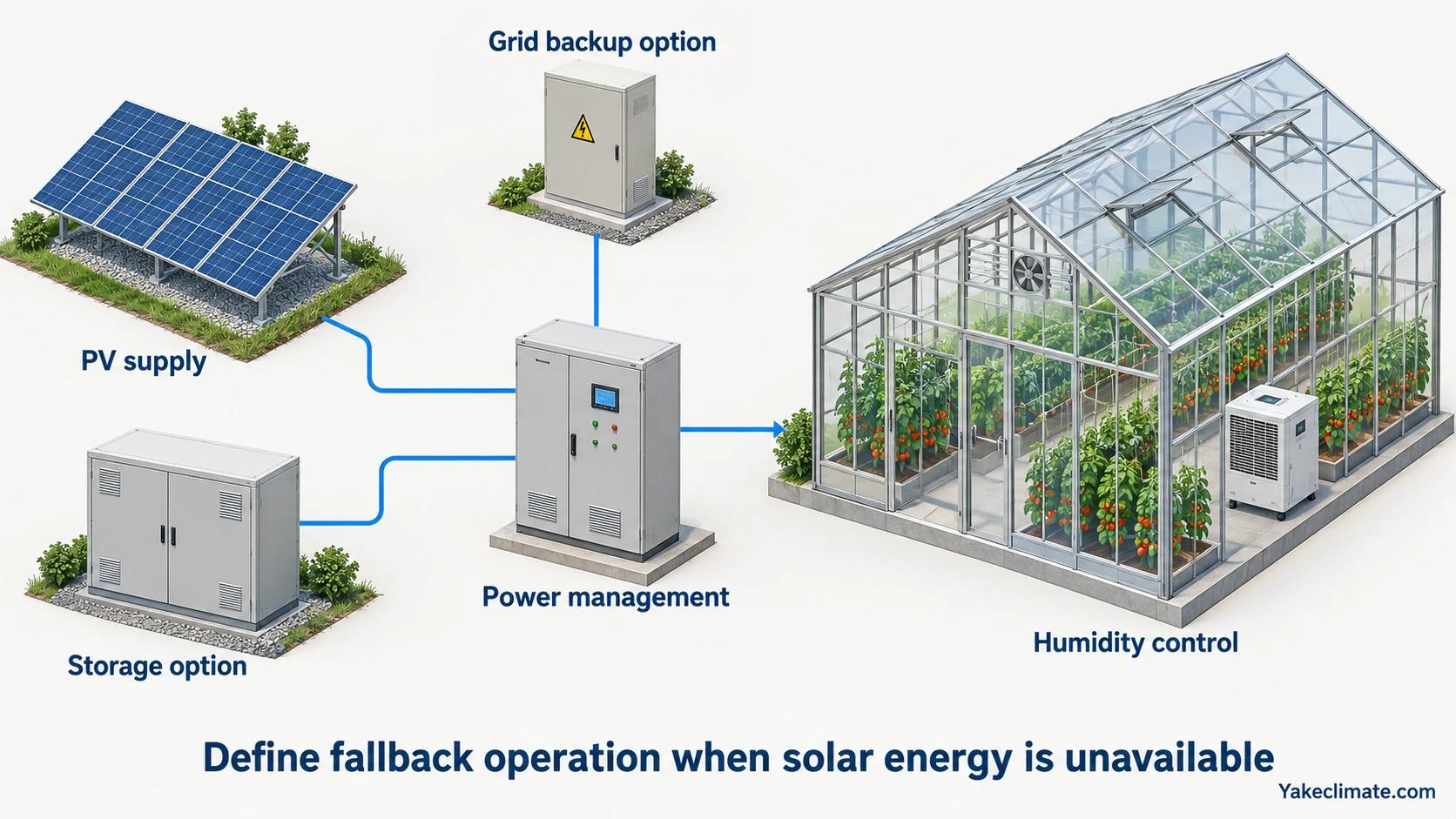
This is why a direct solar-only dehumidifier is often too simple for commercial agriculture. If night humidity control matters, the system needs battery storage, grid power, thermal strategy, or a hybrid control plan.
Use PV Production Tools for Energy, Not Humidity
PVWatts estimates energy production for grid-connected photovoltaic systems from project inputs. That is useful for checking whether a solar array can offset part of the electrical load. It does not size the dehumidifier, prove crop-zone humidity control, or decide whether night condensation risk is solved.
A practical energy check should compare:
- expected dehumidifier power input by operating mode,
- estimated runtime during day, evening and night,
- PV production by month and hour where available,
- battery capacity and usable depth of discharge,
- inverter capacity and starting current,
- grid backup or generator backup,
- control priority during low-battery conditions.
If the greenhouse must protect a crop, the fallback mode matters. The design should state what happens when there is not enough solar energy available.
Check the Heat Balance
Dehumidifiers do more than remove water. Refrigerant dehumidifiers reject heat into the space unless heat is ducted or managed. Desiccant systems can add reactivation heat or require a separated process/reactivation airflow arrangement. In a greenhouse, that heat can help in some periods and create cooling load in others.
| Equipment behavior | Design question |
|---|---|
| heat added to greenhouse | useful at night, problematic during hot periods? |
| condensate collected | where does water drain, and can it freeze or back up? |
| fan airflow | does air reach the crop zone or short-circuit? |
| low-temperature operation | can the unit maintain capacity under cool night conditions? |
| controls | does solar availability override crop protection or only optimize energy? |
For technology selection, compare operating condition in the refrigerant vs desiccant dehumidifier guide.
When Solar Support Makes Sense
Solar can still be useful. It may reduce grid consumption, support daytime latent removal, charge batteries for night operation, or power part of the control and circulation system.
It makes more sense when:
- the site has high daytime humidity load and strong solar resource,
- the greenhouse has grid or battery backup for night protection,
- the crop can tolerate defined humidity variation,
- the dehumidifier control sequence is not disabled by low solar output,
- the PV and storage system are sized with real runtime data,
- maintenance staff can support both climate equipment and electrical equipment.
It is risky when the buyer expects a small solar kit to solve a commercial night-humidity problem without storage, controls or project data.
Project Data Checklist
Before asking for a solar-powered dehumidification proposal, prepare:
- greenhouse location and climate design basis,
- crop, canopy area and irrigation schedule,
- target day and night temperature and humidity,
- current ventilation and heating strategy,
- expected dehumidifier runtime by period,
- available electrical supply and backup power,
- proposed solar array size, inverter and battery information,
- controls priority during low-energy conditions,
- required alarms and remote monitoring,
- acceptance method for crop-zone humidity.
Yakeclimate designs and manufactures industrial dehumidification equipment for complex climate applications. Solar power can be part of the energy plan, but moisture load and crop protection remain the design basis.
FAQ
Frequently Asked Questions
Can a solar panel run a greenhouse dehumidifier?
A solar-powered arrangement can run a dehumidifier when the complete electrical supply supports its running and starting requirements during the required operating periods. Storage is one option for a solar-only system that must operate without sunlight; a suitable grid or other backup supply is another configuration. Check the actual power and energy balance rather than assuming every arrangement needs a battery.
Why is night operation important for greenhouse dehumidification?
At night, air and surface temperatures often fall while ventilation is reduced. That can increase RH, dew point risk and leaf wetness even when daytime conditions looked acceptable.
Does solar power change dehumidifier sizing?
No. Solar changes the electrical supply strategy. Dehumidifier sizing still starts with moisture load, target condition, airflow and operating schedule.
Is battery storage required?
If humidity control is required when solar output is absent, the project needs storage, grid power or another reliable backup. The right choice depends on crop risk, runtime and site power conditions.


