

Greenhouse condensation forms when a surface is at or below the dew point of the air touching it. The first useful question is which surface became wet first. Drops on a roof film, beads on a leaf, and water beneath a gutter can have different paths and different remedies. A wet leaf alone cannot tell you whether water formed on that leaf, dripped from above, arrived through irrigation, or entered through a leak.
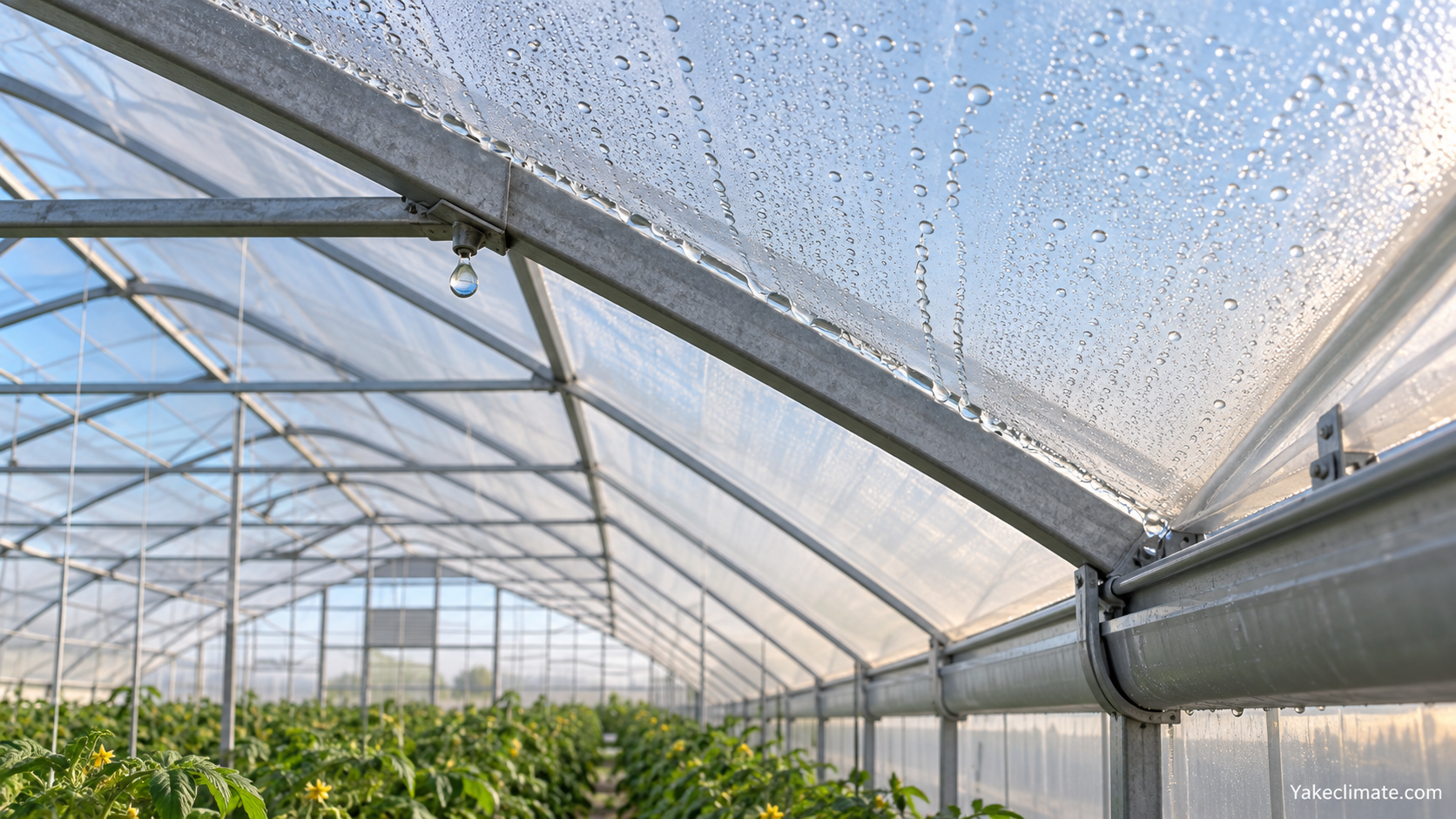
Locate the first wet surface, record when it became wet, and compare its temperature with the dew point of nearby air at the same time. Then choose a response for the confirmed path. The accompanying image is a conceptual illustration, not a Yakeclimate installation or a record of a specific greenhouse.
Where did the water first appear?
Inspect the house during the event, before a later warm period dries the evidence. Note the first wet location and the path below it. UMass Extension's greenhouse humidity guidance distinguishes condensation on the cover from moisture on plant surfaces and describes how cover drips can wet crops. Virginia Tech's covering guide explains why water beads on polyethylene film and may fall onto plants.
| First wet location | Plausible paths to check | Immediate evidence to save |
|---|---|---|
| Underside of cover, glazing, or roof frame | Local surface condensation; rain entry through a joint is a separate possibility | Photo of the inside surface and seams, nearby air temperature and RH, surface temperature, gutter or runoff path |
| Leaves or flowers below a wet cover | Direct leaf condensation, overhead cover drip, irrigation, or spray | Which side of the leaf is wet, matching roof position, irrigation time, canopy temperature and nearby air state |
| Leaves in one stagnant crop zone | Local cool leaf surfaces or poor mixing; irrigation may also explain wetness | Zone map, leaf temperature, local temperature and RH, fan state, wetness timing |
| Screen edge, pipe, or metal frame | A cold surface where humid air meets a different temperature zone, or liquid water running from above | Surface and nearby air measurements on both sides of a screen, drip direction, screen and heat state |
| Floor beneath a vent or wall | Rain entry, irrigation runoff, blocked drainage, or overhead drip | Weather and opening state, visible entry path, floor drainage and water source |
These are hypotheses, not diagnoses from appearance alone. If droplets are already falling from the roof, protecting the crop from that drip is a different task from lowering the crop air's dew point. If water enters through a seam or vent, repair that liquid path before asking air-treatment equipment to carry the resulting load.
Condensation location map
Choose the first wet location below. Each route leads to the observations, competing causes and next checks for that component; a wet surface alone does not identify its water source.
Check: Inner-face droplets, rain entry or runoff leaving a support. Next: Follow the slope, purlins, folds, gutter and outlet.
Check: Inside face, outside face, double-film space or rigid-panel cell. Next: Identify the wet layer; refer enclosed cavities to the glazing installer.
Gutter condensation vs overflow
Check: Underside beads, roof runoff, rainwater load or backup. Next: Find the first escape point and distinguish the two drainage channels.
Check: Leaf cooling, roof drip, applied water or slow canopy drying. Next: Record leaf position, first wet time and drying separately.
Check: Lower-face condensation, water above, stored water or motion release. Next: Observe before movement and compare the air spaces on both sides.
Check: Cold exterior, pressurized leak, overhead water or wet insulation. Next: Identify the service and repeat observations under that operating state.
Duct exterior vs internal water
Check: Outer-face wetting, internal carryover, rain entry or leakage. Next: Sketch supply/return/exhaust and trace toward the upstream equipment.
Check: Cold panel, escaping condensate or water delivered from outside. Next: Separate cabinet wetting from the intended coil and drain path.
Check: Cold frame, joint entry, poor closure or blocked drainage. Next: Record before/after opening; inspect alignment and intended outlets.
Check: Cold connection, rain entry or water tracking from above. Next: Compare like junctions and ask the structure owner to review the complete detail.
Check: Recurring moisture with algae or mold; source still unconfirmed. Next: Record re-wetting, shade and nutrients; assess material condition separately.
Test whether a surface could have condensed water
Dew point describes the air state. Condensation becomes possible at a surface when its temperature reaches or falls below the dew point of the air next to that surface. A sensor in a warmer aisle may miss the condition at a leaf, a roof panel, or above a closed screen. UC Agriculture and Natural Resources describes leaves and greenhouse structure cooling at night and becoming the first wet surfaces. AHDB's plant-temperature guidance uses plant temperature against air dew point to identify the risk.
For a repeatable check:
- Mark the wet surface and the time it first became wet. Record the surface material and whether water could have arrived from above.
- Measure air temperature and RH close to that surface. Record the sensor location, timestamp and calibration status. Derive dew point from those inputs using the greenhouse psychrometric calculation guide if the instrument does not report it.
- Measure the same surface's temperature at that time, using a method suitable for the material. Reflective metal, wet film and mixed plant backgrounds can complicate infrared readings; AHDB notes that plant infrared measurements need care.
- Compare surface temperature with nearby-air dew point, allowing for sensor uncertainty and the time gap between readings. A surface at or below dew point makes condensation physically plausible. It does not prove that every observed drop formed there.
- Check the alternative water paths: overhead drip, irrigation, leaks and runoff. Keep any unresolved cause marked as unresolved.
A reading taken after sunrise cannot prove that the leaf stayed above dew point overnight. Nor does a high greenhouse RH reading prove that a particular leaf condensed water. Save the event-time measurements and a photo of the actual water path.
Surface temperature dew point table
Calculated examples for liquid-water condensation near room temperature and atmospheric pressure. Surface temperatures are assumed, not site measurements or crop settings. Values use the NPL Magnus relation over liquid water and are displayed to one decimal place.
| Local air T | Local RH | Calculated dew point Td | Assumed surface Ts | Ts minus Td |
|---|---|---|---|---|
| 20.0°C | 60% | 12.0°C | 15.0°C | +3.0°C |
| 20.0°C | 70% | 14.4°C | 15.0°C | +0.6°C |
| 20.0°C | 80% | 16.4°C | 15.0°C | -1.4°C |
| 20.0°C | 90% | 18.3°C | 15.0°C | -3.3°C |
| 20.0°C | 80% | 16.4°C | 18.0°C | +1.6°C |
| 20.0°C | 80% | 16.4°C | 16.0°C | -0.4°C |
| 15.0°C | 80% | 11.6°C | 12.0°C | +0.4°C |
| 25.0°C | 80% | 21.3°C | 20.0°C | -1.3°C |
Calculation: γ = ln(RH/100) + 17.62T/(243.12 + T); Td = 243.12γ/(17.62 − γ), with T and Td in °C and RH in percent. These examples are not frost calculations.
Worked example: at 20.0°C and 80% RH, the calculated dew point is 16.4°C. An assumed 15.0°C surface is about 1.4°C below it, so condensation is physically possible. At the same air state, an 18.0°C surface is about 1.6°C above it. If that warmer surface is wet, investigate delivered water, another cold spot or an earlier colder period. Neither difference is a universal safety margin; include measurement uncertainty.
NPL: dew-point and relative-humidity conversion, equations and conditions
Calculate dew point from your local air readings
Measure the actual wet spot
Pair a wet point with a nearby dry part of the same assembly, exposed to comparable air, and measure both during the same event. A thermal camera can help find a cold line but does not establish the water source. Check the indicated line against a suitable surface measurement and the visible liquid path. For leaf infrared measurements, ensure the instrument sees the intended leaf rather than a tray, floor, stem or glazing; retain the leaf position and instrument uncertainty. An inaccessible or moving screen surface estimate remains an estimate.
Why room RH can look acceptable while a surface is wet
Relative humidity changes when air temperature changes even if the amount of water vapor does not. A colder roof or leaf can be below the local dew point while a central air sensor reports RH below 100%. The air touching the surface may also differ from the measured aisle air. UMass Extension and UC Agriculture and Natural Resources both describe that surface and canopy distinction.
The timing matters as much as the highest reading. Record the period before sunset, screen closure, heating changes, overnight cooling and morning warm-up. A cover may wet first and drip later; a leaf may lag behind warming air. The nighttime greenhouse humidity guide develops the evening-to-morning sequence. If a thermal screen divides the house into two air spaces, use the below-screen and above-screen moisture-path guide rather than treating one sensor as representative of both.
Screen moisture paths
Record canopy air, air just below the screen, air above the screen near the roof and outdoor air during the same event. A screen can transfer moisture by bulk airflow, vapor diffusion or wet-material transport; these paths require different evidence. Edge gaps and tears bypass the fabric. Follow where the moisture finally leaves the greenhouse, and check crop-zone conditions during closure and opening.
Greenhouse humidity under thermal screens: material transport and control options
Match the response to the water path
For cover or glazing drip, inspect the inside surface, slope, gutter and runoff path. A suitable anti-drip covering can change how condensate travels along a film; it does not eliminate the vapor that led to condensation. Virginia Tech describes film additives that turn beads into a draining film, while UMass describes the same crop-wetting problem. Confirm material compatibility and actual drainage with the greenhouse designer before changing the covering.
For wet crop surfaces, first separate direct condensation from water falling or spraying onto the crop. Review irrigation timing and avoidable standing water. Check whether air reaches the affected canopy without creating an unacceptable crop draft. Washington State University Extension describes horizontal airflow fans as a way to distribute heat and reduce foliage condensation. Circulation can reduce local differences, but a recirculating fan does not remove water vapor from a closed house.
For a cold structure, pipe, or screen, review the relevant surface temperature, heat loss and air path. Warming a surface may increase the margin above dew point; heating air alone can lower RH while leaving its water content in the greenhouse. If moisture continues to enter the air, a verified water exit is still needed. The general greenhouse humidity-control guide compares ventilation, heating, circulation and mechanical removal across the whole moisture balance.
For liquid water entry or poor drainage, correct the opening, joint, irrigation or floor route first. Air drying can help a wet zone recover, but it does not repair the source. Check the site with the greenhouse operator before changing vent or screen controls; those settings also govern temperature, rain protection and crop conditions.
Roof drips and runoff
| What you observe | Likely path to investigate | Evidence to record before intervention |
|---|---|---|
| Broad beads on the inner film that later drop over crop rows | Cover condensation and uncontrolled drip | First wet time, roof zone, nearby air temperature and RH, cover temperature where safely measurable, drip and crop locations |
| A continuous film of water running downslope | Condensate guided toward an edge | Whether the film stays continuous past supports and reaches a gutter or falls before it |
| Water concentrated at a seam, vent or glazing joint during rain | Rain entry or a failed joint, potentially alongside condensation | Outside weather, joint and seal condition, inside path and the time water first appeared |
| Moisture inside the double-film air space | Inflation-air or envelope issue | Intake air source, blower state, film separation and service history; request installer review |
| Dry roof but wet leaves below | Another water path or direct leaf condensation | Irrigation and overhead equipment times, leaf temperature, nearby-air dew point and any prior roof drip |
Follow the route from the first wet point downslope. Does the water stay on the inner face? Does it collect at a purlin, frame member or film fold and then drip? Can the gutter receive it, remain clear and discharge it without rewetting the crop or floor? A Wisconsin Extension greenhouse energy guide describes roof details with small gutters in purlins that collect condensation away from plants. That is an example of a managed path, not approval of a retrofit detail for another greenhouse. The covering supplier and structure designer must check compatible film, supports, slope, drainage and maintenance access.
Record the intervention date and compare a later period with similar outside weather, screen and vent settings, irrigation timing and crop stage. Photograph the same roof zones and crop rows. Note the time when water first appears, whether it beads or sheets, how it passes supports, whether the gutter remains clear and whether drops land on plants. Repeat the nearby-air and surface-temperature check if the measurement method is reliable.
Glazing face or cavity
| Observation during the event | First question | Responsible next check |
|---|---|---|
| Drops or a film on the room-facing surface | Is that surface at or below the dew point of the air next to it? | Record nearby air state and a suitable surface-temperature reading; inspect where the liquid travels. |
| Haze or water between two inflated polyethylene sheets | Is moisture entering or accumulating in the inflation space? | Have the installer review the inflation-air source, blower and film assembly. |
| Haze apparently inside a multiwall rigid panel | Is the water actually in a cell, or on one accessible face? | Confirm the layer from both sides where safe; ask the panel supplier or installer to assess the panel and edge details. |
| Water concentrated at a bar, seal, fastener or opening during rain | Could liquid be entering through the assembly? | Document timing and route; send the joint to the structure or glazing maintainer. |
| Exterior wetting after a cold night | Is the water on the outside rather than in the crop air? | Record outdoor conditions before attributing it to interior humidity control. |
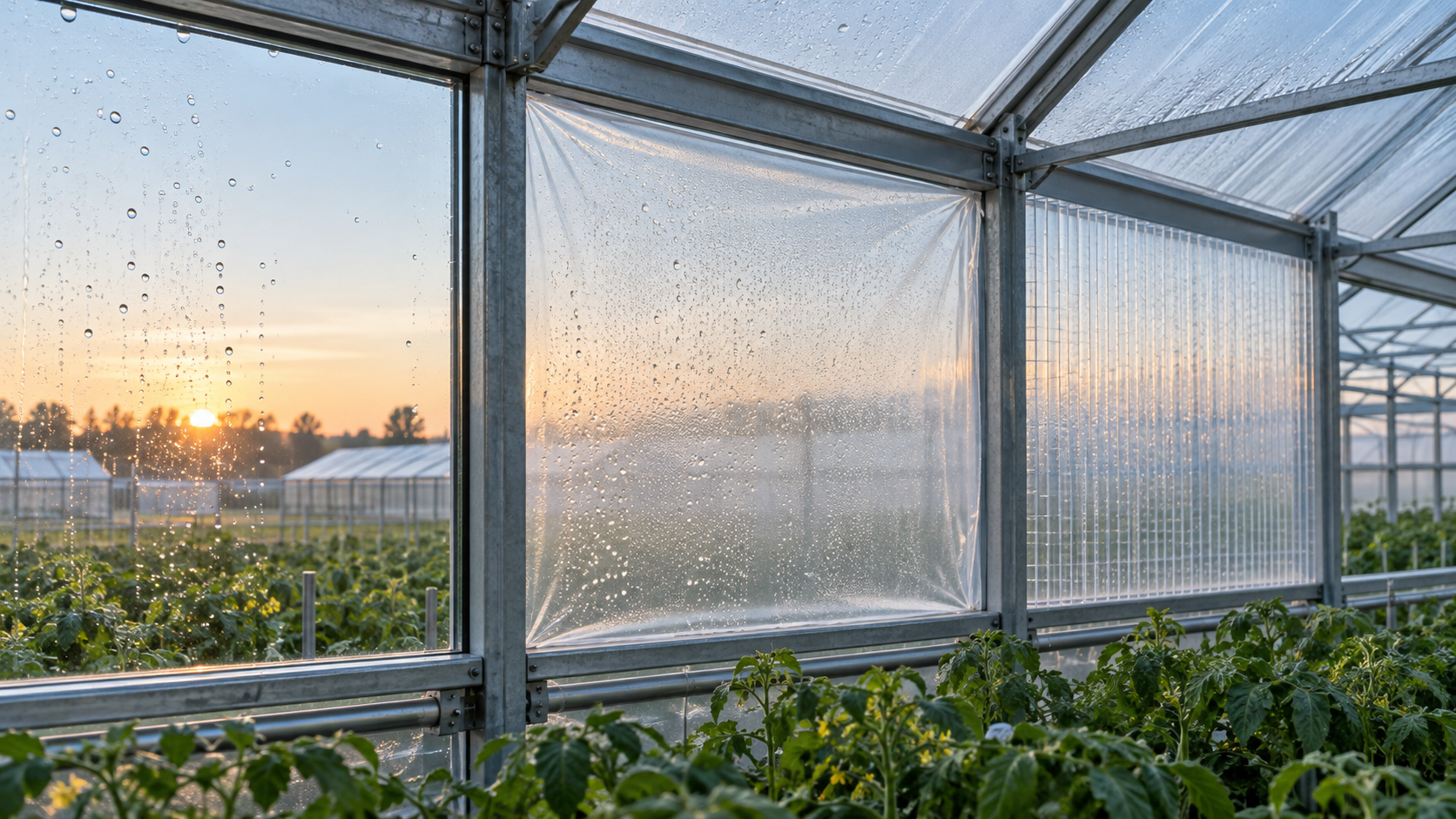
For inflated double polyethylene, inner-face wetting and moisture in the inflation space are separate observations. UConn Extension's film guidance discusses outside-air inflation to reduce moisture between the sheets and explains that condensate-control treatment alters droplet formation. Verify the actual air source and assembly with the installer. A crop-zone dehumidifier cannot repair a damaged inflation line, and a dry crop-zone reading alone cannot clear an interlayer issue.
The appearance of wet glazing may also affect light entering the crop area, but a photograph is not a light-loss measurement. The Rutgers greenhouse glazing and light-transmission review describes condensate effects under specified materials and conditions. Record the installed material, its age and treatment, the wet and dry states, shading and structure before commissioning a comparable light check. Do not transfer a published percentage to an unmeasured house or promise a yield result.
Gutter condensation vs overflow
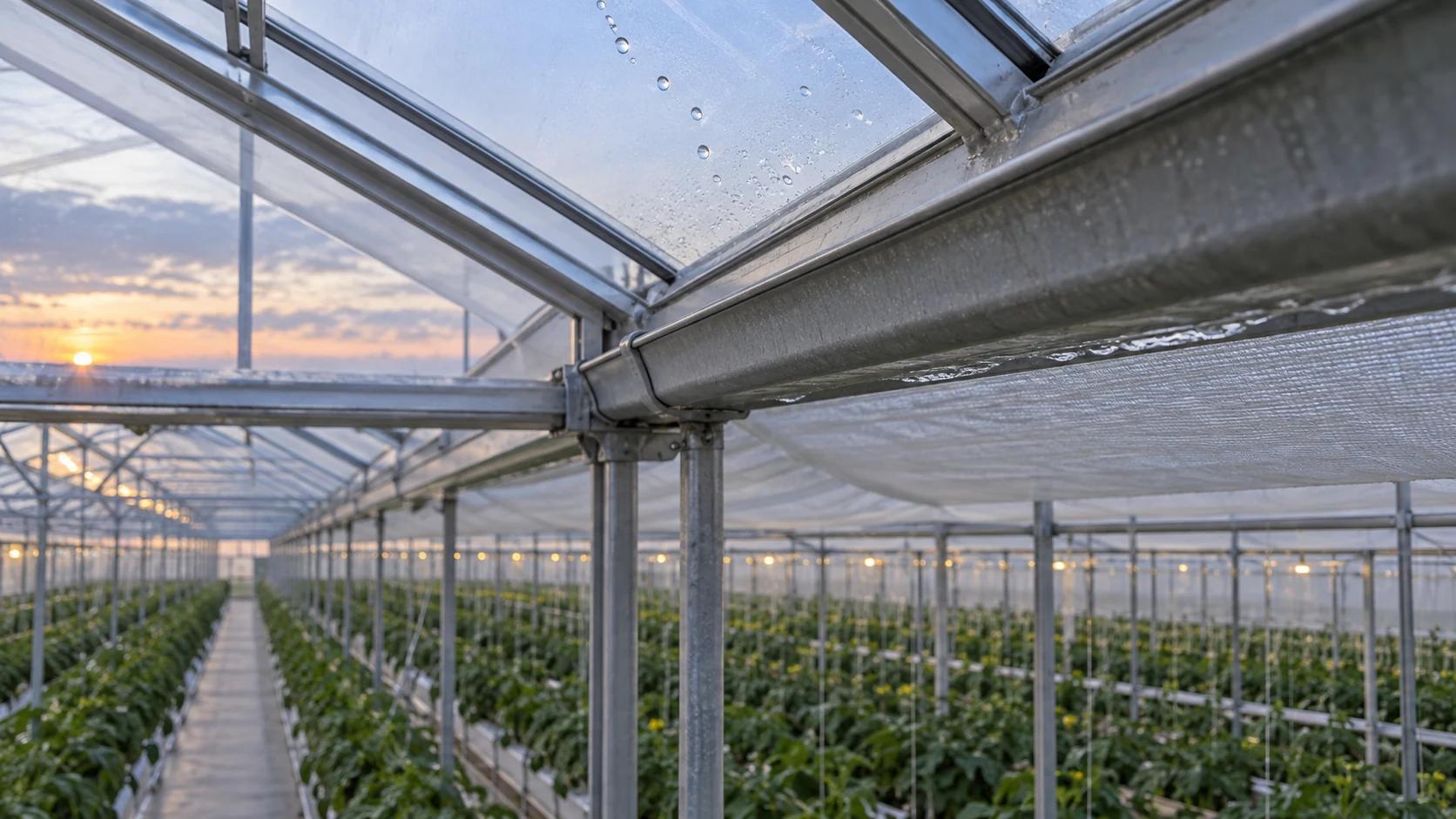
In a gutter-connected greenhouse, neighboring roof bays meet at an eave or gutter. Some assemblies also have a separate interior condensate collection detail. The visible metal below a roof valley, its rainwater channel, a small condensate channel, and a nearby pipe or screen edge may be different parts with different owners. Confirm the installed drawings and inspect only accessible areas before naming the source. UF/IFAS Extension's physical design guide describes bays connected at an eave or gutter; it does not prescribe the detail in your house.
| First observable water | Working explanation to test | Next observation that can separate paths |
|---|---|---|
| Beads appear on the room-facing underside of a gutter while the roof and channel above remain visibly dry | Local surface condensation is possible | Record local air temperature/RH and gutter-surface temperature at the same time; look for repeated beads along similarly cold exposed sections |
| Water is visible on the inner roof covering before the gutter edge or underside becomes wet | Roof-cover condensate is following or escaping its collection route | Follow the wet line downslope through a support, inner lip, joint and outlet; note the first point where water leaves the intended path |
| The gutter or a seam becomes wet during rain, washdown or a drain backup, without an earlier indoor bead sequence | Liquid entry or overflow is possible | Compare the event with rain and cleaning logs; ask the structure/drainage owner to inspect joint, outlet and downpipe conditions |
| The screen edge or nearby duct is wet before water appears below the gutter | Water may have moved from another component | Record that component's first wet point and operating state; do not assign every overhead drop to the gutter |
Rainwater entry is a separate question. Compare dry nights with rain, wind direction, vent position, roof cleaning and irrigation or mist events. Check whether the same bay becomes wet only when the rainwater channel carries a load or a downpipe backs up. The structure and drainage owner should examine the installed design before any seal, outlet, slope or load-bearing detail is changed. The outside rain gutter and an interior condensate channel may share a visual location while carrying different water.
An institutional Wageningen Plant Research report gives a useful counterexample to guessing from the landing point. In one monitored, lit tomato greenhouse with two screens, its abstract reports drip from the greenhouse cover/gutter and ventilation equipment rather than the screens. It says an added condensation gutter addressed drip below the main gutter in that installation. The full report was unavailable to this review, so that observation is not a general retrofit recommendation or a claim about every screen or gutter.
Leaf dew vs delivered water
| Event observation | Plausible water route | Check before calling it leaf condensation |
|---|---|---|
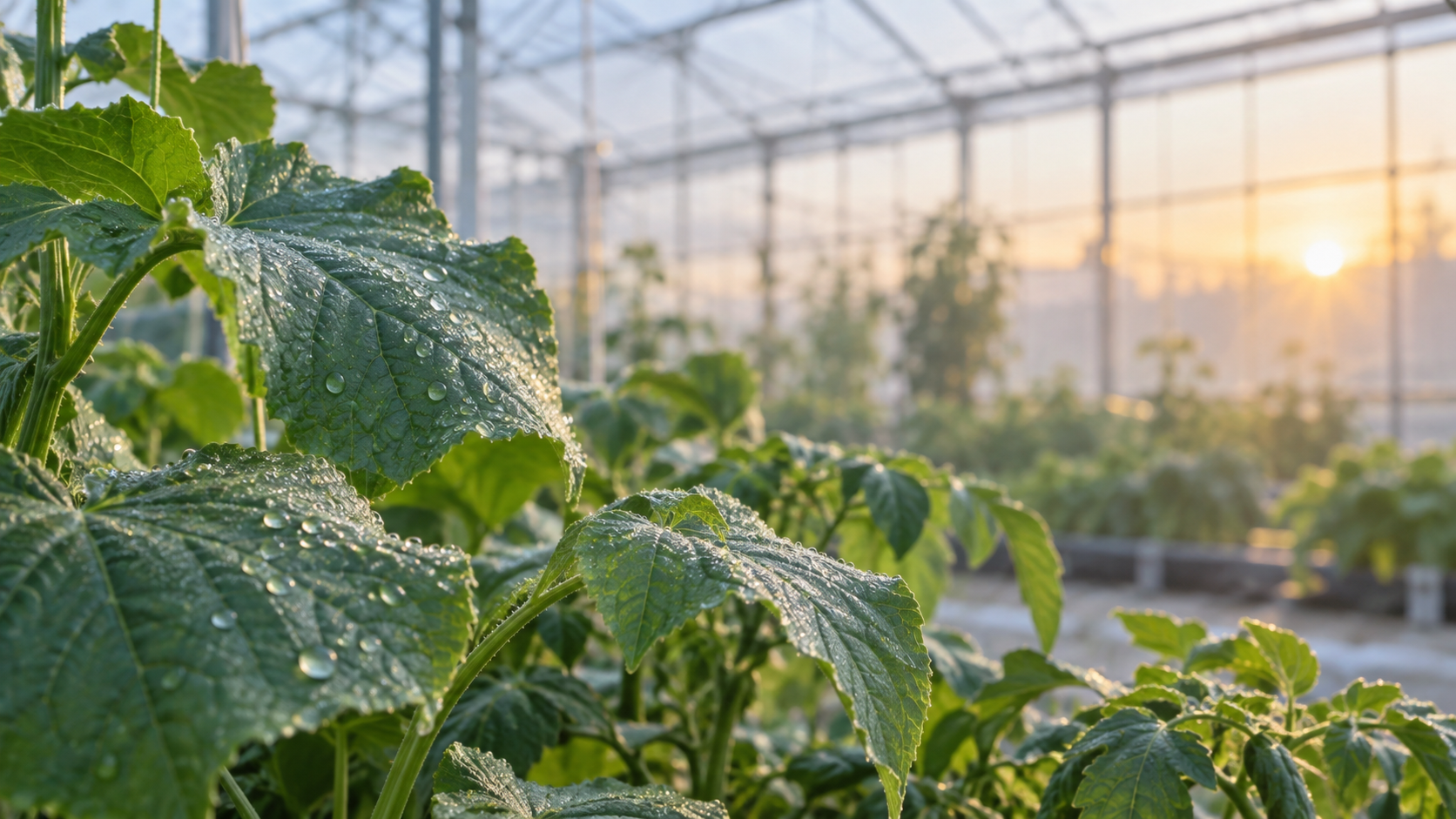
| Droplets appear on exposed leaf tops with no observed fall from above | Direct dew is plausible | Time-stamped leaf temperature and nearby-air dew point; inspect the cover and irrigation log |
| Wet patch follows a roof rib, gutter, or one line of plants | Cover drip or liquid entry is plausible | Photograph the overhead origin and landing path during the event |
| Foliage wets after irrigation, mist or spray | Applied water is plausible | Record the start and end of application and whether adjacent untreated rows also wet |
| Dense lower canopy stays wet after upper leaves dry | Slow local drying or a separate wetting path is plausible | Compare canopy positions, air movement and wet/dry times; do not infer the first source from duration alone |
Repeat measurements at exposed canopy tops, within denser foliage and at the affected edge or bay if those areas differ. Do not average them into one fictitious leaf temperature. A thermal screen, fan pattern and heating sequence can change the local air and leaf state; retain those operating states with each reading. The nighttime greenhouse humidity guide puts the dusk-to-morning transition in a wider control context.
The time when a leaf became wet helps investigate its water source. The time it became dry helps describe exposure after wetting. These are different measurements. A leaf that dried slowly did not necessarily condense the water itself. Record first wet time, last observed wet time, missing observation intervals, affected leaf level and the event source hypothesis in separate fields.
A leaf-wetness sensor can add a time series, but it senses its own surface and placement, not every leaf in a bay. UF/IFAS guidance explains that wetness duration varies by position and that placement or maintenance errors can mislead interpretation. If a logger supplies processed wet minutes, keep the model and wet/dry rule with the record. The published leaf-wetness duration guide explains how to read such output and distinguish a sensor record from an RH-based estimate. This article does not set a universal wet-hour threshold.
Thermal curtain drips
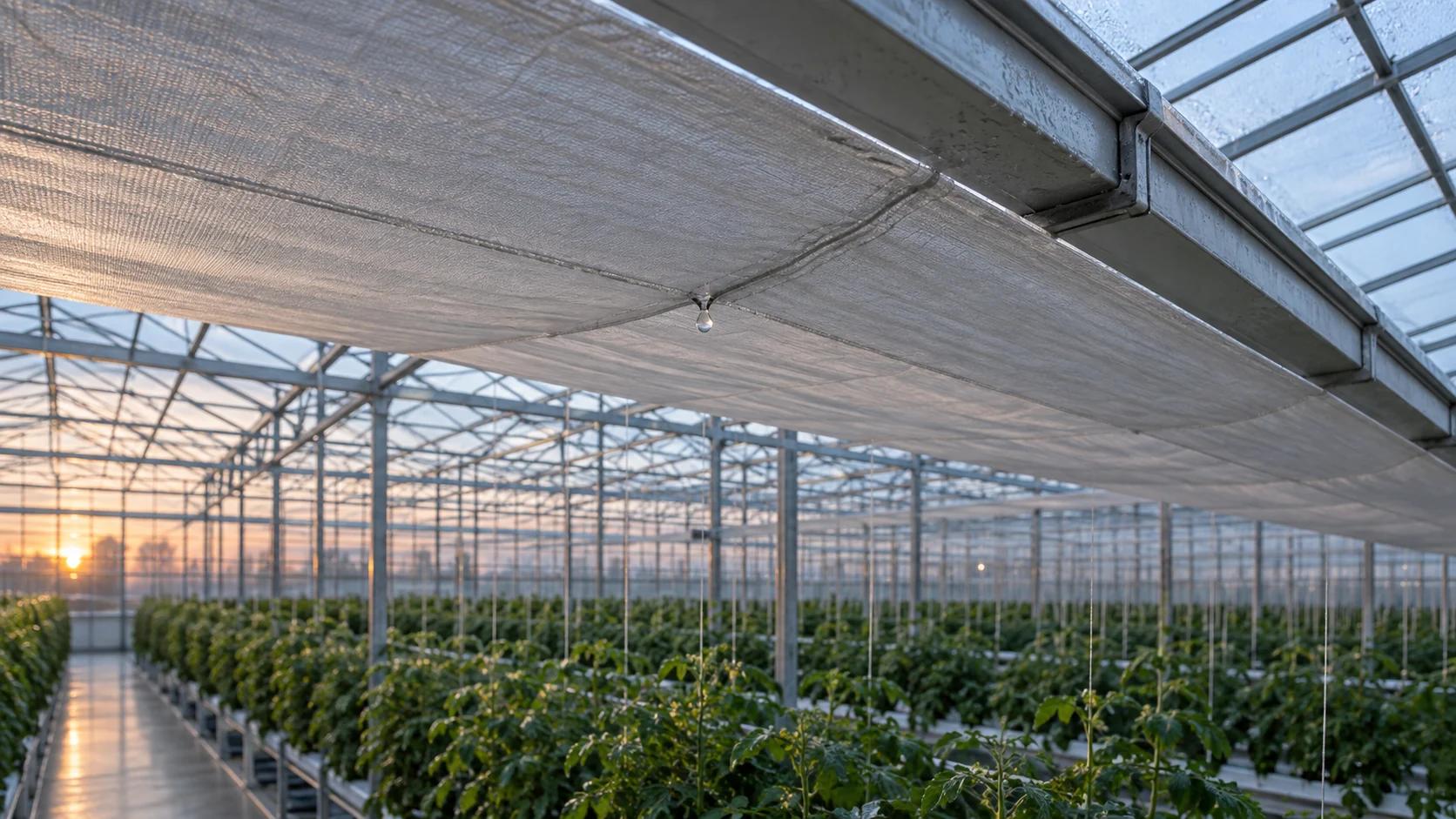
University of Wisconsin Extension's curtain guide distinguishes porous fabrics that allow roof condensate to drip through from nonporous sheets that can hold water above the screen. UC Cooperative Extension notes that water can accumulate on or under a thermal screen and may fall when it moves. These are possible mechanisms; inspect the installed fabric before treating passage as its property.
Two studies show why the water source needs to be traced. In an AHDB thermal-screen project, water condensed on a tested mobile polythene screen and fell onto the crop as it moved. In a different Wageningen Plant Research greenhouse investigation, the researchers observed condensation in the screen material but attributed the measured drip to the cover and equipment, not the screens. These installations and materials differ. Neither result justifies assuming that all wet screens drip, or that a screen cannot be the source.
Trace the sequence, not merely the final puddle. Does a bead first form on the fabric's lower face while the screen is still? Is the upper face already wet? Does water run along a seam before dripping from its lowest point? Does the drip begin only when the leading edge moves? A roof or gutter source can land on a curtain and later fall from it; the final drop location is not necessarily the source. The roof-condensation guide covers roof-face and runoff diagnosis, and the glazing guide covers moisture inside a glazing layer or joint.
| Observation during the event | Competing explanations | Next evidence to collect |
|---|---|---|
| Beads first appear on the crop-facing screen while it remains still | Direct condensation from adjacent crop-zone air; water arriving from above through a gap or a material that permits it | Same-time near-screen air temperature and RH, lower-face temperature if safely measurable, upper-face and roof observations |
| Screen upper face or fabric is wet before a lower drop appears | Roof or gutter runoff; condensation on the upper face; water carried through fabric | First wet point above, cover and drain route, upper-zone air and surface condition, fabric specification |
| Drip appears along a seam, edge or support at retraction | Water stored at that detail; runoff routed there; motion releases water formed earlier | Stationary-state photos, exact motion time, wet edge or support path, drive and screen inspection by the supplier |
| Crop is wet but screen remains dry at the checked location | Leaf dew, irrigation, overhead equipment or an unobserved water path | First wet crop point, irrigation and equipment log, leaf-origin method |
Do not treat an unverified surface-temperature estimate on an inaccessible or moving screen as a confirmed measurement. Record the method and its limits; ask an instrument specialist when a disputed temperature matters. Record screen position, vent and fan state, heating, irrigation, outside weather and the exact time of each image and reading. Compare the period before closure, the closed interval, the moment before opening and the opening event. Do not combine a sunrise surface reading with a night-time wet photograph as though they were simultaneous.
Pipe condensation vs leaks
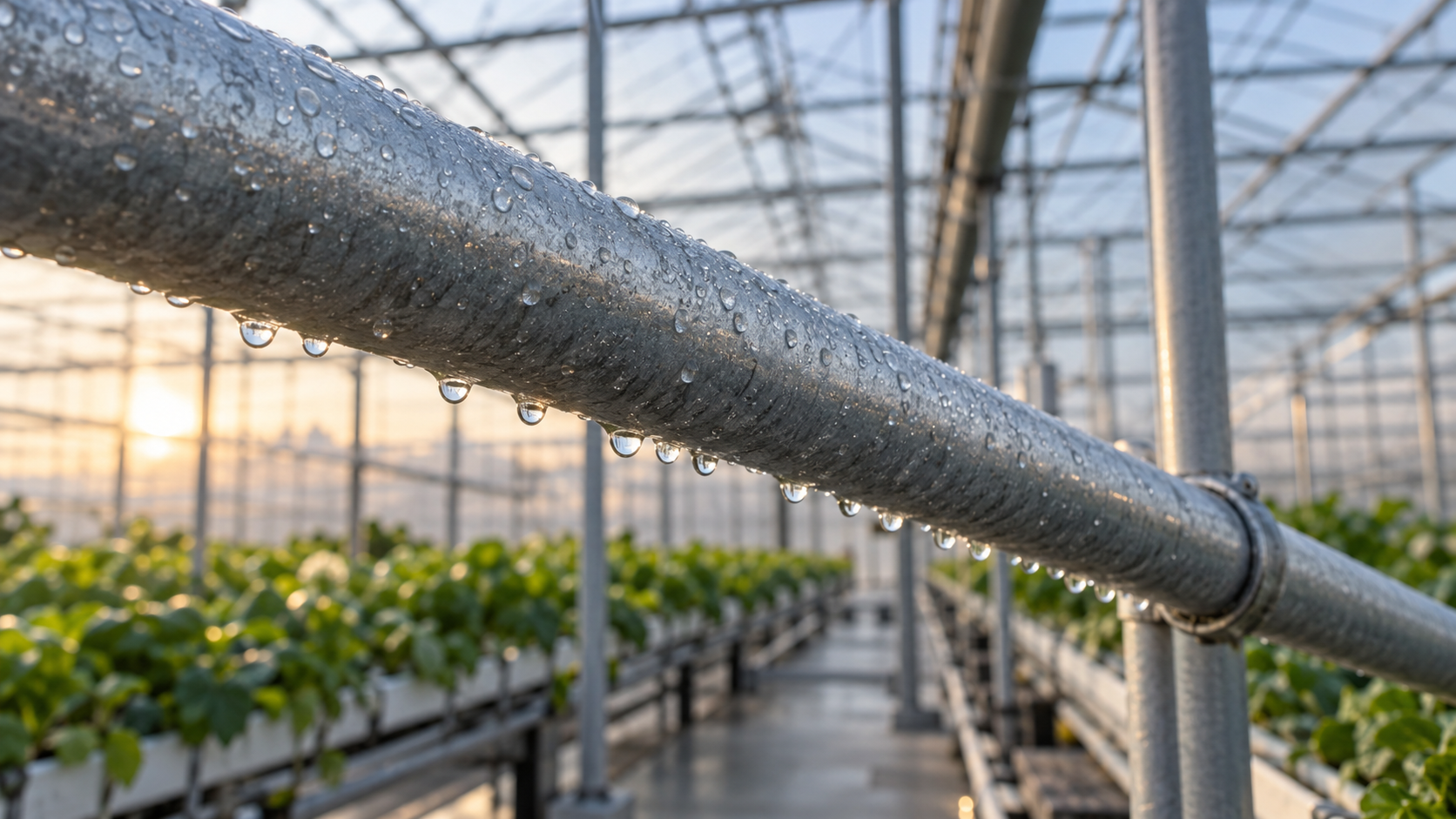
Record what the line carries and when it operates. A hot-water heating pipe, an irrigation supply, a chilled-water line and a deliberately cooled condensing pipe do different jobs. Cornell's greenhouse heating overview describes hot-water and steam pipes as heat-distribution components. Their presence does not establish that a wet pipe is a humidity-control device. Likewise, a line that is warm while heating runs may be colder during an idle period; use the condition when droplets first appear.
| Event-time observation | Possible route | Next check |
|---|---|---|
| Fine droplets over an exposed, cool length of pipe | Vapor condensing on the outside | Compare pipe surface temperature with nearby-air dew point at the same time; check the entire exposed run and supports |
| Water starts at a joint, valve, emitter or damaged segment when the line is pressurized | Liquid leak | Isolate and inspect the line under the responsible operator's procedure; record operating pressure and timing |
| Pipe is wet only beneath a roof rib, gutter or overhead line | Water delivered from above | Trace the upper wet surface and drip path before assigning the pipe as the source |
| Insulation jacket is wet at a seam, termination, hanger or damaged patch | Vapor entry, a liquid leak, or outside water ingress | Have the pipe/insulation owner inspect both the liquid path and vapor-control continuity |
| A cooled, finned pipe has a deliberate collection channel | Designed condensation route | Verify that condensate enters the intended drain and that operation is measured; do not treat nearby incidental drips as designed removal |
If an exposed below-ambient line sweats, ask the mechanical/pipe owner to assess an insulation system for that line's temperature, humidity, service and maintenance conditions. The ASHRAE mechanical-insulation handbook explains why below-ambient piping needs effective vapor control and continuous seals: vapor can enter through gaps and condense at the cold pipe beneath the insulation. The review needs to cover fittings, valves, supports, seams and later maintenance closures, not only the straight pipe. A cover that hides droplets while admitting vapor can move the water problem inside the insulation. Material choice, thickness, vapor-retarder specification and installation belong to the qualified pipe/insulation designer; this article does not size them.
If the pipe is intentionally cooled to condense moisture, inspect its collection and drainage route as part of that system. A Wageningen University & Research greenhouse study tested finned pipes deliberately cooled below air dew point with condensate monitored. That experimental design is different from incidental beads on an irrigation line. Its measured result is specific to the studied system and cannot be applied as Yakeclimate equipment capacity or a design value for another greenhouse. Only a defined, collected and verified route can be counted in a project moisture balance.
Repeat the observation when the same pipe service and climate conditions recur. Compare the first wet time, local air dew point, outer surface temperature, visible water path, line operation and drainage. If an insulation repair was made, inspect the accessible seams and terminations for renewed wetting. If a leak was repaired, confirm the fitting remains dry when the line is pressurized. If a designed condensing line is involved, verify collected condensate at its drain rather than assuming every drop was removed from the house.
Duct exterior vs internal water
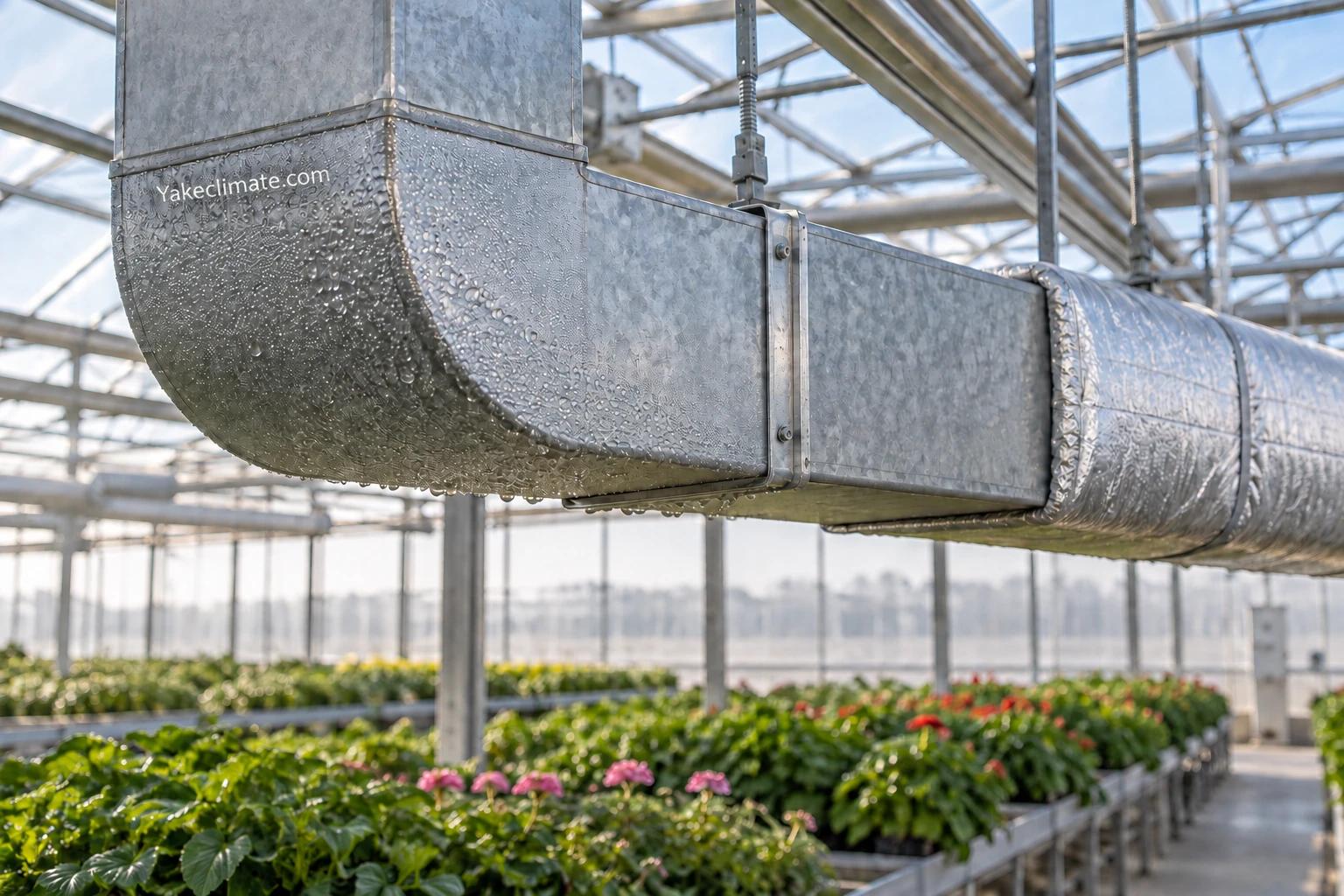
Mark the duct's inlet, equipment connection, elbows, joints, insulation changes and outlets on a simple sketch. Record whether the affected section is supply, return or exhaust, and whether it carries cooled, heated or unconditioned air. Note the unit mode, fans, ventilation, irrigation, misting, wash-down, thermal-screen position and weather when wetness first appears. Take time-stamped photographs from a safe position. Water can travel along the underside of a duct before it drips, so the landing point may be downstream of the source.
| First observation | Possible route | Next check |
|---|---|---|
| Fine beads begin on an exposed outer face or elbow | Greenhouse air condensing on a cold exterior surface; spray remains possible | Pair nearby-air temperature and RH with the same spot's surface temperature and event time; look for overhead water |
| Wetness begins at an insulation seam, hanger or termination | Exterior wetting, liquid ingress or vapor reaching a colder layer beneath a damaged jacket | Record the first wet location; ask the duct/insulation owner to inspect jacket and vapor-control continuity without assuming the layer beneath is dry |
| Water appears at an outlet or low point inside the air path | Internal condensation, water carried from an upstream coil, rain through an inlet, or another upstream source | Trace toward the equipment and intake with an authorized technician; inspect the intended condensate collection route |
| A joint blows cool air onto a neighboring surface, or draws in moist air | Air leakage changing a local surface or duct condition | Record fan state and pressure-side location; have the duct owner check the joint and measured airflow |
| Wetting follows rain, overhead irrigation or a leaking line | Liquid delivered onto the duct rather than formed there | Trace the highest first-wet point and the roof, irrigation or line path |
Water at an outlet may have formed inside the duct, been carried from a wet upstream component, or entered through an intake or opening. US EPA duct guidance lists precipitation through inlet louvers, excessive moisture in incoming air, poorly drained cooling-coil droplets and unsealed ducts among possible duct moisture routes. This is building HVAC guidance; the installed greenhouse duct, equipment and drainage still need site-specific inspection.
Air leakage deserves its own check. EPA notes that a leaking duct can move air into or out of adjacent spaces and contribute to condensation on nearby surfaces. A supply joint that leaks cool air can chill a neighboring surface; a return-side leak may draw humid air into a cooler path. The actual direction depends on the system and operating pressure. Let the duct owner verify leakage, airflow and the intended air path before changing a joint.
For confirmed exterior condensation, the duct designer or insulation contractor should review the affected section's thermal protection, exposed fittings, hangers, seams and vapor-control continuity. US Department of Energy duct guidance explains the role of sealing, insulation and a vapor barrier in limiting duct condensation in buildings. Its residential examples do not specify a greenhouse material, thickness or installation method. Covering a wet seam without finding the water path can conceal ongoing moisture.
Equipment cabinet and drain
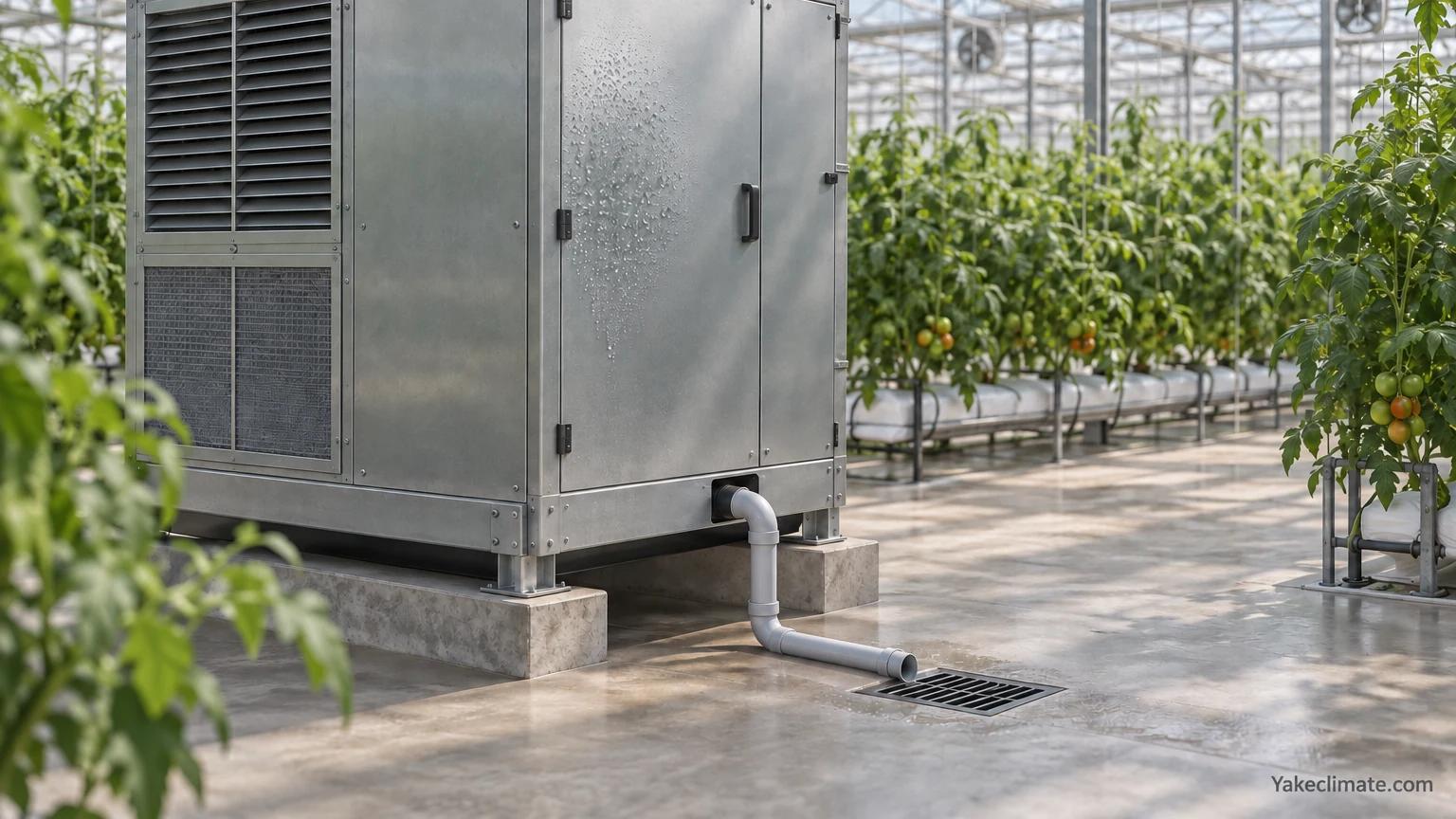
Record the exact panel, seam, door, support, pipe connection or drain outlet that first becomes wet. Photograph it before wiping it down, if safe. Note whether the unit is cooling or dehumidifying, heating, in standby or changing modes; also log irrigation, misting, roof wash, rain, screen position and nearby fans. A later puddle can combine more than one route. Inspect from a safe position and follow the site's electrical and access procedures. Do not open an energized cabinet, reach a moving fan or loosen a pressurized line to investigate a wet mark.
| First observation | Plausible water paths | Evidence to collect before deciding |
|---|---|---|
| Beads spread across a cold outer panel or service door | Direct condensation on the exterior; liquid arriving as fine spray remains possible | First wet time, close-by air temperature and RH, panel temperature, unit mode, overhead and spray check |
| Wet streak begins at a door seam, latch or penetration | Cold local detail, failed seal, internal water escape or water running from above | First visible point on each side where safely accessible, door position, nearby air state, service record |
| Puddle starts at the cabinet base, drain connection or condensate outlet | Designed condensate missing its collection route, pan or drain problem, or another line leak | Follow the visible liquid path, drain discharge, unit mode and service inspection; do not infer the internal cause from a floor puddle |
| Cabinet wets only after irrigation, wash-down or rain | Applied water, spray drift, roof drip or liquid entry | Event timing, roof and irrigation path, earliest wet point above or beside the cabinet |
| Wetness is concentrated on a nearby exposed pipe or duct | Pipe exterior condensation, pipe leak or duct surface problem | Identify that component first; keep the pipe and duct investigations separate from cabinet diagnosis |
Some air-treatment equipment deliberately cools air below its dew point; condensate should then be collected and discharged through its designed route. That internal process is different from beads forming on the outside of a cabinet, door or connection. The EPA moisture-control guidance calls for preventing both drain-pan overflow and exterior condensation on cold air-handler surfaces. It also emphasizes accessible drainage inspection. Neither an active drain nor a wet outer panel alone proves that the unit is performing its required greenhouse moisture duty.
If a puddle appears at the base, an authorized equipment technician should trace the installed pan, outlet, trap or pump route as applicable to that unit. If the first water is on a chilled service line, investigate the line and its joints separately using the unit supplier's service procedure. If water falls from a roof or gutter, trace that overhead path first. Do not seal a cabinet seam, cover a drain, add insulation, change wiring or adjust a refrigerant circuit on the basis of this article.
Door frame and threshold
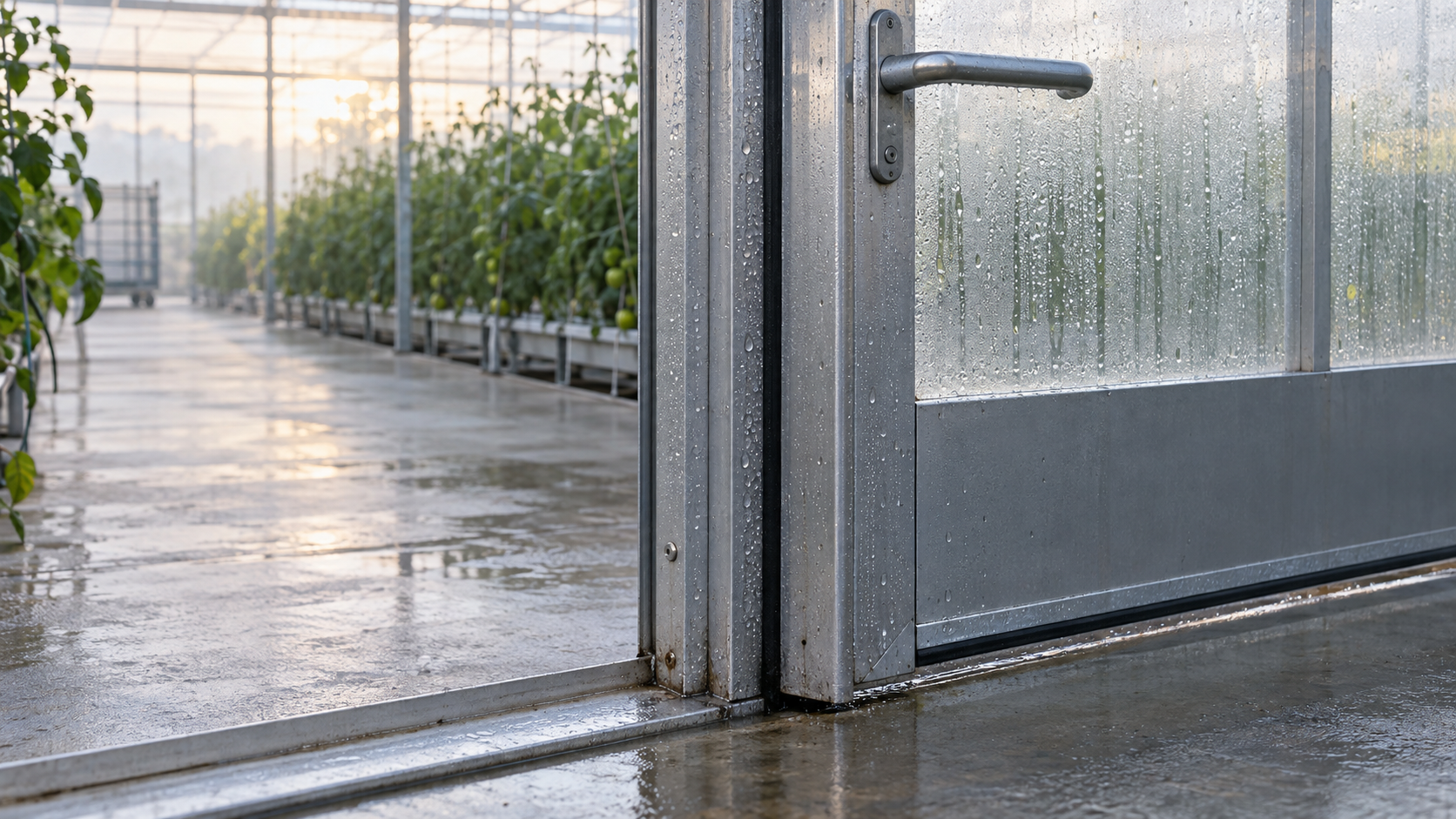
| First observed water | Plausible routes to test | Next useful check |
|---|---|---|
| Beads on the room-facing metal frame, handle or door leaf | Surface below the dew point of nearby greenhouse air; a locally cold component | Measure near-door air temperature and RH, calculate dew point, and compare with the actual wet surface temperature during the event. |
| Water starts at a jamb, header or frame-to-wall joint | Rain or wash water entering a joint; water running down from above; a cold joint can also condense | Trace the earliest water mark and compare wetness during rain, irrigation or washing with a dry-weather cold event. |
| Water appears at the door edge, gasket or bottom sweep | Poor fit, worn seal, repeated opening, or water carried through the opening | Inspect closure, alignment, gasket contact and the operating record; note which side wets first. |
| Water collects in a sliding-door track or at the threshold | Condensate runoff, blocked drainage or liquid entry | Identify the upstream wet surface and check the intended drainage route before changing any climate control. |
Inspect the closed door for incomplete latch engagement, uneven gasket contact, damaged weatherstripping, an unsealed frame joint and an obstructed threshold drainage path. Trace water from the highest wet point downward. A wet inner frame on a dry night supports a different hypothesis from water emerging only at an exterior joint during wind-driven rain. More than one path can coexist: water may condense on a cold header and then run into a track with an unrelated drainage fault.
Do not seal a track, weep opening or planned ventilation path merely because it carries water. Ask the door or structure owner what that component is designed to drain and how the door should operate. The DOE door guide identifies gaskets, sweeps, thresholds and frame joints as distinct inspection points; its home-construction details should not be copied into a greenhouse without checking the installed door, materials, weather exposure and required ventilation. If the water begins on an adjacent roof or glazing assembly, use the roof water-path guide or glazing layer guide for those origins.
For the next comparable event, retain: outside weather; irrigation and wash timing; door opening and closing times; heating, fans, vents and screen state; near-door air temperature and RH; surface temperature at the first wet point; photographs; and the location and amount of collected water. Mark whether each observation was made before or after the door opened. This record lets the team compare a correction against a similar cold period or rain event instead of comparing unlike days.
Cold frame junctions
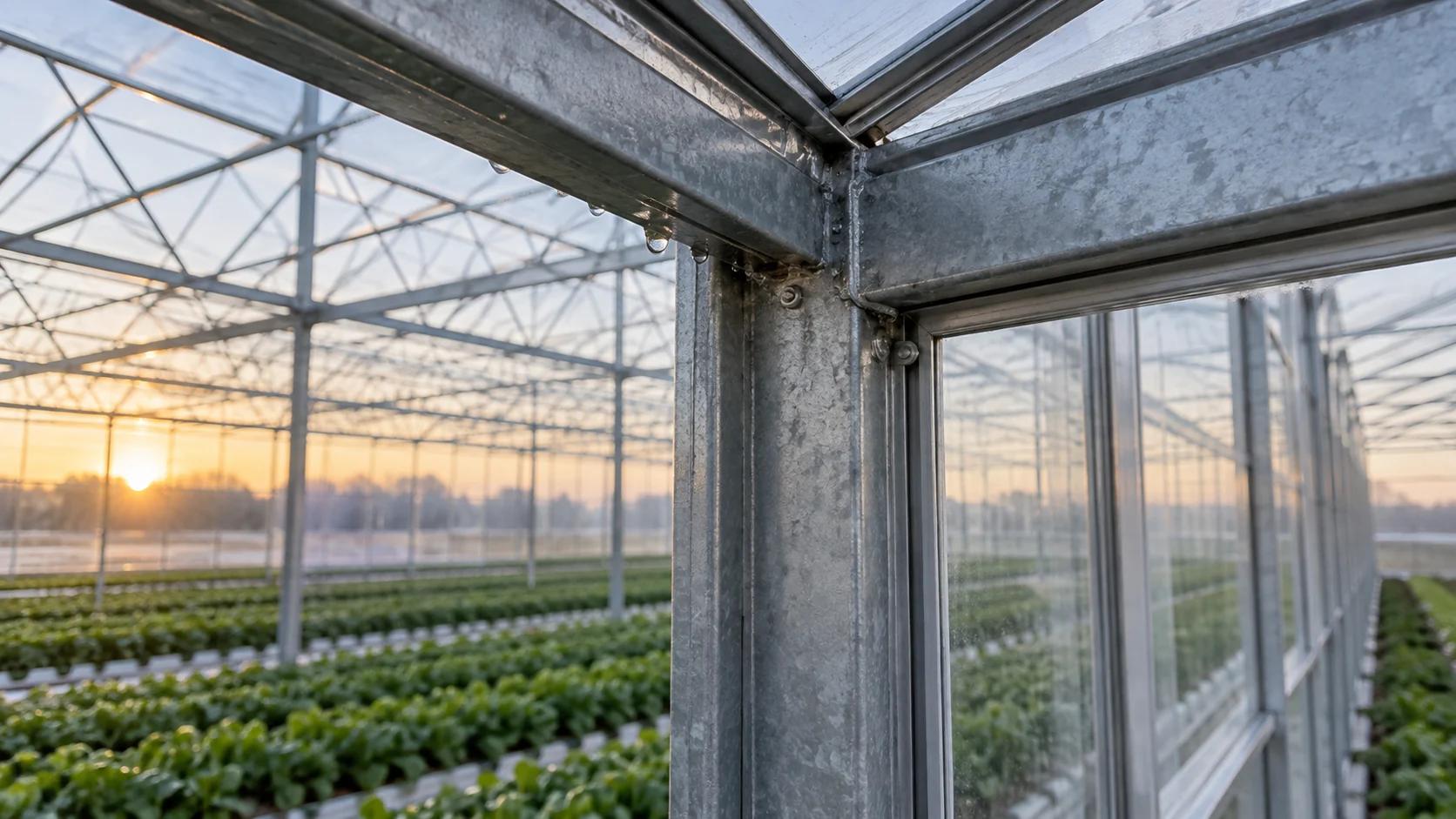
Sketch the physical path: which metal, gasket, pane edge, bracket or fastener connects the inside to the outside? Note whether a thermal break, spacer or insulating layer is present in the installed detail, without assuming that a visible strip is continuous or effective. Examine several comparable connections. A repeated pattern at like joints strengthens a junction hypothesis; one isolated wet fitting may point to a local leak or damage.
If direct condensation is confirmed at a structural connection, ask the greenhouse structure supplier or site engineer to review the full detail: heat-flow path, connection continuity, weather seal, load path, corrosion protection and intended condensate drainage. The U.S. Department of Energy's thermal-bridging guide shows why through-metal attachments can bypass insulation and why correction depends on the whole assembly. It describes multifamily walls, not a greenhouse retrofit instruction. Do not add a pad, wrap a member, drill a drain, block a weep opening or change a structural fastener based on this article.
Persistent wet surfaces
UConn Extension describes algae as organisms that need water, light, and mineral nutrients. In commercial greenhouses, irrigation, misting, runoff, puddles, and condensation are different possible water paths. Plant debris can supply nutrients. On growing media, algae can form a crust that interferes with water penetration; growth on glazing or walkways presents different concerns. (UConn Extension)
The Royal Horticultural Society describes algae on greenhouse glazing and floors as a green film or powdery deposit, often in damp, shady areas. It separately describes liverworts as flat plates and mosses as cushion-like growths. These visual distinctions help organize an inspection, but appearance alone is not a species diagnosis. RHS also notes that growth on glazing can reduce light and that films on floors can become slippery. (RHS)
Oklahoma State Extension discusses algae in shallow, stagnant, nutrient-rich water and connects that setting with irrigation or pump clogging and shore flies or fungus gnats. This is a water-system pathway, not evidence that a green film on glazing came from condensation. A surface film and a reservoir or irrigation problem may coexist while having different sources and implications. (Oklahoma State University Extension)
For a useful handoff, record the surface, location, shade, visible film form, nearby debris or nutrients, and whether re-wetting follows irrigation, misting, runoff, pooling, or visible condensation. Compare those observations with the local air reading, without turning the reading into a cause. For broader airflow context, see practical techniques for optimizing greenhouse ventilation. Share the record with the facility or crop team.
The University of Minnesota's 2023 Deep Winter Greenhouse guide discusses mold in a northern passive-solar setting. It connects growth with moisture, suitable temperature and organic matter, including locations where condensation accumulates. Preventing recurrence means addressing those conditions rather than only the visible growth. The observation belongs to that greenhouse context, not a universal RH limit. (UMN guide)
The USDA Wood Handbook describes surface mold and deeper fungal staining. Their usual strength effects can be slight, but greater absorbency and inconspicuous early decay may accompany discolored wood. Surface appearance therefore cannot certify the condition of a timber member. These are wood findings, not a way to assess metal or glazing. (USDA Chapter 14)
For the moisture question, identify the recurring location and when wetness or growth reappears. For the material question, identify the affected component and material, and retain the relevant photographs and observations for the responsible facility specialist.
Verify that the problem changed, not just the alarm
Choose the affected surface and a comparable operating period before changing equipment or control settings. Record the first wet time, wet area, duration, canopy temperature and RH, local dew point, surface temperature, irrigation, screens, vents, heat, fans, weather, and any collected or drained water. Compare the same locations after the intervention. A lower central RH reading is useful only alongside the surface and crop-zone response.
If a grower is tracking disease, keep visible wetness, leaf-wetness duration and disease observations as separate records. Less visible condensation does not by itself establish a yield or disease outcome. The crop owner defines the acceptable wetness and climate limits; the equipment review uses those limits rather than inventing a universal RH threshold.
| Component/event | Additional log fields | Verification |
|---|---|---|
| Pipes | Service, pressure/pressurization time, first wet joint, insulation seams | Repeat the service state; confirm repaired joints stay dry and designed condensate reaches its drain. |
| Ducts and equipment | Supply/return/exhaust, fan and unit mode, first wet panel, pan/outlet discharge | Check the same mode and air path; distinguish collected water from escaped water. |
| Doors and screens | Before/after door opening; before closure, closed, before retraction, moving | Compare comparable weather and operating periods without mixing timestamps. |
| Leaves and structures | First wet, last observed wet, observation gaps, leaf level or junction location | Track wetting and drying separately; keep crop disease and material condition as separate records. |
When an equipment review is useful
If recurring condensation remains after the liquid path, surface temperature and available air exchange have been checked, define the remaining moisture-removal duty for the relevant hours. Share crop and growth stage, house and screen layout, water-source and dew-point trends, local surface measurements, available ventilation and heat, existing equipment states, electrical supply, condensate drainage, and the control interfaces. Mark missing data explicitly.
Yakeclimate designs and manufactures industrial dehumidification equipment for complex climate applications. An application-specific equipment review can examine the stated inlet conditions, required water removal, air delivery, heat effect, drainage and interfaces. The grower and greenhouse designer retain the crop target, enclosure design and overall climate sequence. No dehumidifier capacity or disease result follows from a photograph or RH alarm alone. The agricultural application overview explains the project-input route.
If a measured moisture-removal duty remains, compare greenhouse dehumidifiers at the actual inlet temperature and RH, available operating hours, air distribution, drainage and control interfaces. Ventilation depends on a suitable outdoor moisture sink and its heat and CO₂ effects; mechanical removal needs a defined water-removal and energy duty.
Greenhouse dehumidifiers: operating conditions and equipment options
We co-develop application-specific dehumidification equipment around the operating conditions, interfaces, and integration requirements of the wider project or system.
Share project requirements for an application-specific equipment review
FAQ
Frequently asked questions
Why are greenhouse leaves wet when the room RH is below 100%?
A leaf can be colder than the measured room air. Condensation is possible when that leaf is at or below the dew point of the air immediately around it. Check for cover drip and irrigation as well; a wet leaf is not proof of direct leaf condensation.
Does condensation on the roof remove moisture from the greenhouse?
It transfers vapor to liquid water on that surface. If the liquid drains out through a designed path, water leaves the air and may leave the house. If it drips onto crops or evaporates again, it has not solved the crop-wetness problem. Do not credit uncontrolled roof drips as dependable dehumidification capacity.
Can fans stop greenhouse condensation?
Circulation can reduce stagnant pockets and help bring warmer air to cool surfaces, but the result depends on the actual surface and crop-zone conditions. Fans that only recirculate air do not export vapor. Verify wetness and temperature at the affected surface after changing airflow.
Will anti-drip film solve a humidity problem?
It can change the path of condensate on compatible greenhouse covering so fewer large drops fall onto crops. It does not stop moisture generation or guarantee that leaves, screens or frames stay above dew point. Confirm the covering, runoff and crop response at the site.
Does water at a duct outlet prove that the outside of the duct is condensing?
No. Water can form inside, travel from an upstream coil or enter through an intake. Trace the upstream path and compare it with any exterior wet point during the same operating event.
Why can an equipment cabinet be wet while its condensate drain is working?
The internal coil and external panel have different water paths. A working drain does not exclude cold-panel condensation, spray or overhead drip, and it does not by itself verify the required moisture-removal duty.
Technical sources
- UMass Extension, Reducing Humidity in the Greenhouse — greenhouse wet-surface paths, canopy moisture, covering drip and ventilation-plus-heat context.
- UC Agriculture and Natural Resources, Condensation on Leaf and Flower Surfaces — measured night wetness and local cooling of crop and structural surfaces.
- AHDB, Avoiding Condensation in the Glasshouse: Using Plant Temperature — plant-temperature comparison with dew point and measurement caution.
- Virginia Tech Extension, Controlled Environment Agriculture Coverings and Glazing Materials — film condensation, beading, drip and additive limits.
- Washington State University Extension, Greenhouse Construction and Management — horizontal airflow and its role in reducing foliage condensation.


