
Strawberry greenhouse dehumidification should be designed around leaf wetness, flower and fruit-zone airflow, and night condensation risk. A room RH target alone is not enough because disease pressure often starts inside the canopy, under gutters, around flower clusters, or near cold glazing.
Why Strawberry Greenhouses Need a Different Humidity Review
Strawberry production often puts flowers, ripening fruit and foliage in a dense band close to trays, gutters or benches. That arrangement is efficient for crop handling, but it can create a humid microclimate that the room sensor does not fully represent.
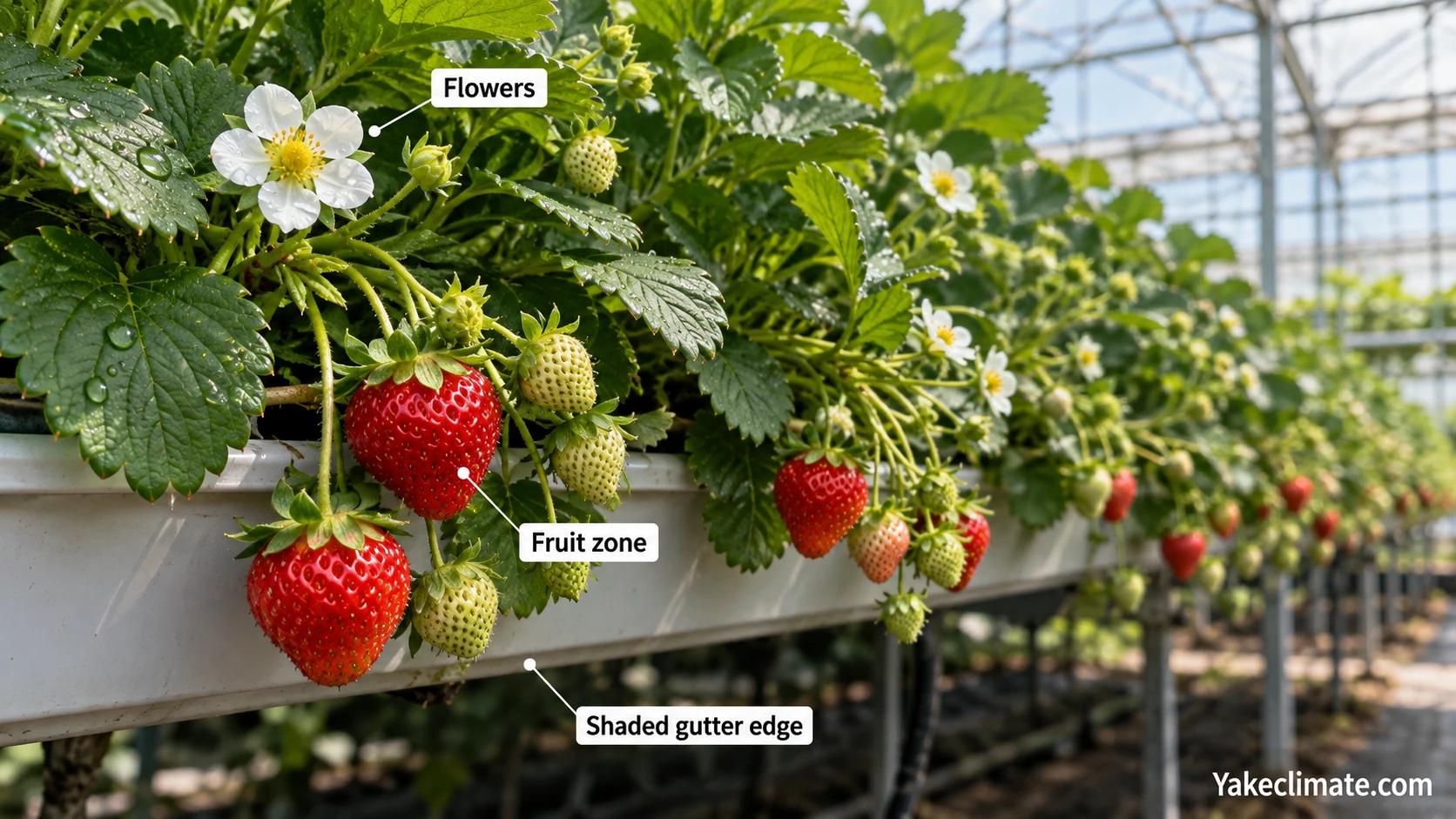
UC IPM's strawberry Botrytis guidance notes that direct fruit infection can occur when berries are exposed to free water and that leaf wetness duration matters for epidemic risk (UC IPM). Penn State Extension also describes gray mold as favored by moisture, high humidity and relatively cool conditions (Penn State Extension).
For dehumidifier selection, this means the useful question is not "what RH number should I set?" The better question is: where does wetness remain after irrigation, night cooling, curtain closure or low air movement?
Where Moisture Usually Stays in Strawberry Houses
The first design step is to identify the risk zones. Different strawberry layouts trap moisture in different places.
| Growing arrangement | Common humidity pocket | What to check before selecting equipment |
|---|---|---|
| Tabletop gutters | Under-gutter air and fruit clusters near the tray line. | Air path below the crop, sensor height and row-end stagnation. |
| Bench propagation | Tray surface and lower leaf layer. | Misting schedule, drainage and gentle airflow. |
| Soil or substrate rows | Ground-level canopy and cold floor surfaces. | Floor temperature, row spacing and circulation fans. |
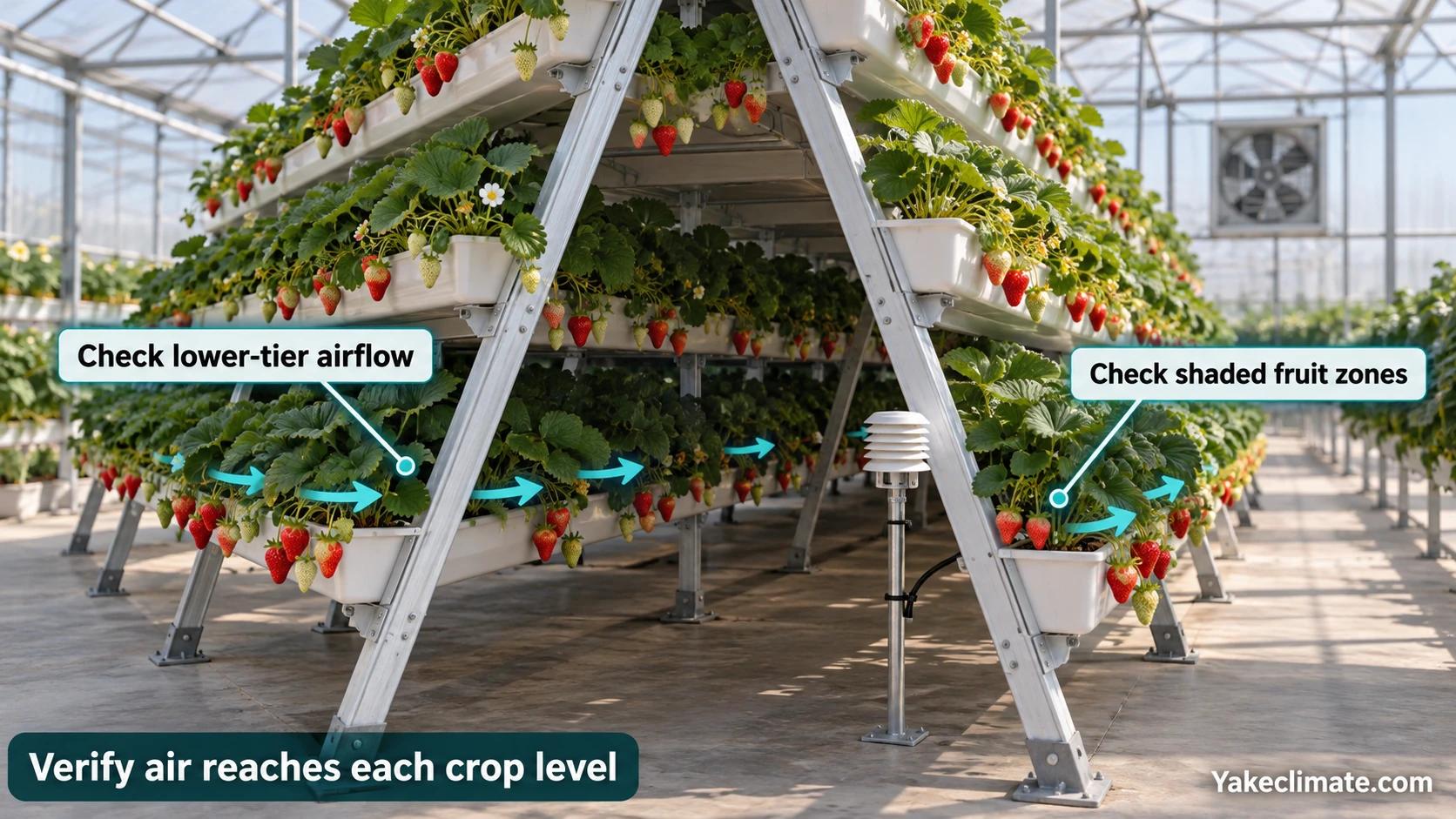
| Multi-tier or A-frame systems | Lower tiers and shaded interior faces. | Whether dry air reaches every tier without over-drying exposed leaves. |
If supply air short-circuits above the crop, the dehumidifier can remove water from the room while fruit and flowers remain wet. The equipment layout has to be reviewed together with HAF fans, ducts, air socks, screens and sensor locations.
Botrytis Control Is Not Only an Equipment Problem
Dehumidification supports disease-risk management when ventilation cannot remove moisture without losing heat, CO2 or crop stability. It does not replace sanitation, plant spacing, irrigation timing, pruning hygiene or agronomic disease control.
Use a combined checklist:
- Keep irrigation and misting from leaving flowers or fruit wet late in the day.
- Remove dead plant material and infected fruit according to crop-management guidance.
- Confirm that air movement reaches the fruit zone, not just the aisle.
- Lower room dew point before a known night temperature drop.
- Use canopy checks or crop-zone sensors when one room sensor hides local wetness.
For a broader crop comparison, see tomato greenhouse dehumidification. The crop is different, but the design logic is similar: moisture source, night transition and airflow distribution must be reviewed together.
Sizing Inputs for a Strawberry Project
Before asking for a model number, collect the project inputs that explain both moisture load and distribution.
| Input | Why it matters |
|---|---|
| Greenhouse area, height and compartment layout | Defines air volume, zones and screen boundaries. |
| Crop layout | Tabletop gutters, benches, rows or tiers change the air path. |
| Crop stage and density | Mature canopy, flowering and harvest periods carry different risk. |
| Water use or irrigation balance | Helps estimate the moisture that may return to the air. |
| Day and night temperature targets | Dew point risk changes when air cools at night. |
| Ventilation and CO2 strategy | Venting may conflict with heat retention or CO2 enrichment. |
| Existing fans, ducts and sensors | Determines whether dry air can reach the crop zone. |
| Drainage and service access | Affects installation, maintenance and long-term reliability. |
For the agriculture application context, see agriculture applications. Then use the commercial dehumidifier sizing calculator inputs guide to organize the load assumptions before selecting industrial dehumidifiers.
Compare greenhouse dehumidifier installation options after confirming crop-row airflow, drainage and maintenance access.
Refrigerant or Desiccant for Strawberry Greenhouses?
For a warm strawberry greenhouse with a moderate humidity target, compare feasible ventilation with refrigerant dehumidification at the actual conditions. If operation is cold or a lower dew point is required, evaluate candidate technologies against that duty and their documented operating limits.
| Option | Where it fits | What can go wrong |
|---|---|---|
| Ventilation | Outdoor air is drier in absolute terms and heat or CO2 loss is acceptable. | Night venting can waste heat and destabilize the crop climate. |
| Refrigerant dehumidifier | Warm greenhouse with moderate dew point target and condensate drainage. | Capacity falls in cooler or drier inlet conditions. |
| Desiccant dehumidifier | Low-temperature or low-dew-point operation. | Requires reactivation heat and a managed exhaust path. |
| Hybrid control | Seasonal greenhouse with changing outdoor conditions. | Controls must decide when each mode should run. |
For the technology decision, compare refrigerant and desiccant dehumidifiers after the crop and airflow conditions are defined.
FAQ
Frequently Asked Questions
Why can strawberries have disease risk when the room RH looks acceptable?
The room sensor may not represent the fruit and flower zone. Wet leaves, cold surfaces, dense foliage and weak air movement can create local condensation even when the aisle sensor looks acceptable.
Should strawberry dehumidification target RH or VPD?
Use both where possible. RH is useful for alarms and equipment control. VPD helps connect temperature and moisture to plant water movement. Neither replaces direct observation of leaf and fruit wetness.
Can ventilation replace dehumidification in a strawberry greenhouse?
Yes, when outdoor air is drier in absolute terms and the heat or CO2 penalty is acceptable. When ventilation conflicts with the crop strategy, mechanical dehumidification becomes part of the climate-control plan.


