
Humidity control for a medical-device material or process starts with the failure mechanism. Moisture uptake during storage or processing, equilibrium conditioning, condensation, corrosion, adhesive behavior and packaging performance do not all use the same control variable. Define the material, process, temperature range and acceptance point before selecting a dehumidification method.
Use the condensation-risk guide for surface-risk reasoning and the commercial dehumidifier maintenance guide for service and records.
Key Takeaways
- Ambient RH at a stated temperature can condition a material; water activity, if specified, is a sample acceptance property measured after equilibrium, not a return-air reading. Dew point is not a universal substitute.
- Dew point is useful when condensation or an absolute moisture limit is the actual duty, with temperature and pressure basis stated.
- A desiccant system is selected only when the defined duty needs its process and reactivation arrangement; media, heat source and exhaust are part of the specification.
- For air acceptance, measure at the point of use or justify a representative return-duct point across operating modes. A material water-activity criterion needs a separate sample test.
Start with the Material and Process Mechanism
Medical-device work can involve hygroscopic polymers, adhesive or cure chemistry, sterile-barrier sealing, electronic assemblies, powders, corrosion-sensitive parts and condensation-sensitive surfaces. Each creates a different question: does ambient RH and temperature condition the material, does a validated specification require sample water activity or moisture content, or must a surface stay above the air dew point? Do not collapse these questions into one generic “dry room” setpoint.
| Requirement being protected | Candidate control basis | Input that must be confirmed |
|---|---|---|
| Ambient conditioning | Air RH with temperature and exposure or equilibration time | Material data, room sensor location and conditioning method |
| Material or product acceptance | Sample water activity or moisture content only if specified | Sample location, preparation, temperature, test method and acceptance limit |
| Moisture-sensitive process or adhesive | Validated air RH and temperature or a separate sample criterion | Process window, substrate and validation method |
| Condensation prevention | Dew point or surface-temperature margin | Surface temperature range, pressure basis and measurement point |
| Corrosion or storage stability | Material-specific moisture and temperature limit | Storage duration, packaging and corrosion evidence |
| Absolute moisture or low-dew-point air | Dew/frost point with airflow and pressure basis | Process inlet state, outlet target and acceptance location |
When RH, Water Activity or Temperature Leads
Relative humidity is temperature-dependent, and material moisture response is material-specific. Ambient RH and temperature may define a conditioning environment. Water activity (aw) is the equilibrium vapor pressure above a material sample divided by the saturation vapor pressure of pure water at the same temperature. Under a defined equilibrium measurement, the sample headspace equilibrium RH in percent is approximately 100 × aw. This is a sample result, not the room or return-air RH reading. Use sample aw or moisture content only when the validated material or process specification requires it; define sample preparation, temperature, method, equilibration time and limit. The general aw definition comes from FDA food-method guidance, not a medical-device setpoint or regulation.
When Dew Point Leads
Dew point is appropriate when the requirement concerns condensation, absolute water vapor content or a low-dew-point air supply. State whether the instrument reports dew point over liquid water or frost point over ice, whether the value is at atmospheric or process-line pressure, the actual measurement location and pressure, and the acceptance temperature range. Do not directly compare readings with different pressure or condensation-phase bases. A dew-point target still does not define a universal medical-device setpoint.
See the condensation-risk context while keeping the device process specification separate.
Select the Equipment Only After the Duty Is Defined
Refrigerant and desiccant systems have different operating boundaries. A desiccant rotor may be considered for a defined low-dew-point or low-temperature duty, but the choice follows from the process requirement. It is not proof that every medical-device room needs a desiccant system.
| Selection field | What to record | Why it matters |
|---|---|---|
| Air requirement | RH or dew/frost point with temperature, pressure basis and tolerance | Identifies the air condition the system must achieve. |
| Material/sample criterion | Water activity or moisture content only if validated, with sample method and limit | Keeps sample acceptance separate from room-air control. |
| Process air | Inlet state, airflow, pressure and operating schedule | Defines the moisture duty and fan boundary. |
| Desiccant media | Selected media and the target condition supporting the choice | Media claims must match the actual inlet and outlet duty. |
| Reactivation | Heat source, entering condition, exhaust route and controls | The second air stream changes layout, utilities and operating cost. |
| Air acceptance | Point of use or justified representative return point, calibration and response time | Makes the air result measurable without treating sample aw as a duct reading. |
Define Process, Return and Reactivation Air
A desiccant system has a process air path and a reactivation air path. Process air leaves warmer after adsorption; reactivation air leaves hot and moisture-laden. Specify the selected medium, heat source, exhaust route, pressure relationships and any downstream cooling required by the room. Do not copy a literature regeneration condition into a project specification without checking the selected media, airflow and equipment design.
- Process supply must reach the point of use at the stated air condition and flow.
- Return-duct measurement may be used only when a study or commissioning record shows it represents the point of use across the operating range.
- Reactivation exhaust must not return removed moisture to the controlled space and must respect facility zoning and pressure boundaries.
- If a pre-cooling or other coil creates condensate, include its drain and hygiene boundary separately.
Hygiene, Materials and Service Access
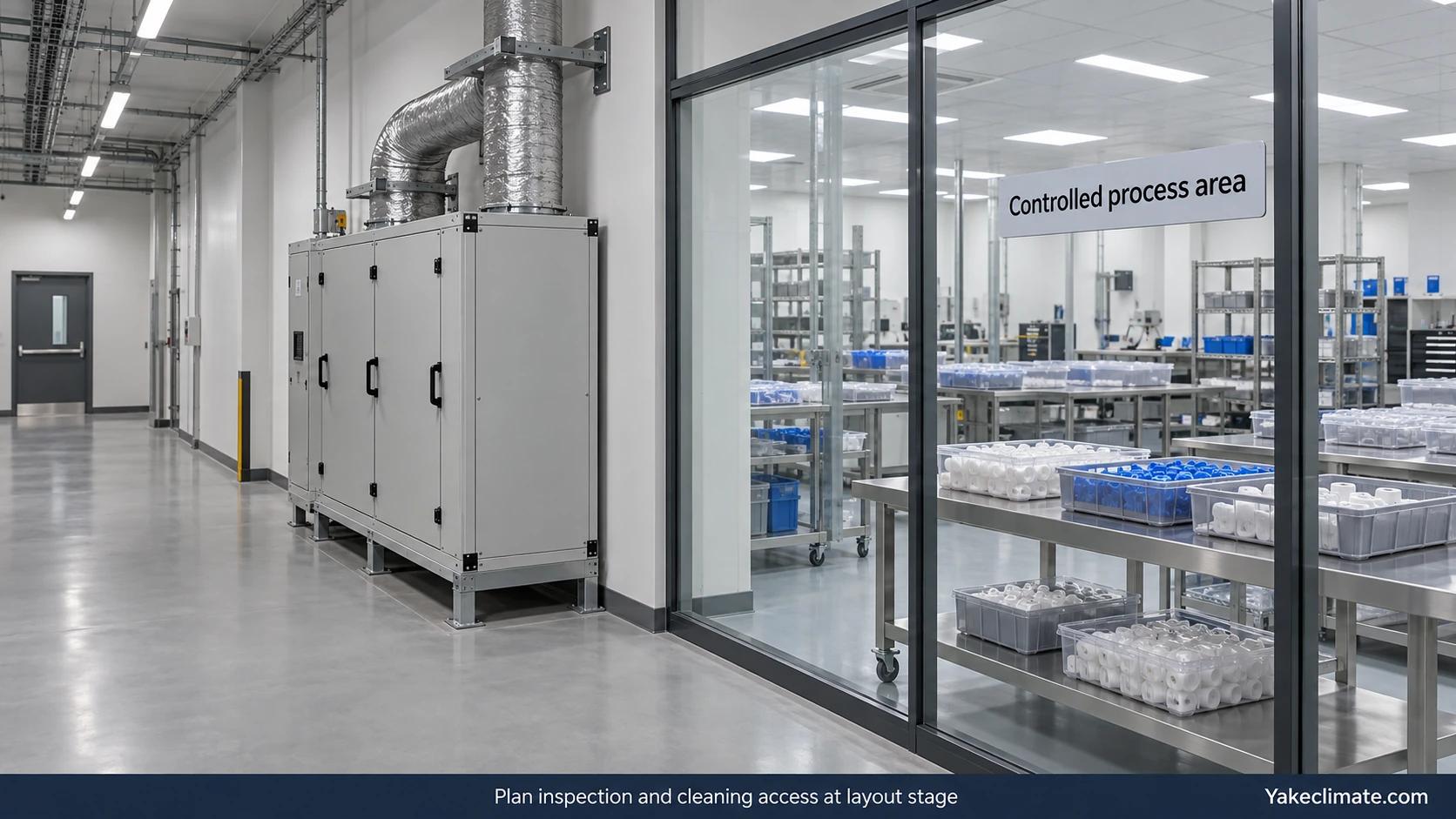
Equipment for a controlled medical-device area must be reviewed for cleanability, finishes, filtration, access, vibration, noise, penetrations and cleaning-agent compatibility. A dehumidifier does not make a room cleanroom-compliant. Particle classification, airflow pattern, filtration, pressure regime, gowning, construction and operational controls remain part of the facility contamination-control strategy.
Measurement, Calibration and Records
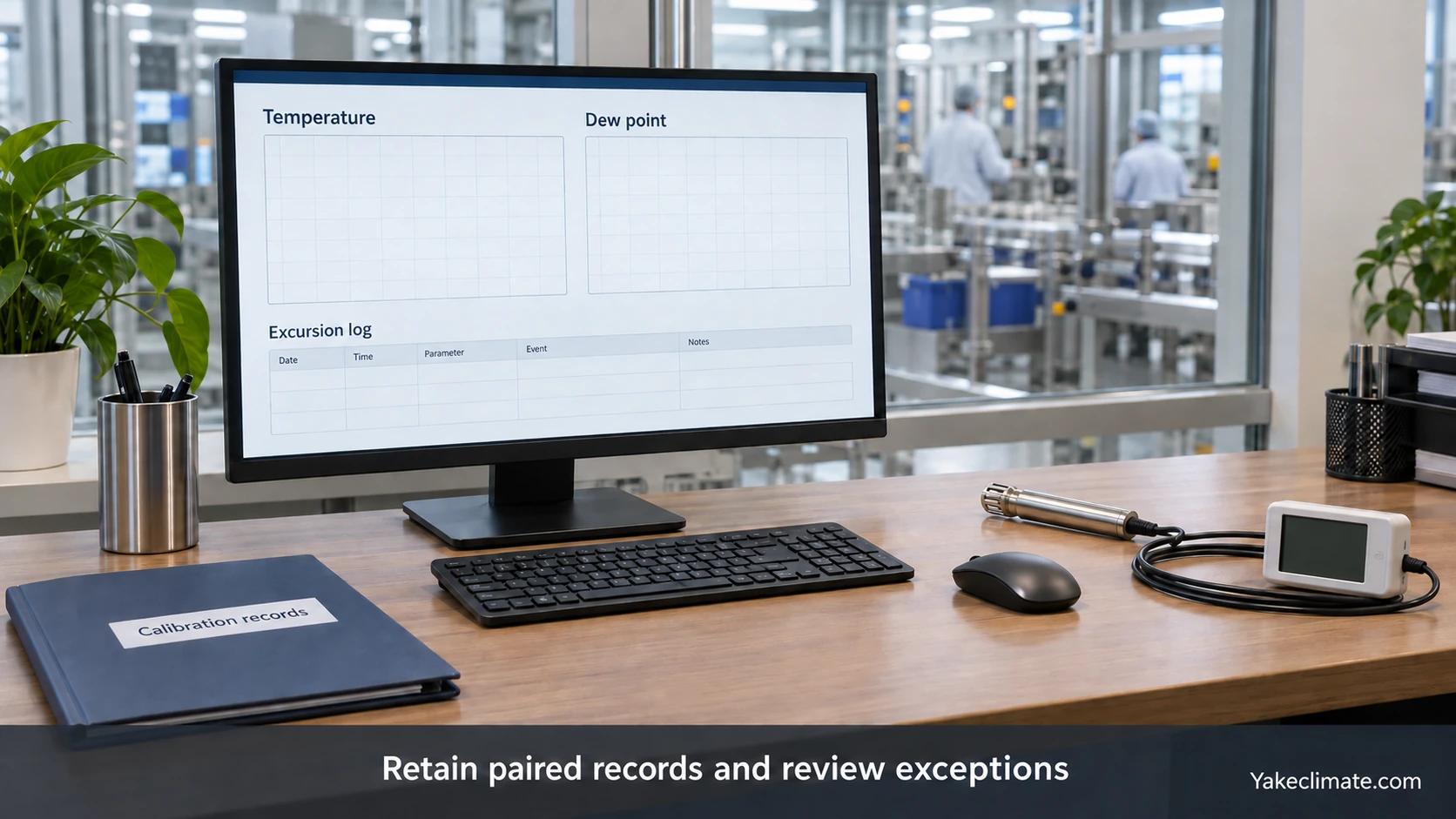
For an air requirement, measure RH or dew/frost point at the specified point of use, or document project-specific evidence that a return-duct point represents it across operating modes. Record temperature, actual pressure and instrument reporting basis; define calibration status, tolerance and response time. For material acceptance, take a defined sample and use the validated aw or moisture-content method at its specified temperature and equilibration condition. An air sensor cannot stand in for a sample result. Commissioning should record process and reactivation conditions, airflow, air moisture state and the applicable acceptance rule.
| Acceptance domain | Measurement | Minimum record |
|---|---|---|
| Air condition | RH or dew/frost point | Point of use or site-validated representative return; temperature, pressure/reporting basis, airflow and operating mode |
| Air instrument | Specified air measurand | Range, calibration status, uncertainty, response time and acceptance tolerance |
| Material sample | Water activity or moisture content only if specified | Sample location, preparation, method, temperature, equilibration and validated limit |
| Acceptance process | Air and sample results recorded separately | Stabilization time, excursions, responsible owner and applicable quality record |
Information Needed Before a Quote
- Material, process step and failure mechanism being controlled.
- Validated air RH or dew/frost-point requirement and, separately if required, the material sample aw or moisture-content criterion, each with temperature, method and tolerance.
- Room dimensions, envelope, ventilation, make-up air and pressure relationships.
- Internal heat and moisture sources, operating schedule and outdoor design conditions.
- Equipment location, duct route, access, filtration, drain and cleanability constraints.
- Selected-media basis, reactivation heat source, exhaust route, controls and monitoring interface.
- Qualification, calibration, record and supplier-documentation requirements.
Evidence and Claim Boundary
This page provides a selection framework. It does not establish a universal medical-device setpoint, prove product or process performance, make a cleanroom classification claim, or promise health, quality, savings or regulatory outcomes. Final limits belong to the material/process owner, facility engineer and applicable quality or regulatory system. Technical sources support terminology and engineering boundaries; they do not replace validation.
FAQ
Frequently Asked Questions
Should a medical device environment be specified in relative humidity or dew point?
It depends on the failure mechanism. Use ambient RH and temperature for conditioning when that is the defined air requirement. If a validated material specification calls for water activity, test a material sample at its stated temperature and equilibrium method; do not use a room or return-air sensor as its substitute. Use dew or frost point for condensation or an absolute air-moisture limit. Do not replace an existing validated RH requirement with dew point without checking the material and process basis.
Why is desiccant equipment used rather than refrigerant?
Only when the defined duty requires the desiccant process/reactivation arrangement, such as a specified low-dew-point or low-temperature air condition. It is not a universal requirement for medical-device environments.
Which desiccant medium should be specified?
Specify the material and operating condition that support the choice. Media, inlet state, outlet target, airflow and reactivation condition must be reviewed together; literature conditions do not establish a universal medium or setpoint.
What does the reactivation air stream require?
It requires a defined heat source, entering condition, exhaust route, pressure boundary and control sequence. The hot, moisture-laden exhaust must not return to the controlled space, and any downstream cooling or condensate must be included in the design.
Does a desiccant dehumidifier make a room cleanroom-compliant?
No. Moisture control is one environmental parameter. Particle classification, filtration, airflow pattern, pressure, construction, gowning, operations and validation remain separate parts of the contamination-control strategy.
Can the dehumidifier be installed outside the controlled room?
Often, if the ducted process and return paths, pressure loss, filtration, service boundary and representative measurement point are demonstrated. Location must also accommodate reactivation heat and exhaust without compromising the controlled space.
What documentation should be agreed with the supplier?
Agree the rated condition, process and reactivation data, selected-media basis, airflow and pressure data, material and finish information, controls and alarms, instrument and calibration details, commissioning test, maintenance records and the facility qualification documents required before manufacture.


