
Greenhouse humidity control depends on the quality of the data. A dehumidifier can be correctly selected and still look wrong if the sensor is exposed to direct sun, located near a heater or drifting away from reference readings.
For application context, see agriculture applications and greenhouse dehumidification. Use greenhouse humidity monitoring and sensor placement to plan where measurements should represent the crop.
Choose the Measurement Before Choosing the Sensor
Relative humidity is important, but it changes with temperature. A greenhouse control plan may also need dew point, leaf-zone temperature and VPD to interpret condensation risk, crop stress and nighttime moisture behavior.
For nighttime condensation and dew point interpretation, use the greenhouse nighttime humidity and dew point guide before turning sensor readings into equipment decisions.
Select Accuracy, Shielding and Response for the Crop Zone
A greenhouse sensor should represent the climate the crop actually experiences. Accuracy, response time, protection from condensation, cable routing, wireless reliability and maintenance access all affect whether the reading can control equipment.
The sensor should be shielded from direct solar radiation and kept away from heaters, vents, fans or unusual drafts. UAF Cooperative Extension gives this practical placement guidance for greenhouse environmental controls.
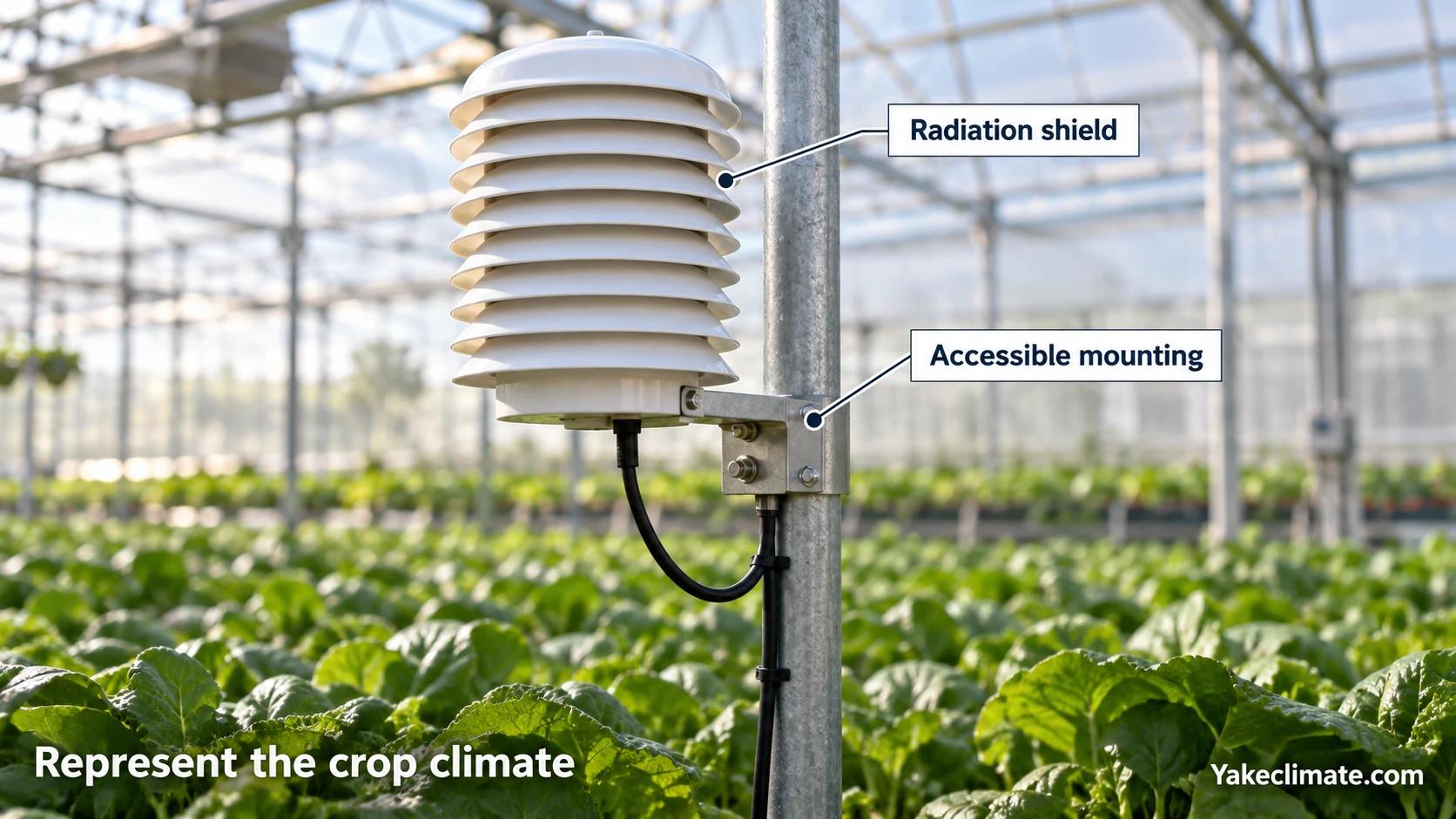
| Selection point | Project question |
| Accuracy | Is the tolerance good enough for the control decision? |
| Shielding | Is the sensor protected from direct radiation and wetting? |
| Response time | Can it follow the control interval? |
| Data output | Can the greenhouse computer or logger read it? |
| Maintenance | Can it be cleaned, checked and replaced safely? |
Read the calibration result in context
An instrument specification or calibration report is relevant input, but a report alone cannot establish the overall uncertainty of a greenhouse measurement made on site. Instrumental uncertainty is one component. Field results can also depend on the measurement method, protocol, operator and environment. Before using a report for a decision, confirm which instrument and measurement time it covers, the reported result and uncertainty statement, and the calibration conditions. Ask whether those conditions match the intended field method and environment. If applicability is unclear, ask the calibration provider or measurement owner to clarify. The measurement owner decides how the information is used; this reading step sets no tolerance or field acceptance.
| Check | Ask or record |
| Instrument and test date | Which instrument and measurement time does the report address? |
| Result and conditions | What uncertainty statement and calibration conditions are reported? |
| Intended use | Do the field method and environment match, and what remains unresolved? |
For a complete measurement model, component budget, covariance check and worked reporting example, use the greenhouse humidity measurement uncertainty guide. A calibration certificate is an input to that assessment; it does not establish the uncertainty or acceptance of every field reading.
Plan Calibration and Cross-Checks
Two greenhouse humidity readings that disagree are a signal to investigate, not proof that either sensor has drifted. First confirm that the instruments are being compared in the same relevant condition, with a suitable reference whose calibration status is maintained, and allow the instruments to reach temperature equilibrium as required by the method. Instrumental drift is a change in readings over time caused by changes in an instrument’s metrological properties; changes in measured humidity or recognized influence quantities are different explanations. Calibration records a comparison. Adjustment changes an instrument’s output, and a calibration service does not automatically include it. Keep the original comparison and service records for the instrument owner to review.
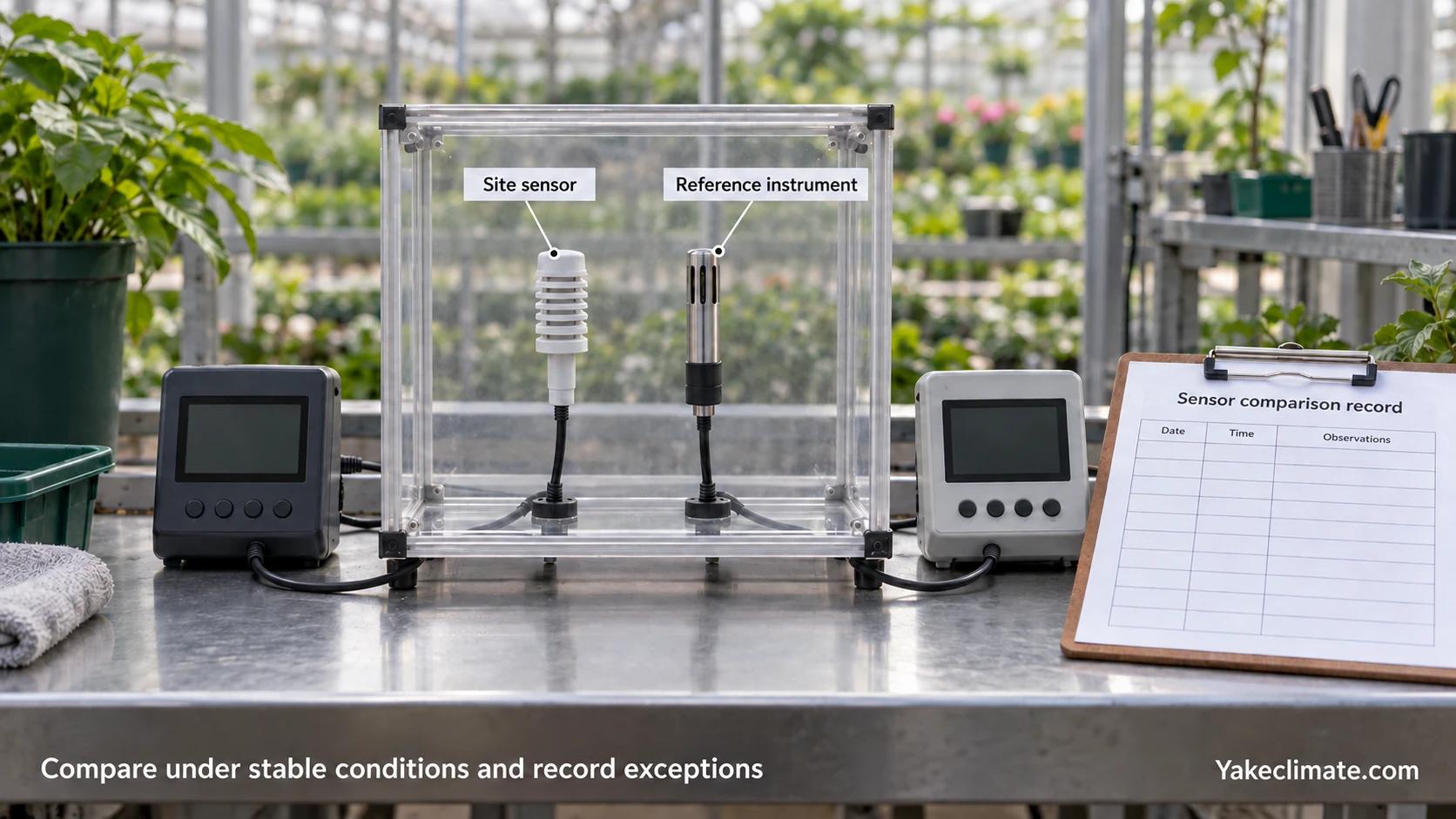
NIST humidity calibration services provide the reference context for humidity, dew/frost point and relative humidity calibration. A greenhouse project does not need to turn every sensor into a laboratory instrument, but it should define a traceable or practical comparison method.
Check the comparison before calling it drift
Before comparing readings, identify the measurand, the purpose of the check and the range that matters. Use the comparison method’s specified stabilization conditions and acceptance criteria.
Decide what the observation supports
| Observation | Next check | Limit of the conclusion |
| Two readings differ | Check the shared conditions, reference status and temperature equilibrium | The difference does not prove which instrument has drifted |
| A stable comparison still differs | Preserve the original result and ask the instrument owner to review the specification and method | Do not change an offset or declare replacement automatically |
| One comparison point agrees | Check whether the real operating range needs a more complete calibration | One point does not establish that the full range is acceptable |
Keep a service-ready record
Record the instrument and reference identifiers, comparison conditions, raw difference, method, date and responsible person. When service occurs, retain the as-found and as-left results alongside earlier differences. Temperature, humidity and chemical exposure history can be useful investigation context; they are clues for the service provider, not proof of damage in a particular case. Use the instrument’s accuracy needs and operating environment to set the inspection or calibration plan. Give the record to the designated instrument technician or manufacturer when a persistent difference needs a decision about expanded calibration, adjustment or repair.
Retain the comparison and service records with the instrument so later readings can be evaluated against the same measurement purpose and conditions.
Measurement References
JCGM / BIPM, International Vocabulary of Metrology (VIM3), 4.21 Instrumental drift.
JCGM/BIPM VIM3 4.24: instrumental measurement uncertainty.
Use Sensor Data in Commissioning and Alarms
Sensor data should close the loop between design assumptions and actual operation. During handover, compare sensor trends with screen status, irrigation, ventilation, dehumidifier runtime and nighttime temperature drop.
The greenhouse humidity control commissioning checklist should include sensor reading checks. The greenhouse project design data checklist should record which sensors support sizing and which support alarms.
Use Crop Context When Interpreting Measurements
Disease-risk interpretation depends on the crop, growth stage, pathogen and local conditions. Air humidity and surface wetness provide different observations; ask the crop specialist which measurements are relevant to the problem.
The UConn IPM Botrytis factsheet provides disease-management context. Use sensor records alongside observations of the affected crop and guidance from its responsible crop specialist.
Prepare the Sensor Specification
State the measured quantity, operating range, required uncertainty or accuracy, representative location, shielding, response requirement and controller interface. Include how the instrument will be compared, serviced and identified in the records.
Assign responsibility for measurement acceptance, maintenance and control settings. Recheck the specification when the crop layout, measurement range or control purpose changes.
FAQ
Frequently Asked Questions
Where should a greenhouse humidity sensor be installed?
Install it near the crop climate being controlled, shielded from direct sun and away from heaters, vents, fans and unusual drafts.
Is RH enough for greenhouse humidity control?
RH alone does not describe every task. Interpret RH with air temperature; condensation assessment also needs the relevant surface temperature and local dew point. Use the crop specialist’s defined VPD basis when evaluating plant water demand.
How often should greenhouse humidity sensors be calibrated?
The interval depends on sensor type and project risk. Commissioning should include calibration records or cross-checks against a trusted reference.
Can one humidity sensor control a whole greenhouse?
Sometimes in a small uniform area, but larger or divided greenhouses need representative zones and trend comparison.
Project Input Checklist
- Greenhouse layout and crop zones.
- Sensor count, mounting height and shield type.
- Temperature, RH, dew point or VPD targets.
- Controller interface and logging interval.
- Calibration or cross-check method.
- Alarm thresholds and commissioning records.
Next Step
Send the greenhouse layout, sensor locations, control variables and commissioning requirements through the contact page. Yakeclimate can review how sensor data should support equipment sizing and dehumidification control.


