Every spring, warehouses report water on the floor and assume the roof is leaking. Usually it is not.
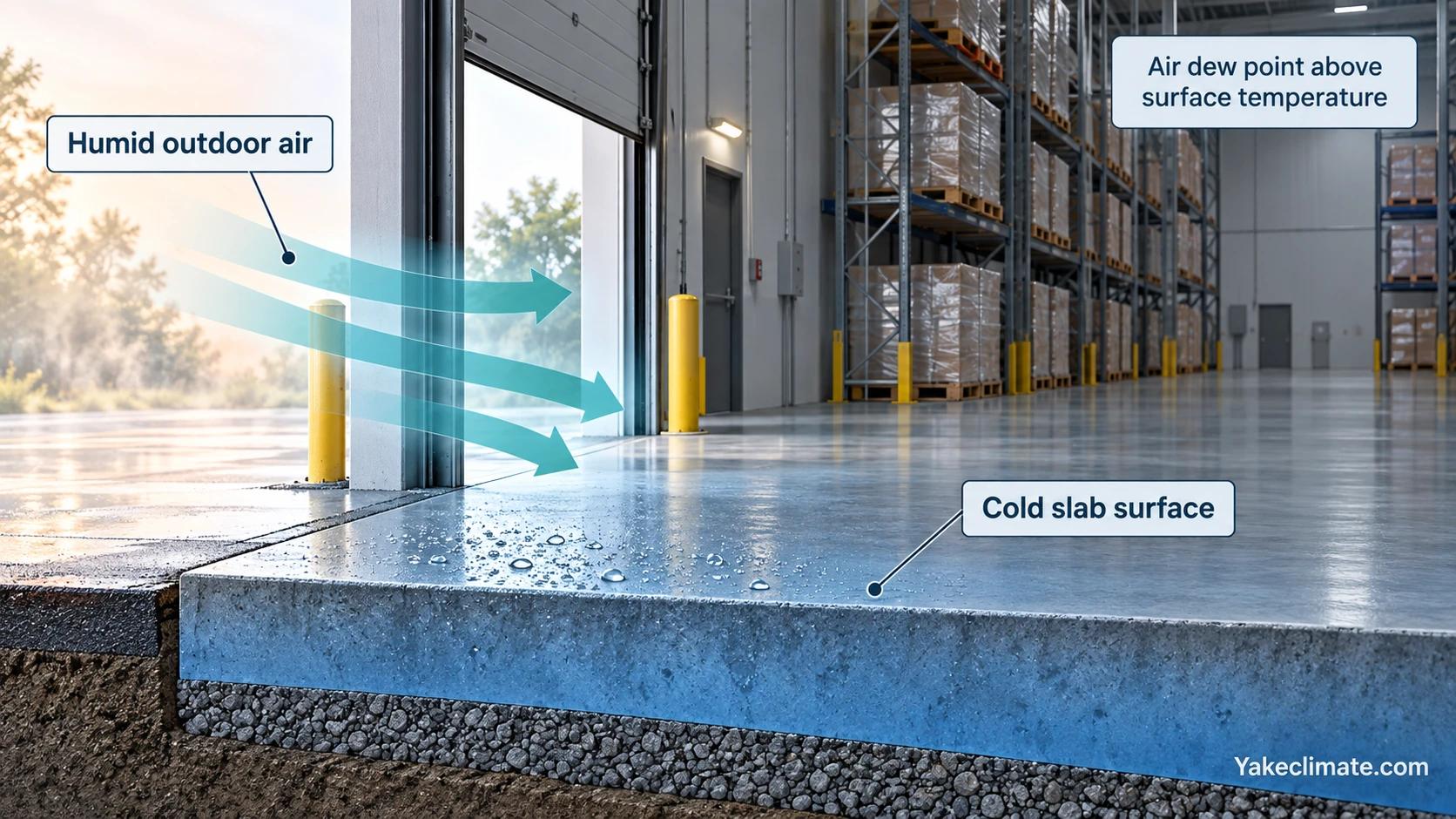
The concrete slab holds the temperature of the winter that has just ended. Outside, the air has turned warm and humid. When that air reaches a slab still sitting at 8 or 10 °C, and its dew point is above that, water condenses across the entire floor at once. It looks exactly like a leak, appears overnight, and disappears by afternoon.
Understanding this one mechanism resolves a large share of warehouse moisture problems, because it also explains condensation on stock, on steelwork, and on packaging.
Two Properties Define the Problem
Warehouses are thermally massive. A concrete slab, racking and stored product together hold an enormous amount of thermal energy. That mass lags the air by weeks — which is why a slab in April still reflects February. Air temperature can change in hours; the slab cannot.
Warehouses are poorly sealed. Dock doors, personnel doors, roof vents, and the general air-tightness of a large industrial envelope mean substantial and uncontrolled air exchange. In most warehouses, infiltration — not the product, not the people — is the dominant moisture source.
These two properties interact badly. Poor sealing brings in humid outdoor air; thermal mass provides cold surfaces for it to condense on. Neither alone would cause a problem.
Define What You Are Protecting
Before any equipment discussion, the requirement determines everything downstream.
| Concern | What matters | Implied control variable |
|---|---|---|
| Condensation on stock or floor | Surface temperature vs air dew point | Dew point |
| Corrosion of metal goods | Relative humidity at the surface, and duration | Relative humidity, with surface temperature considered |
| Mould on packaging or organic goods | Surface conditions and duration | Surface RH over time |
| Powder or hygroscopic product caking | Product equilibrium moisture content | Relative humidity |
| Label and adhesive performance | Relative humidity | Relative humidity |
| Electronics or sensitive equipment | Often a dew point requirement | Dew point |
| Worker safety on wet floors | Condensation on the slab | Dew point |
Where condensation is the concern — which covers the floor, the stock and the steelwork — the specification should be a dew point referenced to the coldest relevant surface, not a relative humidity figure. The reasoning and the calculation are set out in condensation risk and dew point.
This distinction is not academic. A warehouse held at 60 % RH may be perfectly safe in summer and condensing across its floor in spring, because the RH setpoint says nothing about the slab.
The Slab Condensation Mechanism
Worked through explicitly, because recognising it is the point.
Winter. Outdoor air is cold and holds little moisture. The slab cools over the season, reaching a temperature in equilibrium with the ground and the winter indoor condition. No condensation occurs, because the air's dew point is low.
Transition. Outdoor conditions change over days: temperature rises and, more importantly, absolute humidity rises steeply. Air at 20 °C and 70 % RH has a dew point of about 14.4 °C. Air at 25 °C and 70 % RH has a dew point of about 19.1 °C.
The crossing. The slab, still at perhaps 8–12 °C, is now well below the dew point of the incoming air. Condensation begins on the slab surface and on any other high-mass cold object — the lower courses of stored pallets, steel racking legs, metal goods near floor level.
Why it looks like a leak. It appears across a wide area simultaneously, overnight, with no roof event. It is worst near dock doors where the humid air enters. It dries by afternoon as the surface warms.
Why it repeats. The slab takes weeks to warm. Every warm humid day during that period produces the same result.
What does not fix it. Opening the doors to "air it out" brings in more of the humid air causing the problem. Heating the air raises air temperature quickly but barely moves the slab, and raising air temperature at constant moisture content does not lower the dew point at all. Fans move the humid air around more effectively.
What does. Lowering the dew point of the indoor air below the slab temperature — which means dehumidification — and reducing the rate at which humid outdoor air enters.
Quantifying the Door Problem
In most warehouses, infiltration through doors dominates the moisture load, and it is worth estimating rather than assuming.
The load from any air exchange is:
Moisture load = air density × volume exchanged × (outdoor − indoor humidity ratio) with humidity ratio calculated from temperature and relative humidity as set out in ventilation vs. dehumidification.
The practical consequence is that door discipline and door equipment frequently deliver more than additional dehumidification capacity does:
- High-speed doors reduce open time per cycle substantially.
- Air curtains reduce exchange while the door is open, where correctly specified and maintained.
- Vestibules or airlocks at the highest-traffic openings.
- Dock seals and shelters reduce exchange during loading.
- Operational discipline — doors not left open between movements — often costs nothing.
- Pressure control: a slightly positive indoor pressure reduces infiltration through the envelope generally, though it increases exfiltration through open doors.
Where the load calculation shows infiltration dominating, addressing it first changes the required equipment capacity, sometimes dramatically.
Why Cooling Is Usually the Wrong Tool
Warehouses often reach for cooling when the complaint is humidity, and it usually disappoints.
Cooling lowers air temperature, which raises relative humidity at constant moisture content. If the complaint was expressed as an RH number, cooling makes it worse.
Cooling lowers surface temperatures too, including the slab and the stock — bringing them closer to the dew point, not further from it.
Cooling a warehouse-scale volume is expensive, and in a poorly sealed building much of the capacity is spent on infiltration.
Cooling dehumidifies only while it runs, and in mild humid weather — precisely the spring condition described above — there is little temperature demand to make it run. The mechanism is set out in temperature and humidity control in HVAC.
Where temperature genuinely matters for the product, cooling is required. Where the concern is condensation, corrosion or mould, dehumidification addresses it directly and cooling does not.
Stratification and Where to Measure
Tall warehouses stratify strongly. Warm moist air collects at high level; the coldest conditions are at floor level, where the slab is.
Two consequences:
Sensors at a convenient mounting height report neither zone. A sensor at 3 m in a 12 m building describes a condition that neither the roof space nor the floor experiences. Where slab condensation is the concern, the relevant measurements are air dew point near floor level and slab surface temperature.
Destratification changes the picture. High-volume low-speed fans mix the air column, warming the floor zone and cooling the roof zone. This raises slab surface temperature, which directly reduces condensation risk — sometimes enough to solve the problem without dehumidification. It also improves the effectiveness of any dehumidification that is installed, by bringing the moisture-laden air into contact with the equipment.
Treat the Zone, Not the Building
Conditioning an entire warehouse to a tight specification is often uneconomic and rarely necessary.
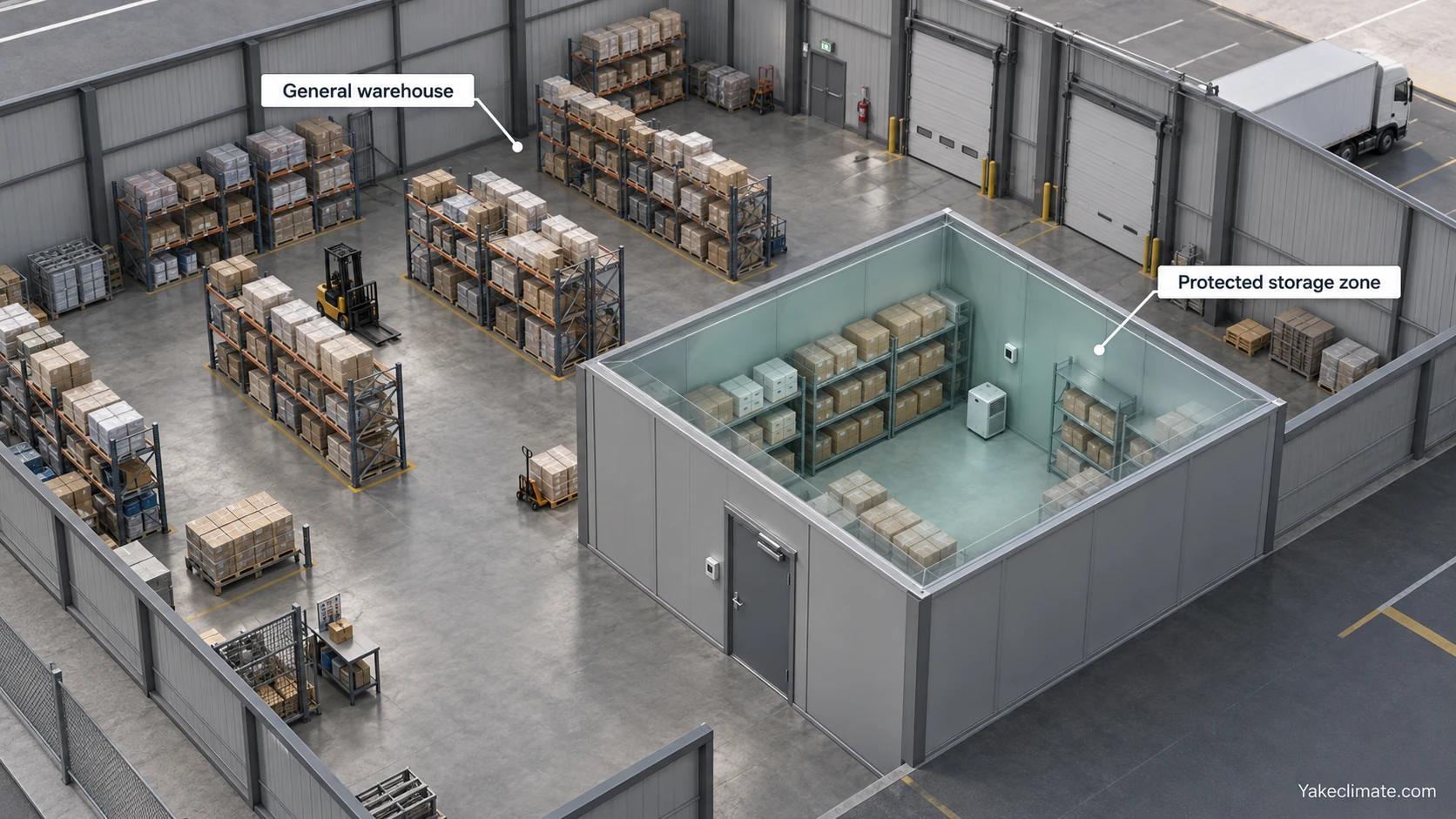
Identify what actually needs protection. In many facilities, a defined area holds the sensitive goods and the rest does not need controlling.
Enclose it. A partitioned, sealed zone within the warehouse can be held to a specification at a fraction of the cost of the whole building, because both the volume and the infiltration are far smaller.
Or protect at the smallest scale that works. For individual sensitive items, sealed packaging with desiccant, or a controlled cabinet, may be more economical than conditioning any part of the building.
Where the whole floor must be protected — because the slab condensation itself is the problem — the treatment is building-wide, but the target is a dew point below the slab temperature rather than a comfort condition, which is a less demanding requirement than it first appears.
Equipment Considerations
Refrigerant or desiccant. Unheated warehouses in cold climates spend substantial time below the range where refrigerant equipment performs well, and coil frosting becomes limiting. Desiccant equipment is far less temperature-sensitive. The comparison is in commercial dehumidifier selection.
Distribution over concentration. A large open volume with racking is full of obstructions. Several units distributed across the space outperform one large unit, and the return air locations matter as much as the supply.
Mounting. Ceiling mounting preserves floor and racking area, at the cost of structural provision, drainage from height and access planning — see commercial ceiling dehumidifiers.
Drainage over distance. Warehouse drain points are often far from the equipment. The route, fall and any pumping need to be designed rather than improvised.
Seasonal operation. The demanding period may be a few weeks in spring rather than the whole year. This affects whether permanent or temporary equipment is appropriate, and how the control strategy is scheduled.
Monitoring
- Air temperature and relative humidity at floor level, logged continuously, from which dew point is calculated.
- Slab surface temperature, logged. This is the measurement that converts the assessment from inference to fact, and it is the one almost never taken.
- Outdoor conditions, to correlate events with weather.
- Conditions at more than one location, particularly near dock doors and in the protected zone.
- Observations: where and when condensation appears, with dates.
Plotting slab temperature and air dew point on the same axis makes the problem self-evident — condensation occurs wherever the dew point trace rises above the slab trace, and the duration of those crossings is the exposure.
Information to Prepare
- Building dimensions, height, construction, insulation and slab construction.
- What is stored, and what the moisture-related concern is.
- Target condition, and whether specified as RH, dew point or a product condition.
- Door inventory: number, size, type, opening frequency and duration.
- Existing heating, cooling, ventilation and air movement equipment.
- Site outdoor design conditions, summer and winter.
- Logged indoor conditions, and slab temperature if available.
- Observed problems with location and timing, particularly seasonal patterns.
- Whether a zone can be enclosed, and its dimensions.
- Available power supply, drain points and mounting positions.
Discussing a Project
Yakeclimate designs and manufactures industrial dehumidification equipment for complex climate applications, with a focus on agriculture and energy projects.
We co-develop application-specific dehumidification equipment around the operating conditions, interfaces, and integration requirements of the wider project or system.
Explore industrial dehumidifiers, review industrial ceiling dehumidifiers, review desiccant rotor dehumidifiers, or contact Yakeclimate to review the operating conditions for your facility.
FAQ
Frequently Asked Questions
Why is my warehouse floor wet in spring when there is no leak?
Because the concrete slab retains winter temperature for weeks while outdoor air turns warm and humid. When the incoming air's dew point rises above the slab surface temperature — a slab at 8–12 °C against air at 20 °C and 70 % RH, which has a dew point of about 14.4 °C — water condenses across the whole floor at once. It appears overnight, is worst near dock doors, dries by afternoon, and repeats on every warm humid day until the slab warms.
Will opening the doors or running fans dry the floor?
No, and both usually make it worse. Opening doors admits more of the humid air causing the condensation. Fans circulate that air more effectively across the cold slab. Heating the air raises air temperature but barely moves the slab, and heating at constant moisture content does not lower the dew point at all. The two things that work are lowering the indoor dew point below the slab temperature, and reducing how much humid outdoor air enters.
Should a warehouse be cooled or dehumidified?
Dehumidified, unless the product genuinely requires a temperature. Cooling lowers air temperature, which raises relative humidity at constant moisture content, and lowers surface temperatures — bringing the slab and the stock closer to the dew point rather than further from it. Cooling also dehumidifies only while it runs, and in mild humid weather there is little temperature demand to make it run, which is exactly when the problem occurs.
What is usually the biggest moisture source in a warehouse?
Infiltration, particularly through dock and personnel doors. The load is air density × volume exchanged × the difference in humidity ratio between outdoor and indoor air. Where a calculation shows infiltration dominating — which it commonly does — high-speed doors, air curtains, dock seals, vestibules and simple door discipline frequently deliver more than additional dehumidification capacity, and change the equipment size required.
Where should sensors be placed in a tall warehouse?
Near floor level, where the slab and the lowest stored goods are, rather than at a convenient mid-height mounting position — tall warehouses stratify strongly and a mid-height sensor describes neither zone. Where condensation is the concern, the two measurements that matter are air dew point at floor level and slab surface temperature. Plotting them together makes the problem, and its duration, directly visible.
Do I need to condition the whole building?
Often not. Where only a defined area holds sensitive goods, partitioning and sealing that zone allows it to be held to a specification at a fraction of the cost, since both volume and infiltration are far smaller. For individual items, sealed packaging with desiccant may be more economical still. Building-wide treatment is warranted where the slab condensation itself is the problem — but in that case the target is a dew point below slab temperature, which is less demanding than a comfort specification.
References
- ASHRAE Handbook — Fundamentals, psychrometrics and infiltration
- ANSI/ASHRAE Standard 160, Criteria for Moisture-Control Design Analysis in Buildings — 2021 addendum a (PDF)