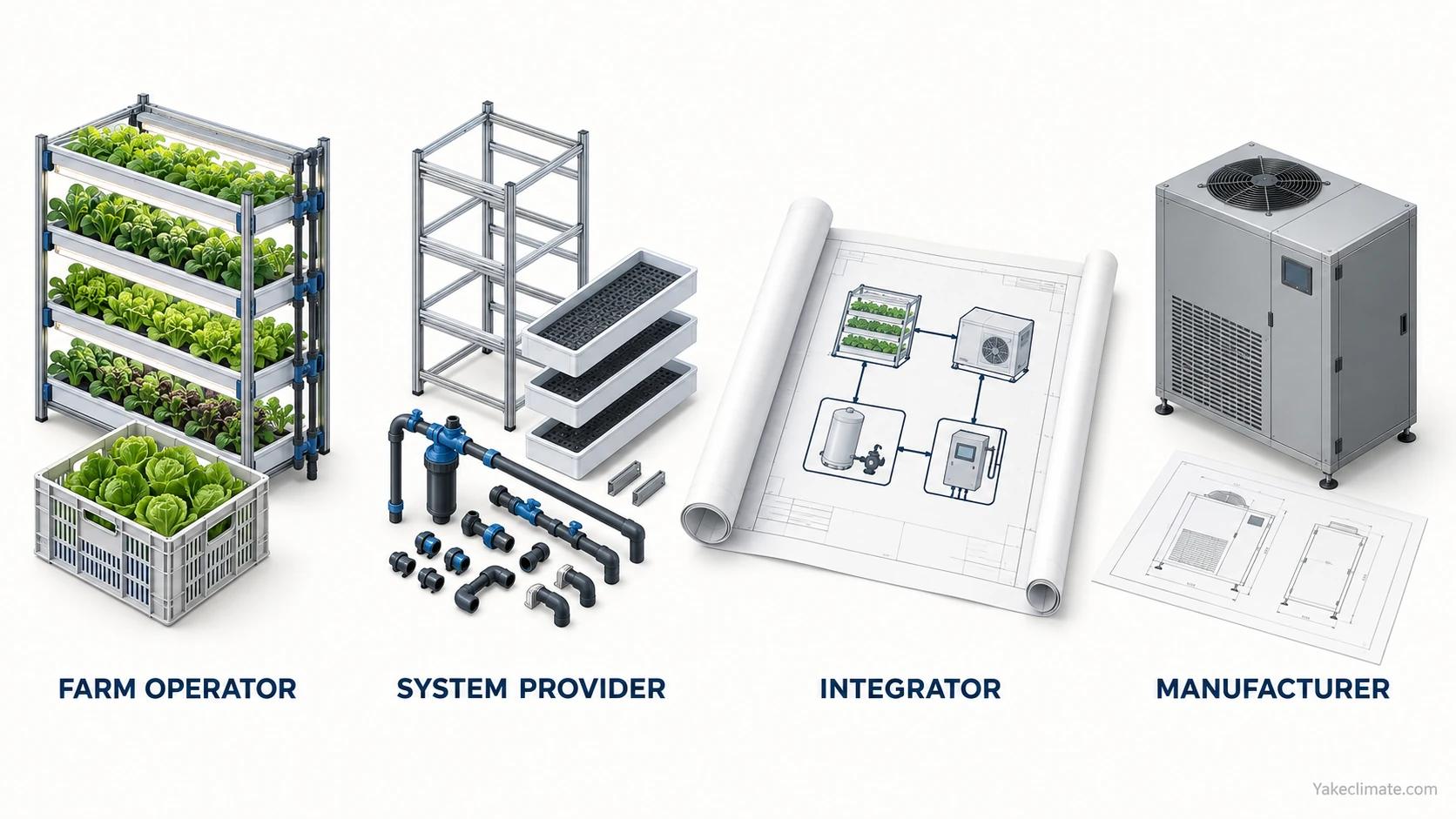
Vertical farming companies do not all provide the same service. Some operate farms. Others supply cultivation systems, racks, lighting, irrigation, controls, climate equipment, software, or project integration. Before comparing vendors, define the role you need and the decisions that role must own. A ranked company list cannot replace that scope work.
This guide provides a long-term method for comparing vertical farming partners without relying on annual rankings, funding announcements, or broad sustainability claims.
Key Takeaways
- Compare companies only after separating farm operators, system providers, integrators, and equipment manufacturers.
- Give every shortlisted company the same design basis, operating conditions, interface requirements, and acceptance criteria.
- Treat labels such as "turnkey" as a scope claim that must be tested against a responsibility matrix.
- Evaluate evidence in context. Ask what crop, facility, climate, scale, control boundary, and test conditions produced the result.
- For climate equipment, compare moisture-load inputs, airflow, controls, drainage, service access, and off-design performance, not only nominal capacity.
- Select the partner whose responsibility, evidence, and lifecycle support match the project, not the company with the broadest marketing language.
First Identify What Type of Company You Need
The USDA Economic Research Service describes controlled environment agriculture as a broad production domain that includes vertical agriculture, greenhouses, hydroponics, aquaponics, and other protected or indoor methods. That breadth matters when evaluating suppliers. Two companies can both appear under "vertical farming" while owning completely different parts of a project.
| Company role | Typical responsibility | Useful deliverables to request | Responsibility that should not be assumed |
|---|---|---|---|
| Farm operator | Grows, harvests, packs, and sells crops | Operating history, crop program, quality controls, production records | Designing or supplying another facility |
| Cultivation system provider | Racks, trays, irrigation, growing hardware, and crop workflow | Layout, utility loads, cleaning access, equipment interfaces | Full building climate performance unless stated in contract |
| Project designer or system integrator | Coordinates multiple systems and project requirements | Design basis, responsibility matrix, interface schedule, commissioning plan | Manufacturing every component it specifies |
| Controls and software provider | Sensors, control logic, alarms, records, and user interface | Point list, protocols, control narrative, data ownership, alarm philosophy | Supplying the physical equipment being controlled |
| Equipment manufacturer | Supplies a defined product such as lighting, air handling, dehumidification, pumps, or dosing equipment | Performance data, operating envelope, interfaces, maintenance requirements | Owning the full crop, building, or system result |
| Service and maintenance provider | Inspection, maintenance, repairs, and spare-parts support | Response scope, parts list, service intervals, exclusions | Redesigning an unsuitable original system |
Start by choosing the row that matches the unresolved decision. If the project still needs full system architecture, comparing individual equipment manufacturers is premature. If the system design is established and one equipment package remains open, a broad farm operator or integrator comparison adds noise.
Build a Common Project Brief Before Creating a Shortlist
Vendor comparisons are unreliable when each company receives a different description of the project. Prepare one controlled brief and issue it to every candidate.
At minimum, include:
- facility location, building type, room dimensions, and production area;
- crop, growth stages, planting density, and production schedule;
- temperature, relative humidity or VPD targets for lit and dark periods;
- lighting power, photoperiod, irrigation schedule, and available water-use data;
- rack geometry, tier spacing, air-distribution concept, and service clearances;
- available electrical supply, heat rejection, drainage, water, and communications;
- control-system owner, required protocols, point list, alarms, and data retention;
- hygiene, material, access, and maintenance requirements;
- redundancy, permitted downtime, expansion plans, and acceptance criteria;
- which party owns crop targets, system design, installation, commissioning, and final operation.
The brief should separate known values from estimates and unknowns. If a design input is unknown, ask candidates to state the assumption they used. Hidden assumptions make proposals look comparable when they are not.
Use Eight Criteria to Compare Vertical Farming Partners
1. Role and Scope Clarity
A credible proposal states what the company will provide, what it needs from other parties, and what remains outside its responsibility. Look for named deliverables, interfaces, exclusions, and decision owners.
If a company uses a broad label such as "complete solution," ask for the contractual scope behind it. Does that scope include crop design, building services, HVAC, air distribution, irrigation, controls, installation, commissioning, performance verification, training, and after-sales support? The useful answer is a responsibility matrix, not a repeated label.
2. Quality of Design Inputs
Strong partners ask specific questions before recommending equipment or a layout. They should distinguish crop targets from room conditions, rated data from project conditions, peak loads from averages, and current requirements from future expansion.
Be cautious when a recommendation appears before the company has received basic operating data. A precise model number based on an incomplete brief is not evidence of engineering speed. It often means the missing inputs have been replaced by unspoken assumptions.
3. Interface Ownership
Vertical farms combine horticulture and engineering disciplines. Cornell's Controlled Environment Agriculture program describes CEA as a combination of horticultural and engineering techniques and notes the range of knowledge needed to operate it successfully.
That combination creates interfaces: lighting adds heat and influences crop activity; irrigation affects moisture generation; airflow affects local conditions; cooling and dehumidification interact; sensors and controls determine what the system can detect and correct. A partner should explain which interfaces it owns, which it only supports, and what information another supplier must provide.
4. Evidence and Applicability
Ask for evidence that matches the proposed scope. Useful evidence can include product performance data, test conditions, drawings, control documentation, commissioning records, service records, or relevant project examples that the company is authorized to discuss.
For every result, ask:
- What facility and crop conditions applied?
- What equipment and control boundary were included?
- Was the figure measured, simulated, estimated, or claimed by a third party?
- What period and operating state did it cover?
- What limitations prevent direct transfer to this project?
A large number without operating context is weaker than a smaller, well-defined dataset.
5. Off-Design Performance
Catalog ratings describe specific test conditions. Vertical farm rooms can operate at different temperature and humidity conditions, and those conditions change between growth stages and lit or dark periods.
Ask how capacity, efficiency, airflow, and control behavior change away from the rating point. If the company cannot provide complete performance data, it should state the limitation and the margin or validation step required. Do not compare nominal ratings as if they were guaranteed project performance.
6. Maintainability and Failure Behavior
Review filter access, coil or rotor cleaning, drain inspection, sensor calibration, replacement parts, firmware or software support, and the space required for service. Then ask what happens when one component fails.
The answer should cover detection, alarms, fallback behavior, isolation, recovery, and permitted downtime. Redundancy is useful only when the controls, airflow, utilities, and maintenance plan allow the remaining equipment to operate as intended.
7. Commissioning and Acceptance
Commissioning should verify the defined responsibility, not promise an undefined business result. Agree on the inputs, operating state, measurement locations, instruments, duration, tolerances, data records, and corrective process before purchase.
Separate equipment acceptance from crop yield, farm profitability, and whole-building performance unless one supplier truly owns those outcomes under a clearly defined contract.
8. Lifecycle and Commercial Fit
Compare delivery lead time, documentation, training, spare parts, service access, warranty boundaries, change control, and support for future expansion. A lower purchase price can create a higher operating burden if documentation, parts, controls access, or maintenance support are weak.
Commercial terms should also reflect scope. A proposal that excludes installation, controls integration, commissioning, or local service is not directly comparable with one that includes them.
Compare Climate-Control and Dehumidification Partners Separately
Climate control deserves its own comparison because temperature, humidity, crop activity, lighting, and energy load interact. A 2024 peer-reviewed Applied Energy study modeled combinations of temperature, vapor pressure deficit, lighting intensity, and photoperiod and found that changing growing conditions changed both energy load and crop yield. The practical lesson is not to copy one condition from the paper. It is to require suppliers to use the project's actual operating schedule and to state how their assumptions affect equipment load.
| Input | Why it matters to equipment comparison |
|---|---|
| Temperature and humidity or VPD by operating period | Defines the condition at which moisture must be removed |
| Crop area, stage, density, and water-use data | Provides the basis for estimating moisture generation |
| Lighting power and photoperiod | Affects sensible heat and the timing of crop activity |
| Cooling and air-handling design | Determines how sensible and latent loads are shared |
| Rack geometry and airflow path | Determines whether conditioned air reaches every tier |
| Installation position and service access | Constrains equipment form, ducting, drainage, and maintenance |
| Condensate route | Defines drain lift, trapping, routing, monitoring, and possible recovery interfaces |
| Controls and communications | Defines setpoints, staging, alarms, trend data, and integration responsibility |
| Redundancy and permitted downtime | Defines unit arrangement and failure response |
For a deeper review of those inputs, use the vertical farming climate-control guide and the controlled agriculture humidity application page.
Create a Responsibility and Interface Matrix
Before selecting a company, place each project function in a single matrix. Name the decision owner, supplier, required input, output, and acceptance method.
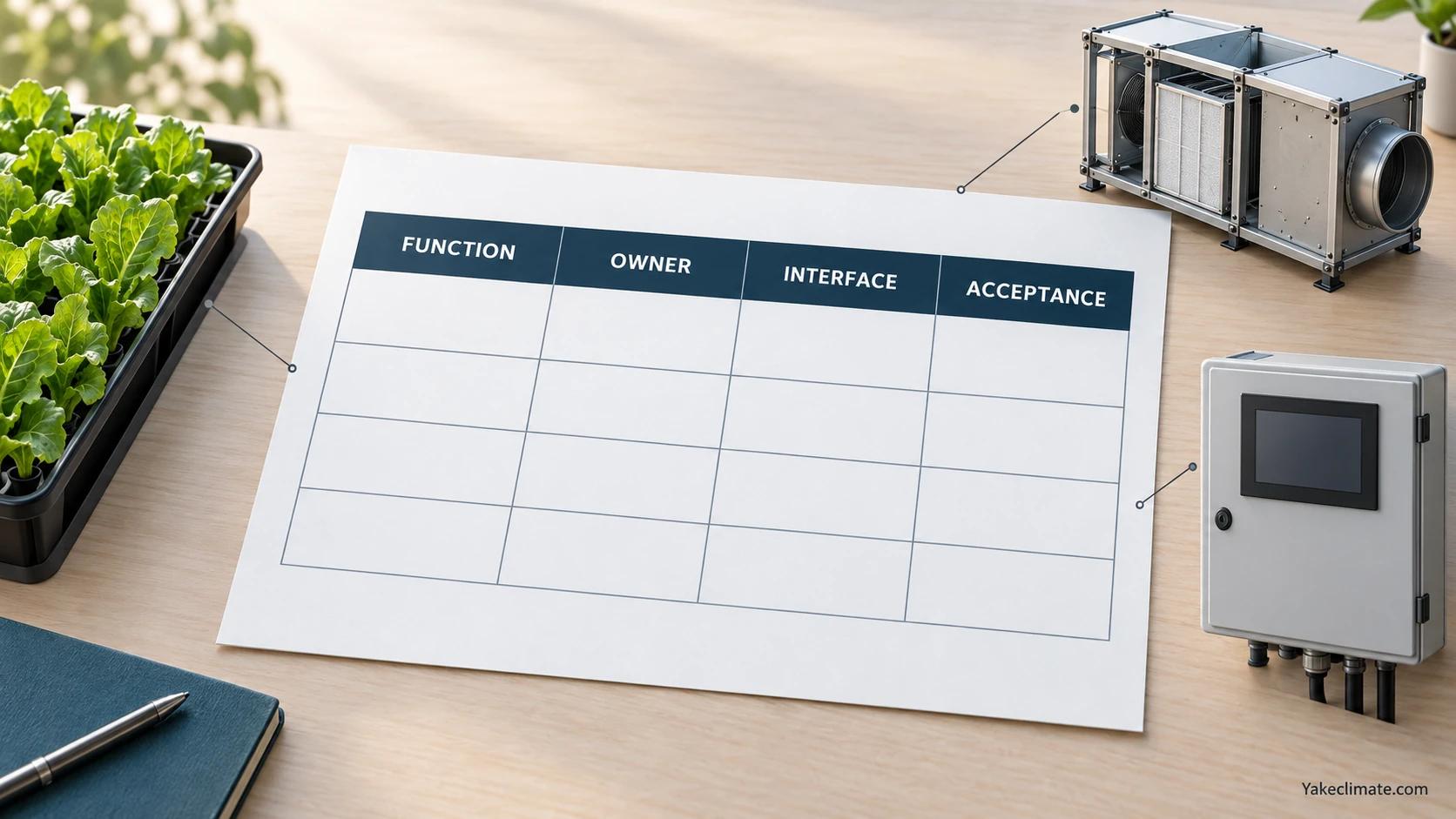
| Project function | Decision owner | Required interface record | Acceptance evidence |
|---|---|---|---|
| Crop targets and schedules | Grower or agronomy owner | Stage targets and operating schedule | Approved crop brief |
| Facility and rack layout | Project designer | Dimensions, loads, access, and airflow zones | Coordinated layout |
| Lighting and irrigation | Respective equipment owners | Power, heat, schedule, water flow, and alarms | Equipment data and functional tests |
| Cooling, airflow, and humidity control | System designer plus equipment suppliers | Load split, air path, setpoints, staging, drainage | Commissioning records at defined conditions |
| Sensors and controls | Controls owner | Point list, protocol, control narrative, alarm plan | Point-to-point and functional tests |
| Installation and utilities | Contractor or project owner | Electrical, drainage, ducts, supports, access | Inspection and installation records |
| Operation and maintenance | Farm operator | SOPs, spare parts, service intervals, escalation path | Training and maintenance records |
The matrix helps reveal two interface failures: responsibility gaps, where no supplier owns an interface, and responsibility overlap, where two suppliers make incompatible assumptions about the same function.
What a Credible Proposal Should Contain
A useful proposal should let another engineer, buyer, or project owner understand how the recommendation was produced. Request:
- a clear scope, exclusions, and responsibility matrix;
- the design basis with inputs, assumptions, unknowns, and source of each value;
- equipment performance at relevant operating conditions;
- layouts, utility requirements, interfaces, and service clearances;
- controls description, point list, alarms, and communications requirements;
- installation, commissioning, and acceptance responsibilities;
- maintenance tasks, spare parts, support path, and warranty boundaries;
- stated changes required if crop, lighting, rack density, or room use changes.
If the proposal cannot be reviewed without a sales presentation, it is not yet ready for a project decision.
Red Flags During Evaluation
- A company ranking that does not define the category or scope being ranked.
- Guaranteed yield, savings, water use, payback, or climate performance without conditions and responsibility boundaries.
- A product recommendation issued before core operating inputs are known.
- One nominal capacity figure used across different room conditions.
- "Turnkey" language without a deliverable and interface matrix.
- Case results with no crop, scale, climate, control boundary, or measurement method.
- No clear owner for controls integration, air distribution, drainage, commissioning, or service.
- Equipment that cannot be inspected or serviced in the proposed layout.
- Dependence on proprietary data or software without clear access, export, and continuity terms.
- Pressure to compare prices before scope and acceptance criteria are aligned.
A Six-Step Shortlist Process
- Define the unresolved decision. Select the company role that should own it.
- Issue one project brief. Give every candidate the same conditions, interfaces, and unknowns.
- Screen for scope fit. Remove candidates whose actual responsibility does not match the project need.
- Normalize the proposals. Separate included work, exclusions, assumptions, options, and lifecycle costs.
- Review evidence and interfaces. Test applicability and close gaps between suppliers.
- Agree on acceptance before award. Record how equipment, controls, installation, and commissioning will be verified.
This process produces a smaller but more comparable shortlist. It also creates documentation that remains useful after the vendor is selected.
Where Yakeclimate Fits
Yakeclimate designs and manufactures industrial dehumidification equipment for complex climate applications, with a focus on agriculture and energy projects.
We co-develop application-specific dehumidification equipment around the operating conditions, interfaces, and integration requirements of the wider project or system.
Our role is limited to the dehumidification equipment and its defined interfaces. Crop strategy, complete facility design, rack and irrigation systems, lighting, building HVAC, controls integration, installation, and overall project performance remain with the parties contracted to own them.
If your vertical farming project has defined climate targets, crop and lighting schedules, installation constraints, controls requirements, and a clear system owner, share those operating conditions with Yakeclimate. We can review the equipment requirements, interfaces, and next technical discussion within our manufacturing scope.
FAQ
Frequently Asked Questions
What is a vertical farming company?
The term can describe a farm operator, cultivation system provider, project integrator, controls company, or individual equipment manufacturer. Identify the company's actual contractual role before comparing capabilities or prices.
How should I compare vertical farming companies?
Give candidates the same project brief, then compare scope, design inputs, interface ownership, applicable evidence, off-design performance, commissioning, maintainability, service, and lifecycle responsibility. Do not compare a farm operator with an equipment manufacturer as if they provide the same result.
Does turnkey mean one company owns the whole project?
Not automatically. Ask for a responsibility matrix that names every included deliverable, interface, exclusion, acceptance test, and outcome owner. The contract, not the label, determines responsibility.
What information does a dehumidification supplier need for a vertical farm?
Provide room and rack geometry, crop area and schedule, temperature and humidity or VPD targets, water-use or moisture-load data, lighting and irrigation schedules, cooling and airflow design, installation constraints, drainage, controls, redundancy, and permitted downtime.
Should I choose a supplier by nominal dehumidification capacity?
No. Nominal capacity applies at a stated rating condition. Compare performance at the project's actual temperature and humidity conditions, along with airflow, controls, drainage, access, service, and failure behavior.
Who owns the final climate performance?
Ownership depends on the contract. The system designer or integrator normally coordinates the complete climate strategy, while each equipment manufacturer owns the documented performance and interfaces of its supplied equipment. Record those boundaries before purchase.
