
Key Takeaways
- Temperature and humidity monitoring protects sensitive equipment, products, and building infrastructure while caring for human comfort, health, and compliance in homes, workplaces, and specialized facilities. Any storage environment with food, medicine, electronics, or paper/rag benefits from permanent climate tracking.
- Different meter styles suit different requirements, from basic analog for quick room checks to digital, datalogging, wireless, and industrial units for accuracy, record keeping, remote access, and brutal environments. Choosing the appropriate class of device varies based on how important accuracy is, how frequently data needs to be consulted, and if remote or multi-room monitoring is desired.
- Primary sensor types including capacitive, resistive, and thermal possess different accuracies, prices, and upkeep requirements. Knowing these trade-offs makes it easier to select a device that strikes the right balance of accuracy, long-term stability, and budget for your application.
- When selecting a temperature and humidity monitor, consider how accurate it is, its measurement range, how quickly it responds, and its robustness to the actual environment in your room. A quick checklist comparing these across a few products will help you make sure you don’t trade away essential performance for a cheaper price.
- Here’s where smart integration and sensor fusion can take climate management to the next level by combining temperature and humidity data with other environmental inputs and connecting it to automation. This lets you receive alerts, control ventilation or dehumidification automatically, and track trends over time to maximize comfort and energy efficiency.
- Regular calibration, careful cleaning, and correct placement are the basis of reliable long-term monitoring. An easy maintenance schedule noting calibration, inspection, and positioning checks will keep your device accurate and compliant, whether you use it in a home, office, lab, or industrial setting.
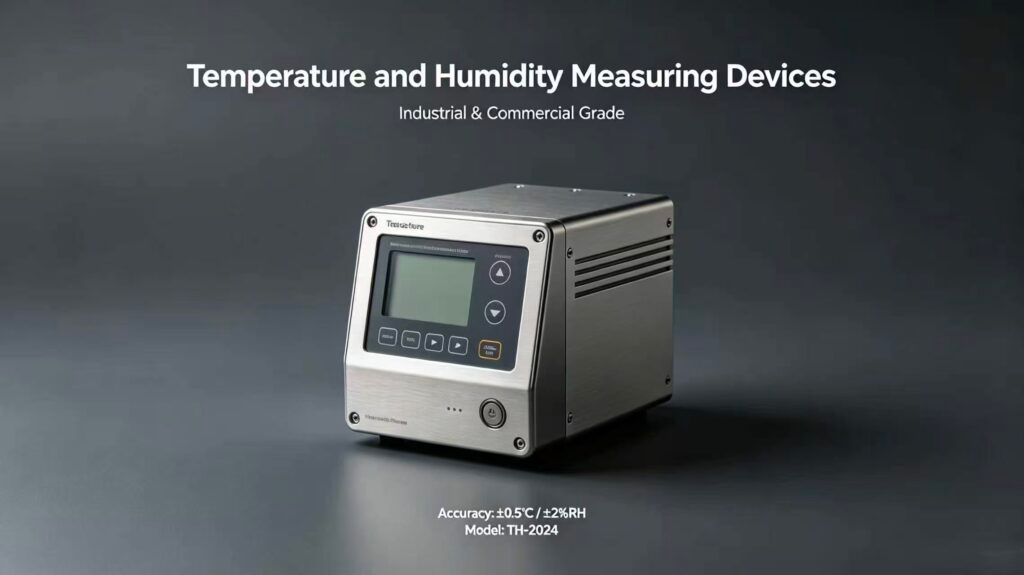
A temperature and humidity meter is known as a thermo-hygrometer and it monitors air temperature in °C or °F and relative humidity in percentage. Within grow rooms, greenhouses, and vertical farms, growers use these devices to maintain critical climate ranges steady, frequently interfacing them with dehumidifiers, HVAC units, and data loggers. Most newer ones have digital sensors, provide on-the-spot readings, and save short-term trends that help identify swings over the course of a few hours. Some models affix to the wall near plant canopies, while others reside inside ducting to monitor supply and return air. To get ahead, the following sections classify how these devices function and what characteristics genuinely interest indoor farmers.
Why Monitor Temperature and Humidity?
That’s basic environmental control. For indoor farms, storage rooms, labs, or offices, it’s one of the only low-cost measures that safeguard assets, empower people, and maintain systems stable and energy efficient in the long run.
Protect sensitive equipment, products, and materials from damage due to improper environmental conditions.
As do many substances and equipment. Electronic drivers, LED fixtures, and control boards, for instance, all have their own recommended operating ranges, such as 18 to 30 degrees Celsius and 40 to 60 percent relative humidity. Above this band, you get corrosion on contacts and sensor drift. Beneath it, plastics and sealants become brittle and crack. For plant production, seed stock, nutrient concentrates, and biological inputs respond to heat and moisture fluctuations. Dried powders can cake at high relative humidity and lose flow. Paper packaging twists. Labels come off.
Collections and archives are even more so. Books, herbarium sheets, seed banks, or genetic libraries require consistent temperature and relative humidity in order to prevent warping, cracking, or fading. Each material class has its own target window, so precise monitoring informs you if storage rooms truly remain in those ranges, not only on a good day but through seasons, shutdowns, and load fluctuations.
Improve comfort and health by maintaining optimal indoor air quality in homes, offices, and public spaces.
Air that’s too warm or damp puts a strain on both humans and systems. At high relative humidity, sweat doesn’t evaporate well, so grow room staff wear out quicker, and the feel-heat is higher than the thermostat reads. At low relative humidity, eyes and airways dry out, dust suspends in the air longer, and static discharges increase, which can upset workers and control electronics.
Maintaining temperature and RH within suggested comfort ranges, typically between 20–24 °C and 40–60 % RH in occupied areas, promotes indoor air quality by reducing dust suspension, inhibiting the growth of many microbes, and enhancing the effectiveness of ventilation. Constant measurement provides facilities teams a strong indication when loads shift, for instance when plant canopy grows, more people inhabit a space, or external conditions vary. Armed with that information, it becomes easier to optimize dehumidifier settings, ventilation rates, and air distribution so the room feels consistent, not “sticky” one week and “dry” the next.
Prevent mold growth and structural issues caused by excess moisture or extreme temperatures.
Mold and condensation is where bad humidity management becomes an immediate expense. When relative humidity remains above about 70% on surfaces, mold has optimal growth conditions on gypsum boards, insulation, sealants, and even painted steel. Framing rots, finishes peel, and insulation performance sinks. In greenhouses, cold surfaces adjacent to glazing attract condensation if warm, moist air comes in contact with them. The same applies to chilled water piping or leaky ductwork in controlled rooms.
At very high humidity, around 100 percent RH, heat exchange between surfaces and air virtually ceases. Evaporative cooling doesn’t work, and the space stores heat rather than dissipates it. In a grow environment, that translates to leaf temperature spiking right when plants are already stressed. Monitoring lets you catch RH and surface temperature moving in the direction of liquid water, so you can boost air movement, change setpoints, or operate dehumidification more proactively before liquid water shows up.
Seasonal closures are an additional hazard. For facilities that are inactive throughout the winter, unmonitored rooms can swing back and forth between freezing nights and short bursts of warmth from the sun or intermittent heat. This pattern forces air beyond its dew point resulting in continual condensation on walls, windows, and stored material. Over time, monitoring during these off-hours provides the information necessary to adjust baseline heating or drying to prevent condensation from forming in the first place.
Ensure compliance with industry standards and regulations in sectors like healthcare, food storage, and manufacturing.
Most regulated sectors need evidence, not speculation, regarding environmental conditions. In healthcare storage, some drugs, diagnostic kits and reagents require that they remain within temperature and relative humidity thresholds to preserve shelf life. In food storage, recommendations for chilled rooms, dry stores and packaging areas indicate both temperature ranges and maximum relative humidity to avoid spoilage and texture degradation. In manufacturing, particularly for electronics, pharmaceuticals and certain composite materials, specifications sometimes call out very tight humidity windows for processing or curing.
Monitoring facilitates both real-time control and documentation. Continuous systems, instead of ‘snapshot’ handheld readings, record conditions even at night, weekends or holidays, when staff is absent. This prevents blind spots that can conceal short-lived but detrimental excursions. Over time, these records exhibit regularities. You can observe how a space performs during heat waves, cold snaps, or high-load production runs and then fine-tune setpoints or replace equipment with direct data.
Precision matters if you make compliance and quality decisions on these readings. Sensors drift, particularly inexpensive hygrometers. Frequent calibration against known standards for humidity probes in controlled air maintains the data’s reliability. Without that, a couple of percent RH error could lead you to believe a room is safe when it is actually above a mold-friendly threshold. When calibrated, long-term monitoring allows small problems like slow RH creep or repeated short condensation events to show up early, and adjustments to venting, insulation, or dehumidification can be made before materials, products, or structures suffer.
Types of Temperature and Humidity Meters
Temperature and humidity meters fall into a few main groups: analog, digital, datalogging, wireless, and industrial systems. Every category fits various risk profiles, budgets, and control requirements in grow rooms, greenhouses, and vertical farms.
1. Analog
Analog meters employ basic mechanical or chemical components to indicate measurements, typically via a dial. A typical example is the metal-paper coil hygrometer, in which the coil twists as moisture fluctuates and turns a needle, sufficient for a fast glance by an entrance or within a pantry.
Some analog hygrometers employ human or animal hair under tension. Once oils are stripped, the hair responds more to humidity swings, so the pointer shifts more distinctly with changes in RH. Analog thermometers are easy to compare. Set a few in an insulated container of water or alcohol, mix well to balance temperature, then see how closely they match.
They require no power, so they continue to function during outages and in remote locations. They don’t have data logging, alarms or network links, and accuracy typically lags digital equipment, so they belong better to non-critical or decorative functions than in high-value grow areas.
2. Digital
Digital meters provide precise numeric temperature and RH readings, typically with an accuracy of ±2 to 3% RH, which already beats many analog dials. Response is quicker, therefore you experience swings from irrigation or dehumidifier cycles much earlier.
Most handheld or panel units tack on min/max memory, clock functions, and simple alarms, which assist staff in recognizing when a tent, rack, or curing room has strayed out of range. The trade-off is power. They need batteries or a low-voltage supply, so farms must plan battery change cycles or central power.
3. Datalogging
Datalogging meters save readings over time, which is crucial for real climate intelligence rather than one-time spot checks. You’re able to download records through USB or wireless connections and import them into spreadsheets or farm management software to analyze trends.
In controlled industries like medical cannabis or seed production, these records assist in demonstrating compliance and facilitating audits. They uncover patterns like post‑lights‑off nightly humidity spikes that can direct you to upsize dehumidification or adjust setpoints instead of fishing.
Others dataloggers connect directly into a central control system, so the same device that records history can feed alarms and drive corrective actions. This facilitates a closer connection between sensing and dehumidifier control, which is often where Yakeclimate systems enter the picture.
4. Wireless
Wireless temperature and humidity meters send readings in real time to phones, tablets, or a central server. One hub can collect data from numerous nodes distributed across racks, canopies, and HVAC plenums, letting you visualize your environment’s true uniformity.
Eliminating signal wiring, wireless nodes minimize install time and disruption in existing structures. They pair nicely with smart building or farm platforms that operate on open protocols, so data can populate dashboards, notifications, and automatic adjustments to fans or dehumidifiers.
For remote or multi-site operations, wireless monitoring is usually the only sensible way to keep tabs on multiple grow rooms and drying spaces simultaneously, even after hours.
5. Industrial
Industrial meters aim at harsh and critical settings: high humidity, dust, chemical load, or wide temperature swings. Housings are sealed, sensors are more stable, and accuracy remains tight even near saturation. This is important when you’re running aggressive dehumidification during dense flowering.
They range from chilled-mirror dew point hygrometers that measure the dew point directly and heated psychrometers, which heat very low-temperature air to above freezing, to highly sophisticated capacitive probes with long-term ratings. Classic psychrometers, with wet and dry bulb thermometers, still have a role as reference tools, though wet-bulb depression often falls short of theory, which can make RH look 2 to 5 percentage points too high.
Industrial meters often provide robust connectivity for SCADA or PLC systems, with protocols that integrate seamlessly with dehumidifiers, chillers, and air handlers. They’re pricier to begin with and require calibrated inspections. Upkeep is scheduled instead of ongoing, and they satisfy the rigid codes of pharma-grade or food-grade farms.
| Type | Key Features | Typical Cost* | Maintenance Need |
|---|---|---|---|
| Analog | Dial display, no power, low accuracy | Low | Occasional manual calibration |
| Digital | Numeric display, alarms, faster response | Low–Medium | Battery change, sensor check |
| Datalog | Internal memory, data export, trend analysis | Medium | Periodic calibration, backups |
| Wireless | Remote access, multi‑point, no signal wiring | Medium–High | Network upkeep, batteries |
| Industrial | High accuracy, robust, advanced connectivity | High | Scheduled pro calibration |
*Relative cost, in consistent terms, for global readers.
Core Sensor Technologies
Core sensor tech in temperature and humidity devices sits at the heart of any serious indoor grow or controlled environment. Three main types show up in real projects: capacitive, resistive, and thermal sensors. Each reads the same air differently, and each suits a different combination of cost, precision, and long-term stability that growers and engineers value.
Capacitive
In a capacitive humidity sensor, the core sensing element consists of two electrodes separated by a thin dielectric polymer layer that absorbs water from the air. As the relative humidity fluctuates, the dielectric constant of that layer shifts, which changes the capacitance. The interface circuit follows that change and converts it to a humidity reading, while a dedicated solid-state component, commonly a band-gap or RTD, measures temperature in the same housing.
This approach provides high accuracy over a broad range, typically 10 to 90 percent relative humidity and minus 20 to 60 degrees Celsius for indoor farming, with low drift provided you keep the sensor clean and away from corrosive gases. It is the default option in digital and wireless nodes that live in grow rooms, ductwork, or even within dehumidifiers. Most of the multi-sensor modules in vertical farms and hydroponic racks employ similar capacitive cores to monitor “micro-climates” near the canopy.
Capacitive principles underlie some wearable core temperature systems that infer core temperature from skin and ambient readings. Those devices can provide real-time, continuous data during exercise or labor in hot greenhouses and have been validated against rectal thermistors in heat exposure trials. Accuracy still varies with airflow, perspiration, and location on the body.
- Pros: High accuracy, good stability, low power, easy digital output
- Cons: sensitive to chemical contamination, needs protection from condensation
Resistive
Resistive humidity sensors employ a hygroscopic layer whose electrical resistance varies as it absorbs or desorbs water. The electronics voltage and resistance shift, then a calibration curve converts this into % RH, paired with a simple thermistor or silicon sensor for temperature.
You typically find this in discount monitors, inexpensive data loggers, or basic grow tents where the emphasis is on trend tracking, not strict process control. Sensitivity is good, but drift from dust, nutrient aerosols, or aging results in having to recalibrate or replace sensors more frequently, particularly in nutrient-rich hydroponic air.
- Pros: Low cost, simple circuits, and good enough for basic consumer use.
- Cons: more drift, more impact from contaminants, lower long-term stability
Thermal
Thermal humidity measurement depends on the temperature difference between a “dry” and a “wet” element or between sensors with different thermal conductivities that vary with water vapor content. By measuring the rate at which one warms or cools against the reference, the device deduces humidity, with temperature derived from the same sensing pair.
This technique requires steady airflow and additional power, so it is rarer in small wireless nodes but does appear in some industrial probes, laboratory setups, and reference systems used to calibrate other sensors. Comparable thermal models show up in some core body temperature wearables and research-grade systems in sports medicine and occupational health, where they deliver continuous, real-time core data during intense labor or workouts.
They’ve been found to be accurate when well calibrated, with appropriate placement and good data algorithms, and can lose validity in extreme heat, direct sun, or when user behavior violates the assumed model. Environmental conditions, sensor position, and individual variability all factor into it, so serious programs consider them an element of a broader monitoring strategy, not a silver bullet.
- Pros: Strong performance in controlled setups. Useful as a reference.
- Cons: higher power draw, larger size, more sensitive to airflow patterns
Finding the Best Humidity Monitor
Choosing a device that measures temperature and humidity is mostly about fit: fit to your crop, your room size, your control strategy, and your risk tolerance. For a grow room, greenhouse or vertical farm rack, hone in on four key factors: accuracy, range, response time and durability. Then look at product sheets side by side. A practical checklist is specified accuracy, operating range, response time, enclosure rating, data logging, calibration method, power options, and warranty. Mapping these points to your mission produces much better results than choosing the cheapest or smartest app laden.
Accuracy
Accuracy fuels any serious climate plan, since every downstream decision from dehumidifier setpoints to irrigation timing hinges on the figures you receive. For most indoor farm work, target hygrometers whose specified humidity accuracy is plus or minus 2 to 3 %RH, as the most precise commercial models are within approximately 5 percent of actual values in test environments. Temperature accuracy of plus or minus 0.3 to 0.5 °C is typically sufficient for day-to-day management in grow rooms.
Assume the manufacturer’s spec table for both temperature and humidity, not just the marketing headline. Some instruments advertise resolution that sounds impressive, such as measurements to the ten-thousandth of a percent, while others only measure to a hundredth of a percent. Resolution is not the same as actual accuracy. For grow rooms, a steady ±1 %RH resolution with calibrated ±2–3 %RH accuracy is typically a good compromise.
Calibration is a huge chunk of over time accuracy. All sensorgain drift hygrometers have varying levels of precision from unit to unit, so prepare for either user calibration with salt solutions or scheduled factory calibration, particularly if you’re cultivating high-value crops. Inexpensive consumer units typically overlook hardened calibration features and can be off by a few percent in either direction. That can push your plants out of the optimal range in a tight VPD plan.
It comes in handy to cross-check devices. Like thermometers, hygrometers aren’t 100 percent accurate, so take readings as one data point in a larger picture rather than gospel. Avoid the absolute lowest-end models that sacrifice accuracy for cost.
Range
Range is about if the device can even see your conditions run. For instance, an 18 to 26 degrees Celsius, 55 to 75 percent relative humidity vertical farm has very different requirements from a curing room that may be cooler with tighter humidity bands, or an equipment room that can have spikes in heat and dry air. Be sure to check minimum and maximum temperature and humidity on the datasheet as well. Sensors operated near their limits become less accurate and occasionally die prematurely.
If you operate industrial environments, cold storage, or semi-outdoor spaces like intake plenums or greenhouse headhouses, extended-range models are a good value. These can withstand near-freezing temperatures, the heat of a mechanical room, or humidity right up to fogging lines without soaking. Psychrometers, which use a dry-bulb and wet-bulb thermometer pair to calculate relative humidity, have a place as a sanity check in rough or non-standard environments.
Typical target operating ranges you can use as a quick filter:
- Standard indoor grow room: 15–35 °C, 30–95 %RH
- High‑humidity propagation zone: 18–30 °C, 60–100 %RH
- Greenhouse with seasonal swings: 5–45 °C, 20–100 %RH
- Cold storage / post‑harvest rooms: −5–20 °C, 60–95 %RH
Whatever monitor you look at, it should comfortably span your worst-case ranges with some overhead, not just your normal setpoints.
Response Time
Response time describes how quickly the sensor output updates when conditions shift. In consistent, gradually varying surroundings such as massive soil greenhouses with abundant thermal mass, you can get away with slower devices, as humidity and temperature shift over minutes, not seconds. In small, crowded rooms with powerful airflow and rapid dehumidifier or HVAC cycling, slow response can cause you to miss short-term swings that still stress plants or trigger mold risk.
Most quality product sheets will list response time as something like “T63 < 8 s,” which means the sensor travels 63 percent of the distance to the new value in under 8 seconds. For active control loops, or when you push VPD tightly, seek out units in the 5 to 30 second class. If a device takes minutes to settle, it will erase hard blows and valleys in your logs, and you’ll under record actual stresses.
Match response time to your pace. A small tent with manual venting and simple fans doesn’t require the same speed as a large facility connected to a building management system, where seconds can make a difference in how a dehumidifier or fan stage behaves.
Durability
It’s durability that keeps your readings trustworthy after years of real-world abuse from moisture, fertigation mist, dust, and day-to-day handling. In wet or soiled environments—by NFT channels, flood tables, or evaporative pads—prefer units with rugged housings, replaceable sensor heads and at least IP-rated protection against dust and splashes. A simple IP54 or better enclosure already strips a lot of risk from spray, stray leaves and fine substrate particles.
Check build quality in small details: cable strain relief, sealing around the probe, and the stiffness of mounting brackets. For devices in industrial or outdoor portions of your system, like intake ducts or service corridors, where there’s more physical impact and vibration, it’s worth investing in models engineered to handle these loads, not recycled home gadgets. Certain instruments even have data logging memory to save trends for more than two years. This long memory assists you in connecting equipment failures or disease outbreaks back to prior humidity problems.
Power and support impact long-term reliability. Battery life may last from a few months to six or more, depending on how fast the unit logs and if it transmits wirelessly, so select what suits your maintenance pace. A good warranty and transparent service path means you can maintain sensors in calibration rather than guesstimating with half-trusted numbers in a critical grow.
Sensor Fusion and Smart Integration
Sensor fusion and smart integration transform a simple temperature and humidity device into an actual climate tool that slots into a broader control system for indoor farms and grow rooms.
Combine temperature and humidity data with other environmental sensors for comprehensive monitoring
Sensor fusion means you don’t read temperature and humidity in isolation. You fuse them with data from CO2, PAR light, substrate moisture, VPD, air velocity, and occasionally differential pressure between rooms. By fusing streams from multiple sensors, you can filter noise and drift, so the system can counteract a false peak in humidity with consistent trends from adjacent probes. This provides a more accurate representation of plant stress and microclimates, essential in dense vertical racks or sealed rooms.
In practice, a grower might deploy three to four small temperature and humidity nodes per zone, then fuse those with leaf-surface temperature from infrared sensors to calculate vapor pressure deficit at canopy height. That fused value then drives dehumidifier staging, fan speed, and irrigation timing. These same smarts help you size and control Yakeclimate dehumidifiers more precisely, so they run in tighter bands rather than on and off swings that waste energy.
Integrate devices with smart home systems for automated climate control
Smart integration means your sensors communicate with control systems, not just record data. Devices can become part of Zigbee, Z-Wave, Thread, Wi-Fi, or Bluetooth platforms. A few require a hub or bridge, while some go directly to the network. Your selection here determines data speed, link robustness in a metal-laden grow, and battery life. Sensor Fusion and Smart Integration Low-power meshes like Zigbee or Thread can keep a sensor alive for up to five years on one battery set, which matters when you mount probes high above a canopy.
Once connected, these sensors provide input to climate controllers, building systems, or farm management software that can activate dehumidifiers, modulate HVAC dampers or shift airflow patterns without any on-site inspection. Interoperability is the point. Each device plugs into a shared logic that aims for stable VPD and energy savings.
Enable alerts and remote access through mobile apps or cloud platforms
With cloud links and mobile apps, that same fused data powers real-time alerts and remote modifications. Smart platforms alert when humidity drifts above a mold risk range, when temperature nears a night setpoint that could slow growth, or when a sensor drops offline and risks blind spots. Alerts can be simple threshold triggers or rule sets like combining several signals, such as high humidity and low airflow, which frequently identify a fan failure before plants show symptoms.
Remote access allows a manager to tune dehumidifier set points, fan speeds or irrigation schedules remotely from offsite. This minimizes night visits, decreases fault response time, and enables multi-site management. For teams running large cannabis or leafy green facilities, this means clearer task handovers since logs and alarms are shared.
Support data sharing and analysis for improved decision-making
From these over time, sensor fusion and integration build a rich data history. Multi-sensor logs indicate how temperature, humidity, and CO₂ fluctuations impact yield, disease outbreaks, or energy consumption. Teams can share this data cross-sites, compare cultivars, and fine-tune climate recipes instead of guessing. Fine-grained logs assist in optimizing Yakeclimate dehumidifier staging windows and coil load, so equipment operates closer to the actual latent load curve and consumes less energy.
Shared data simplifies working with consultants or system integrators. Everyone sees the same graphs, all the way down to sensor level, and can follow how a shift in airflow path or set point impacted humidity recovery time post-irrigation. Over time, that loop of measure, review and adjust results in steadier rooms, lower operating costs, and fewer crop losses.
Maintaining Your Device
Temperature and humidity equipment is only as good as its maintenance. In production facilities, that equates to a clean slate, a documented checklist, and trackable records so information remains auditable in inspections and harvest evaluations. Routine maintenance should include visual inspection, calibration, cleaning, and placement checks, all performed according to the manufacturer’s guide, not guesswork or habit. Written logs, even a spreadsheet, tie climate data back to maintenance actions and give you early warning when a sensor drifts.
Calibration
Calibration keeps readings within the narrow ranges that controlled environment agriculture requires. For devices that infer humidity from temperature — like most electronic probes or psychrometers — you must first ensure your thermometer is calibrated correctly. Even a slight temperature bias can introduce several percentage points of error in relative humidity. A premium liquid in glass thermometer generally holds value for years when treated carefully, so many growers keep one as a reference, only pulling it out during calibration runs.
For comparison checks, put the device probe and a reliable reference thermometer in an insulated vessel of well-mixed water or alcohol. Stir vigorously to eliminate gradients before reading. Never extend thermocouple leads with plain copper wire that introduces huge junction errors and can offset your readings in crazy directions. When possible, employ certified calibration tools and saturated salt solutions for hygrometer checks, as certain pure salts with distilled water will maintain a near-constant humidity in a sealed box and provide repeatable test points.
Psychrometers and wet-bulb systems require even greater maintenance. At low relative humidity, it is difficult to achieve the theoretical wet-bulb depression. In fact, liquid-in-glass wet-bulb thermometers tend to run warmer than theory by an amount sufficient to bias RH readings 2 to 5 points high. A psychrometer by itself can easily exhibit a 10% variation or more, so keep track of calibration dates and deviations. Replace or service any sensor that keeps failing those checks.
Cleaning
Cleaning provides long-term stability and minimizes unexplained drift. Dust, algae film, nutrient mist, or foliar spray residue on a probe housing all slow response and bias readings which then misdirect dehumidifier setpoints or VPD targets. Wipe housings and radiation shields regularly and check cable glands and enclosures for fine substrate dust in vertically farmed setups with active airflow.
Adhere to the manufacturer’s cleaning recommendations, particularly regarding solvents. A mild detergent and distilled water usually suffice for housings, while exposed sensor elements may require dry brushing or compressed air alone. Stay away from harsh chemicals, alcohol, or high-pressure jets unless the datasheet explicitly authorizes, as coatings on humidity sensors are fragile. In every cleaning pass, look for corrosion on terminals, cracked housings, loose strain relief, or discoloration adjacent to solder joints. Note any imperfections so they feed into your maintenance record.
Conclusion
A quality temperature and humidity meter provides hard information, not guesswork. Growers use that information to maintain a constant vapor pressure deficit, prevent mold, and reduce plant stress. A home user checks comfort and nips damp spots before they become a problem.
Every configuration requires a different instrument. A simple digital meter does the trick in a small grow tent. A smart sensor grid with logging suits a big farm. A lab or clean room might require top-grade sensors with tight error bands.
To select the appropriate device, align its sensor type, range, accuracy, and data capabilities with your environment and your crop or application. To walk through an actual grow or facility, contact the Yakeclimate team.
Frequently Asked Questions
What is a device that measures temperature and humidity called?
They usually refer to this as a temperature and humidity meter, hygrometer, or thermo-hygrometer. These units show both readings and assist you in maintaining balanced indoor conditions for comfort, health, and the welfare of some delicate objects such as plants, electronics, or musical instruments.
Why is it important to monitor indoor temperature and humidity?
Even temperature and humidity guard your health, comfort, and belongings. It keeps mold, allergies, wood warping, static, and equipment damage under control. It promotes improved sleep, increased energy efficiency, and perfect conditions for growing or storage.
What types of temperature and humidity meters are available?
Primary types are digital meters, analog dial hygrometers, data loggers, and smart Wi-Fi or Bluetooth monitors. Some are handheld for spot checks, while others are wall-mounted or built into HVAC and smart home systems for continuous tracking.
How do I choose the best humidity monitor for my needs?
Concentrate on precision, measuring scale, response time and display readability. Look for smart features such as app support, alerts and data logging if you require tracking over time. Go with a reputable brand and seek out transparent calibration methods and robust user feedback.
How often should I calibrate or check my humidity meter?
For typical household use, verifying calibration every 6 to 12 months is sufficient. In critical spaces, like labs or indoor garden rooms, check more frequently. Use a reference method or professional calibration if you need reliable measurements.
Can a single device control as well as measure temperature and humidity?
Some of the more high-tech devices out there actually do both. These are closed-loop controllers that read sensors and then switch heaters or fans or humidifiers or dehumidifiers on and off. They are typical in greenhouses, indoor grow rooms, server rooms, and climate-controlled storage.
How can I keep my temperature and humidity meter accurate over time?
Avoid direct sun, heaters, vents, and windows. Shield sensor vents from dust and moisture. Steer clear of drops and extremes. Adhere to the maker’s recommendations for calibration and battery replacement. Keep it in a stable environment when not in use.