
Key Takeaways
- Indoor pool dehumidification costs stem from not just equipment, but installation, energy, maintenance, and repairs. It’s crucial to analyze the complete cost breakdown, not just the up-front price. Nothing beats a transparent cost table and itemized quote in keeping surprise expenses at bay!
- System type and sizing has a huge effect on both upfront and long term costs, as mechanical, desiccant, and ventilation options each perform differently based on pool size and climate. Matching capacity and technology to the actual pool room conditions can save money on buying oversized units and prevent losses from underperforming systems.
- Installation factors like whether it’s a new build or retrofit, the difficulty of the ductwork, and site limitations can all drive costs much higher or lower. Determining structural conditions, access, and duct routing early enables more precise budgeting and fewer delays.
- In many cases, the long term costs, notably energy, simple maintenance, and replacement parts throughout the system’s life, eclipse the initial price of the equipment. The indoor pool dehumidification system costs Generating a multi-year total cost of ownership forecast enables more informed technology comparisons and investment decisions.
- Effective dehumidification provides value beyond dollars and cents by promoting good air quality, preserving the building envelope and increasing occupant comfort in the pool environment. These advantages decrease health risks, prevent moisture damage and boost facility utilization and enjoyment.
- Local climate, building codes and available rebates impact system selection and cost as well. By checking regulatory requirements and incentive programs before purchase, you can further optimize the system design, potentially unlocking some meaningful financial savings.
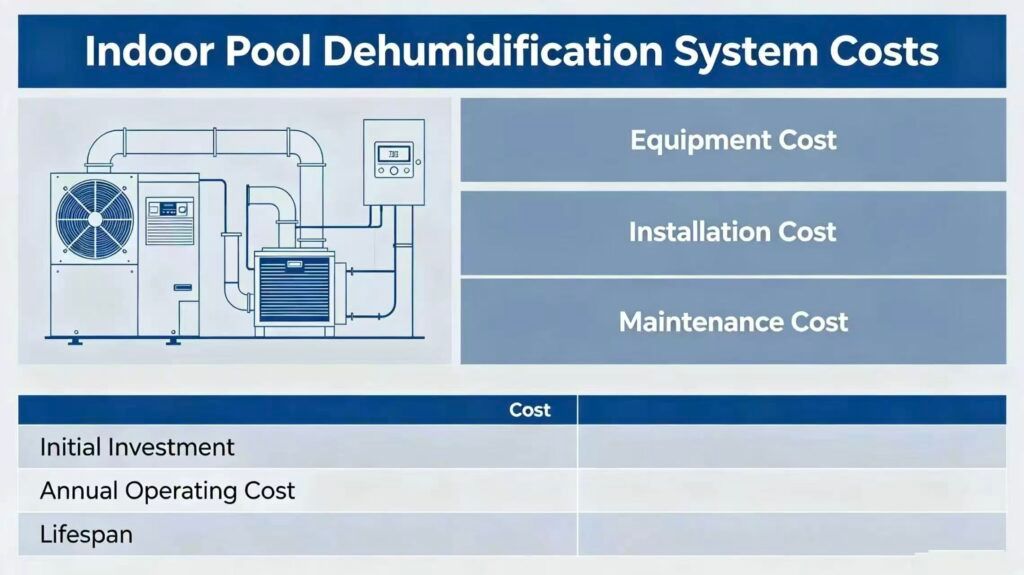
Indoor pool dehumidification system costs vary by pool size, space volume, desired RH%, and energy strategy. Big pools with warm water and long run hours require larger capacity units, thus capital cost and power consumption quickly increase. System design changes cost, such as utilization of heat recovery, outdoor air load, or integration with existing HVAC. In some commercial pools, dehumidification can account for 40 to 60 percent of total HVAC energy, so life-cycle cost often trumps price tag. Facility teams and management plan budgets by comparing upfront cost, energy usage in kWh per year, service accessibility, and part life. The following sections decompose each cost driver in easy steps.
Deconstructing Dehumidifier System Costs
Indoor pool dehumidification is a long-term cost center, not a one-time purchase. Total cost breaks down to equipment, installation labor, operating energy, routine maintenance, and unexpected repairs. Every piece tugs on your budget differently, which is why you need them all out in the open before you choose a system or brand to compare.
| Cost Component | What It Covers | Typical Impact on Budget |
|---|---|---|
| Equipment | Dehumidifier unit, controls, accessories | Largest upfront cost |
| Installation Labor | HVAC work, ducting, electrical, permits | One-time, varies with site complexity |
| Operational Energy | Electricity or heat for year‑round running | Major ongoing cost over system lifetime |
| Routine Maintenance | Filters, coil cleaning, inspections, minor parts | Predictable annual expense |
| Unforeseen Repairs | Major part failures, emergency call‑outs | Irregular but can be high without good warranty |
1. Equipment Price
Indoor pool dehumidifiers for smaller pools frequently hover in the $2,000 to $5,000 range, but that’s just a segment of the market. A normal residential-grade system will typically run around $3,000 to $10,000, whereas true commercial units for massive hotel or rehab pools begin around $20,000 and can climb well past that once capacity and heat recovery are factored in. More liters per hour or pints per day capacity, better EER or COP, quieter fans, smart controls — all of those things push the price up, particularly when you add automation like BMS integration and remote monitoring.
Brand and engineering approach count as some units combine pool water heating or space heating, which can eliminate separate equipment but increase the line item price. Sizing should begin from the water surface area, for example, approximately 110 pints per day for pools of 23 m² or less and approximately 190 pints per day for 37 to 42 m², then adjusted for water temperature and air change rate. A unit with just a slightly more capacity than the minimum can be your least expensive route, because it runs shorter cycles, maintains 50 to 60% relative humidity more consistently, and typically lasts longer under load.
2. Installation Labor
Labor cost is about what’s hard to do, not just how many hours onsite. Simple ducted replacement in a transparent mechanical room may take one to two days, while a new commercial build with tight ceiling space, corrosion-resistant ductwork and condensate routing can extend longer and pull in both HVAC and electrical crews. Many indoor pool projects require technicians familiar with psychrometric design, corrosion risk and pool codes, and that skill premium pushes the hourly rate up versus ordinary comfort-cooling work.
Local rules can tack on permit and inspection fees, particularly in locations where indoor pools are subject to more rigorous building or health codes, so it’s prudent to factor that in during early budgeting. Actual installation time changes with system type: wall-mounted units are faster, but large centralized systems with outdoor condensers and long duct runs need more planning, lifting gear, and commissioning time, which all feed back into your total installed cost.
3. Operational Energy
Once the system is installed, energy is the dominant cost driver over 10 to 15 years. Deconstructing dehumidifier system costs Two models with the same nominal capacity can have very different EER or COP, and that delta shows up on the utility bill every month, especially in warm, humid climates or facilities with year-round pool operation. Higher-efficiency models can cost more initially but can pay back in terms of lower kWh per liter removed, especially when operated for many hours each day to maintain humidity below the 60 percent level that creates misty windows, peeling paint, and corrodes steel, concrete, and finishes.
Larger water surface, higher water temperature and heavy bather load all increase latent load so energy use increases with pool size and usage. For cost control, it aids to log run hours and compare monthly electricity bills with outdoor conditions and set points. If energy drifts up inexplicably, that frequently flags fouled coils, incorrect airflow, or controls that no longer correspond to the actual moisture load. Evaluating these varying system types—from ventilating with outdoor air to mechanical dehumidification with heat recovery—on a kWh/m2/year basis provides a much more solid foundation for lifecycle cost decisions than simply comparing equipment price.
4. Routine Maintenance
Regular maintenance for indoor pool dehumidifiers is not a choice if you desire consistent costs and performance. Common activities involve air filter cleaning or replacement, washing and descaling coils for chloramine deposits, inspecting the condensate drain, examining the fan and belt, and verifying that sensors and control sequences continue to monitor set points. In a chlorinated, warm, and often occupied pool space, these tasks typically need to occur more frequently than in standard comfort-cooling systems, perhaps quarterly instead of annually.
Servicing by trained staff or a service partner slows corrosion, keeps EER or COP near design values, and mitigates the risk of last minute downtime right before peak demand periods. Most operators sign maintenance contracts locking in visit frequency, parts discounts, and response time that turns a variable risk into a known annual budget line. If maintenance is deferred, grime and corrosion increase fan and compressor energy consumption, reduce compressor longevity, and can ultimately lead to moisture damage of the building envelope that costs far more than the deferred service calls.
5. Unforeseen Repairs
Even with rock-solid design and upkeep, unexpected repairs are still ownership costs, so they get a line in the budget. Typical problems are compressor failure due to sustained high head pressures, fan motor or bearing failure in the corrosive pool air and control panel failures where sensors drift or circuit boards fail, often following power quality events. These repairs can range from a couple of hundred dollars for electronics to several thousand dollars for a big compressor job on a larger commercial system and they almost always come with indirect costs such as missed pool time or temporary humidity surges.
Maintaining a small reserve budget for emergency call-outs and key spare parts, especially at remote sites or critical-use pools, softens these blows and prevents hurried, ill-suited replacement decisions. Warranty terms play a strong role in how much you actually pay when something breaks. Longer compressor warranties, clear coverage of electronic components, and defined labor allowances can shift a big share of that risk back to the manufacturer during the early years. Buying a system with really good warranty and reliability data ends up costing less over its life than a cheaper unit with weak support, even if the initial price difference seems significant.
Compare Dehumidifier Technologies
Indoor pool rooms will drive it upward of 80% if unmonitored. To keep floors dry and safe, most designs go down to around 50 to 55% RH, when 30% is often preferred in other buildings. Over 60% the pool hall begins to drift into unhealthy territory with increased corrosion, mold potential and patron complaints. Dehumidifier type determines both your up-front budget and your long-term energy bill, so we need a clean comparison across the major technologies.
| Technology | Typical Use Case | Capex Level | Energy Use | Climate Fit |
|---|---|---|---|---|
| Mechanical (DX) | Most hotel, fitness, private pools | Moderate | Moderate, model‑dependent | Wide range, from cold to hot |
| Desiccant | Cold, damp climates, low‑temperature halls | Higher | Lower moisture kWh, more fans/heat | Cool to cold, high latent load |
| Ventilation-based | Mild outdoor climate, backup or hybrid | Low equipment, high thermal | High heating/cooling energy | Mild, dry seasons or partial use |
Your choice of technology should be aligned with your pool size, climate and usage pattern. A small private pool in a dry area wouldn’t warrant the same system as a busy commercial pool with dozens of users per day and where air feels stuffy even at 50-55% RH. Codes that require 80 to 100 cubic meters of fresh air per person also alter the calculations, as more outside air means more thermal energy to treat.
Mechanical Systems
Mechanical or refrigerant-based units cool the air below its dew point, condense water on the coil, and then reheat the dried air before it reenters the pool hall. Several units reclaim heat from the refrigerant loop to heat supply air or even the pool water, which reduces boiler load and stabilizes operating costs over time.
They make up the vast majority of residential and commercial pools globally because they provide a nice balance of cost, footprint, and control. Upfront cost is typically modest, and performance is certain when sized for evaporation load and fresh-air requirements. Energy efficiency varies widely by brand, compressor type, control logic, and ductwork handling airflow volumes that can be 10 to 20 times higher than a typical room. Bad duct design causes noise and drafts, which encourages occupants to turn down airflow. Then humidity starts creeping back up to 60 percent and higher.
Desiccant Units
The desiccant options employ a silica gel or special wheels that adsorb water vapor to a dry surface. The damp process air moves through the desiccant, sheds its moisture, and returns to the pool area much drier, even at low air temperatures where traditional DX coils lose their advantage. A separate hot “regeneration” airstream then dries the desiccant so it can repeat the cycle.
They excel in chill pool halls and freezing cold areas, or locations that already have waste heat or steam available to regenerate the desiccant at a low marginal cost. You usually find them in industrial systems with strict corrosion or condensation constraints throughout the building’s shell. These upfront purchase and integration costs tend to come in higher than a direct mechanical unit, and maintenance can be more hands-on, as wheels, seals, and filters require close tolerances to remain effective.
Energy use for moisture removal alone can be less per kilogram of water removed, particularly when combined with heat recovery. You exchange that for additional moving parts and more nuanced service schedules that facility teams need to schedule into OPEX.
Ventilation Methods
Ventilation dehumidification is the most basic method. It pushes out humid indoor air and pulls in drier outdoor air, then heats or cools it as needed. If outside air has lower absolute humidity, moisture in the room declines over time. This can operate with basic fans and dampers or a more fully developed air handling unit.
Equipment cost is low because the primary hardware is fans, ducts, and perhaps dampers or heat recovery. A duct dehumidifier without fresh-air mixing and a completely separate supply ventilation system with heating is an alternative. You’ve got two separate systems running and paying for two sets of fans and coils. Operating at large air exchange rates, sometimes 10 to 20 times that of a normal comfort space, clears moisture and smells but introduces more noise and the potential for drafts near occupied areas.
Thermal energy cost is the true problem. In cold or hot climates, outside air requires heavy heating or cooling to maintain the pool zone, and that can dwarf any savings from the basic equipment. You still need to comply with codes anticipating 80 to 100 cubic meters of fresh air per person, so you can’t reduce outside air to zero even when the space is arid. A simple rule of thumb is to think in two tasks: dehumidification and ventilation. Ventilation alone rarely tackles both well in harsh climates, and even at a “good” 50 to 55 percent humidity, a bustling commercial pool can feel stifling without sufficient outdoor air diluting chemicals.
Ventilation control works best in mild climates, or as a topper to mechanical or desiccant units, where it cuts shoulder season peaks without shouldering the burden in winter or peak summer.
Uncover Installation Variables
Indoor pool dehumidification installation costs vary wildly from site to site, even when pool size and usage appears similar. Core variables include:
- New build vs retrofit conditions
- Pool hall size, height, and glazing ratio
- Access for equipment, cranes, and duct routing
- Required structural changes for equipment and duct loads
- Duct length, routing complexity, and diffuser layout
- Power availability and electrical upgrades
- Local code, permitting, and inspection requirements
- Chosen energy‑recovery and control strategy
- Contingency allowance (typically 10–15% of quoted cost)
A complete indoor pool job typically takes 6 to 18 months from design and permits to construction and finishing. Dehumidification needs to be scoped concurrent with structure, enclosure, and HVAC.
New Construction
On new construction, the dehumidification can be part of the base build that helps keep total cost down. The enclosure alone (walls, roof, foundation) frequently falls between approximately $50,000 and $200,000 or more, with engineering and architectural fees adding another $5,000 to $20,000 and permits costing roughly $2,000 to $10,000. Incorporating the pool dehumidifier in early drawings barely shifts the design budget and can reduce change orders down the line.
The design team could design room layout, plant space and even duct paths around the system rather than vice-versa. That simplifies selecting a unit type, aligning airflows to evaporation loads and providing the dehumidifier with unobstructed service access. Install crews typically go quicker because the floors, walls and ceilings are still open. Routing ductwork, drains and power is more straightforward and less invasive than in a finished building.
New builds provide greater flexibility to integrate energy‑efficient features like heat recovery from dehumidifier to pool water or space heating, smart controls, and properly‑sized dedicated outdoor air systems. A typical residential‑scale pool dehumidifier might run $15,000 to $40,000 installed, with a dedicated HVAC and fresh‑air system adding another $5,000 to $20,000 or more. A well‑coordinated new build can minimize lifecycle cost and help keep ongoing household expenses predictable.
Retrofit Projects
Retrofit work tends to run more expensive on a per-kilowatt or per-litre-per-second basis since the system must work with an envelope and structure that wasn’t built for a pool. Crews may be forced to work around finishes, occupied spaces, or tight ceiling voids, all of which decelerate install rates and inflate labor hours.
Well, let’s face it, sometimes partial demolition just cannot be avoided. Cutting new duct chases, adding openings through load-bearing walls or reinforcing roof trusses to carry air handling units all add significant expense. We often find structural or building finish work to be equal to or greater than the mechanical scope in these complicated retrofits.
Retrofit conditions can restrict equipment options. You might be compelled to use smaller sectional units to get them through existing doors, or wall-mounted or ceiling-hung units in the absence of a mechanical room. That can affect both capital cost and efficiency results.
Thinking in longer timelines helps. If you keep a building operational during the upgrade, phasing, temporary dust walls and off-hour work windows all add overhead. Installation Variables Budgeting a 10 to 15 percent contingency above quoted cost is wise because subterranean conditions, such as hidden steel, unknown utilities, or inadequate existing insulation, have a habit of emerging once walls come down.
Ductwork Complexity
Ductwork is a big swing factor in dehumidification install cost. Long runs, multiple branches and tight coordination around structure, lighting and overhead services drive both material and labor up, particularly when corrosion-resistant metals and special hangers are needed for the pool environment.
Custom duct solutions are often driven by one-of-a-kind pool shapes, massive glass walls, balconies, and elevated spas. You could require curved or oval ducts to trace the pool perimeter or low-level supply near glazing to wash cold surfaces with dry air. These specifics optimize comfort and condensation management. Every custom fitting, transition, or diffuser increases both manufacturing time and installation labor.
Bad duct design nibbles away at system efficiency and increases operating costs for decades. Short‑circuiting between supply and return, dead zones with still air, or weak airflows over wet decks all cause the dehumidifier to run longer at a higher load, which increases power consumption and component wear.
A focused ductwork audit early in the design process repays. That means load calculations for evaporation, air change rate checks, diffuser placement along glass and exterior walls, and verification that ceiling and wall cavities can carry ducts without major rework. In cost terms, this step helps you avoid late layout changes and provides a clearer sense of the actual installed price before any contract is signed.
Calculate Long-Term Expenses
Indoor pool dehumidification is a year-round, round-the-clock load. Cost decisions only make sense when you amortize them over 10 to 20 years and look at total cost of ownership, not just the sticker price. That is, you model power, regular service, consumables, and major part replacements and then compare platform styles on a multi-year cash-flow basis.
Energy Consumption
Begin with the unit’s rated power input and duty cycle. For a standard indoor pool, the dehumidifier contributes approximately 20 to 30 percent on top of a building’s yearly electricity consumption. In a pool home, that frequently amounts to 4,000 to 7,000 kWh annually just for dehumidification, which you should multiply by your local euro per kWh or dollar per kWh to estimate realistic yearly cost.
Actual consumption never equates to the catalog sheet. It varies based on pool size, water temperature, usage frequency, whether or not you have a pool cover, how well ventilated the room is, outside air temperature, and insulation. An off-hours covered pool can reduce evaporation by 70 to 90 percent, which reduces latent load. Latent heat at pool conditions is approximately 2,430 to 2,500 kJ per kg, so even minor reductions in evaporation leave an obvious kWh footprint.
To get precise numbers, define a load factor that reflects real use: busy hours, shoulder hours, and standby. From there, it’s easy to figure out daily, monthly, and annual kWh. Then compare systems on kWh per year, not just COP or nominal efficiency.
Factor in the impact of neglect. Dirty filters, for example, can increase fan power by 15 to 20 percent due to additional resistance. Aim for baseline monitoring with sub-meters or BMS trend logs so you can optimize setpoints and fan speeds and detect drifts in performance early.
Service Agreements
- Predictable budgets with fixed or capped yearly costs
- Higher uptime through planned inspections and tune‑ups
- Better efficiency from regular cleaning and calibration
- Priority response when failures occur
- Structured records to support insurance and compliance audits
Indoor pool service contracts are usually seasonal or quarterly inspections, coil and filter cleaning, air flow, refrigerant, leak check, and condensate and control check. Others include remote monitoring or energy optimization audits for higher load facilities.
Well-designed contracts assist in extending equipment life and reducing unplanned downtime, which is paramount in locations where pool closure results in lost revenue or broken service obligations. Big operations tend to benefit more by aggregating multiple units and locations into a single contract, which can reduce per-unit service rates and unify performance across the estate.
Component Lifespan
Significant components have very different design lifespans and this molds your long-term expenses profile. Compressors on nicely designed indoor pool systems will sometimes run 10 to 15 years in a stable environment. Fans and EC motors could last 12 to 20 years. Control electronics can linger in the 8 to 12 year span, though basic components such as sensors and contactors might require replacement earlier.
A higher-grade compressor, corrosion-resistant coils, and industrial-class fans are more expensive initially, but they frequently pay themselves back in fewer breakdowns, greater efficiency, and quieter operation under high moisture and chemical stress. In long-hour pools, that premium can be small compared to a single unplanned shutdown.
Keep tabs on the age and runtime of major components in an easy asset list. Leverage that information to schedule replacements pre-failure, within your outage windows. Proactive upgrades minimize the risk of cascade failures, secondary damage, and emergency call-out fees. They assist with insurance negotiations as well. Some insurers account for indoor pool risk in their premiums and it is not unusual to see an extra €500 to €2,000 or $500 to $2,000 per year. Therefore, evidence of strong maintenance can be relevant.
Beyond the Price Tag
Indoor pool dehumidification is more than a bullet on a capex list. It is a control point that influences air quality and building health, user comfort, and long-term operating risk across the entire facility.
Air Quality Value
A properly sized, properly tuned dehumidification system drains the air fast enough to keep relative humidity below around 60 percent. That one change decreases the thriving of mold, mildew, and many fungi on wet surfaces, and it reduces airborne spores that float on little droplets over the water. With air flowing through clean filters and across clean coils, the unit removes lint, skin flakes, and other fine particles that accumulate in enclosed pool halls.
Better air quality connects directly to respiratory health. For staff, frequent swimmers, and coaches who sit hours poolside, less spores and chloramine haze means less throat and eye irritation, less coughing, and more tolerance for those hard training sessions. This is even more vital in spaces frequented by kids, seniors, or asthmatics, who respond quickly to compromised air and stale moisture burdens.
From a compliance and brand perspective, it pays to monitor air metrics. Basic trends on humidity, temperature and even periodic spore or particulate checks can back up health inspections, feed ESG reporting and provide you credible data for marketing “clean air” claims, instead of empty gestures.
Structural Protection
High humidity over time is the quietest, most costly threat in an indoor pool. When air sits above 60% relative humidity, warm, moist air pushes into walls, ceilings, and fixtures, then condenses in cooler areas. You recognize the telltale symptoms: foggy windows, flaking paint, blown trim, rusted out metal grilles, and crumbling drywall corners. Behind finishes, you have wet insulation, corroded anchors, and mold in cavities that are difficult to access and expensive to remediate.
A good dehumidifier keeps the dew point low enough that these cold surfaces remain dry for the most part. That inhibits rust on metal frames, ductwork, and pool equipment and it minimizes the risk of rot in wood decks and roof systems. It’s not just about the dehumidifier; ignored maintenance shortens system life and efficiency. Dirty filters and clogged coils cause increased runtimes and higher discharge temperatures, which can promote excess moisture being pushed into ductwork and subsequently lead to damage to ductwork or early unit replacement.
Over a 10- to 20-year horizon, this prevention counts. Structural repairs, window replacement and remedial coating jobs can quickly go well beyond the original system cost, especially on concrete pools that already encounter re‑surfacing every 10 to 15 years. When you keep the envelope dry and corrosion at bay, good humidity control is part of protecting property value and keeping insurers warm and fuzzy about those additional USD 500 to 2,000 per year they love to charge for pool coverage.
User Comfort
This is where the payback beyond the price tag is most apparent. When humidity is regulated and air temperature is handled by a specialized HVAC system, usually another USD 5,000 to 20,000 or so, the pool hall is warmer without stuffiness, and swimmers don’t get chilly when emerging from the water. Sweat dries, so players and fans remain energized during marathon matches.
Simultaneously, the proper dehumidification rate avoids the ol’ indoor pool smell that is more indicative of chloramines and trapped moisture than chlorine. Dry, clear glazing, no drip on handrails, and no haze across the water surface all whisper a quiet message of good control. This has a direct link to usage. Clubs and hotels with clean, comfortable air tend to see higher pool occupancy and more repeat visits, which helps justify the ongoing indoor pool expenses of USD 1,000 to 3,000 per year for upkeep, plus chemicals at roughly USD 15 per month and cleaners at USD 25 to 50 per hour.
Comfort feedback is another good performance measure. Brief, formatted questionnaires or online feedback forms provide you with information on the perceived air quality, odor, and thermal comfort. When you combine those answers with energy records, you witness that system tuning or maintenance tightening not only increases comfort but even contributes to energy savings of up to around 40 percent in well-managed plants.
External Financial Influences
Indoor pool dehumidification costs don’t exist in a vacuum. Climate, local regulations and public or private funding all push your budget up or down and define which solution makes sense long term.
Climate Impact
Local climate propels both system size and annual expenditure. In hot, humid areas, a pool room draws in high-grains outside air. Therefore, the dehumidifier requires increased moisture removal ability (kg/h) as well as often larger condensers and coils. In cold climates, the system needs to facilitate large dew point swings and protect the enclosure from condensation on glazing, steel, and ductwork. That might result in increased air change rates, more aggressive heat recovery, and superior insulation, all of which increase first cost.
Weather influences the energy footprint throughout the year. In a mild climate, monthly energy for pool, air heating and dehumidification can sit near the lower end of a typical $500 to $1,500 per month band. In more severe areas, that same pool can fall at or above the top of that range, particularly where outdoor design temperatures generate extended compressor run times. Chemicals and water treatment typically contribute another $100 to $300 per month, independent of climate, but inadequate humidity management typically increases that outlay via increased evaporation.
If you’re planning for real-world use, it’s best to grab 10 to 15 years of local climate data, not just one “design day.” That information informs load calculations, system selection, and whether to purchase higher-efficiency Yakeclimate units that exchange higher capital expenditure for lower lifetime kilowatt-hours. When most indoor pool projects easily run in the $100,000 to $500,000 range and dehumidification takes a big chunk of that, climate-driven right-sizing helps avoid an underbuilt system that fails in the peak season.
Building Codes
Codes and standards add another external pressure on system cost. Indoor pools generally come under a combination of mechanical, energy, and indoor air quality regulations, typically associated with standards like ventilation or moisture control standards for natatoriums. Many places mandate minimum exhaust rates, outside air fractions, and sometimes even maximum allowed relative humidity at the occupied zone and at the building shell to avoid mold and corrosion.
These needs influence fan sizes, air-handling units, duct design, and control sequences. Compliance tends to add additional sensors, more complex control panels, and occasionally dedicated outdoor air systems with heat recovery wheels or run-around coils. Engineering and architectural fees for work at this scale can add around USD 5,000 to 20,000 on top of equipment and labor, so they need a line in the budget from the outset.
Because codes can set a minimum system performance level, “cheaper” undersized dehumidifiers often aren’t even a legal choice. Checking local codes early with your design engineer, AHJ, and insurer prevents late re-designs, permit delays, and change orders that efficiently wipe away any early savings.
Available Rebates
Rebates and financing tools can offset a real share of the upfront cost of a high-efficiency pool dehumidifier, particularly when tied to variable-speed compressors, heat recovery, or advanced controls. For many owners, the dehumidifier nestles within a larger project where indoor pool budgets already span from $100,000 to $500,000-plus, so any outside assistance helps keep cash flow sensible. A number of programs offer low-interest loans, which can be as much as USD 450,000 for major renovation work, while some homeowners use personal loans that require no collateral and can close in a day or two. In most cases, these pre-qualification checks are soft inquiries, meaning they don’t impact your credit score, and cash can be in your account in as little as a day, which helps lock in bid pricing.
Here’s an easy way to phrase the opportunity. Values are indicative only and vary by region and utility:
| Program type | Typical benefit (USD) | Key conditions |
|---|---|---|
| Utility HVAC efficiency | 1,000–10,000 | Verified kWh savings vs. baseline |
| Heat‑recovery incentive | 2,000–15,000 | Documented heat reclaim from exhaust or pool |
| Green building / ESG grant | 5,000–50,000 | Project meets published sustainability targets |
These offsets don’t eliminate long-term expenses, so you still budget about USD 1,000 to USD 3,000 annually for routine maintenance, filters, and servicing on the dehumidifier and air-side components. The way to go for most facilities is to scour national, regional, and utility databases for active programs, verify eligibility by system type and size, and submit applications before ordering equipment so pre-approval is in the pocket. Most Yakeclimate projects feature this step as a collaborative effort between the facility team, local engineer, and our technical support to match chosen features with the best available incentives.
Conclusion
Indoor pool dehumidification system costs read complicated initially, but the underlying narrative remains transparent. Initial cost, installation labor, and long-term energy consumption all tug on the same rope. Cheap equipment with poor control will incinerate your money in energy and fix bills. A savvy pairing of system size, heat recovery, and airflow can reduce that load for years.
Great initiatives always begin with clean, straightforward reality. Pool size, water area, air and water setpoints, glazing and local climate drive the right choice. Good design transforms that information into fresh air, dry surfaces, and reasonable bills.
For your own pool, provide some actual numbers to an experienced HVAC engineer or pool expert and request two or three configurations with complete life-cycle costs.
Frequently Asked Questions
How much does an indoor pool dehumidification system typically cost?
Total costs typically range from €10,000 to €80,000+ based on pool size, humidity load, and system type. Smaller residential pools are at the bottom end. Big commercial pools, hotels, and wellness centers need more muscle and budgets.
What factors have the biggest impact on dehumidifier system costs?
The primary drivers are pool surface area, the water temperature, building insulation and ventilation design. System type (refrigerant versus desiccant), energy efficiency, and control options are important. These factors dictate the necessary capacity and project cost.
Which dehumidifier technology is most cost-effective for indoor pools?
For the majority of indoor pools, refrigerant-based dehumidifiers are cheaper to purchase and operate. Desiccant systems are usually reserved only for special-case applications such as ultra-low-temperature spaces. The better option depends on climate, building design, and operating schedule.
How much should I budget for installation and setup?
Installation can add 20 to 40 percent on top of equipment price. This includes the ductwork, electrical work, condensate drainage, controls integration, and commissioning. Complicated retrofits or really cramped areas tend to run higher than new construction.
What are the long-term operating costs of a pool dehumidification system?
Electricity is the biggest recurring expense. It can range from a few hundred to a few thousand euros annually, depending on pool size, hours of operation, and energy efficiency. Routine upkeep, filters, and occasional repairs contribute to long-term costs.
How can I reduce the lifetime cost of my indoor pool dehumidifier?
Select an energy efficient unit, cover the pool when not in use, and maintain the water temperature as low as comfort allows. Keep the system maintained and optimize control for occupancy schedules. Such measures reduce power consumption and increase equipment longevity.
Are there any incentives or financing options for dehumidification systems?
Depending on your location, energy-efficiency rebates, low-interest loans or tax incentives might kick in, particularly if this is a commercial or public pool. Here, check with local energy agencies or utility companies or green building programs. Most vendors will provide financing plans as well.