
Key Takeaways
- Mold prevention begins with moisture control, so maintain indoor relative humidity between 30% and 50% and check it with digital hygrometers, particularly in basements, bathrooms, and laundry rooms. Anything above 60% humidity means you’re asking for mold, damage to your property, and possibly health concerns.
- Dehumidifier mold prevention Dehumidifiers help prevent mold by removing moisture from the air. They need to be the proper size for the room and moisture level and placed near wet areas with good ventilation. Proper settings, like using the humidistat to keep humidity at 30% to 50% and running units continuously in humid weather, are key to effective control.
- Maintenance of your dehumidifier is important to prevent mold growth within the unit itself and to keep it efficient, such as cleaning or replacing filters, inspecting and cleaning coils, and sanitizing the water bucket. Even a basic maintenance checklist keeps these chores on schedule and results in healthier indoor air.
- Right-sizing and dehumidifier technology selection can significantly boost performance and energy efficiency. Refrigerant units are best for warm, humid conditions. Desiccant models are better for cooler climates or confined spaces. Whole-home systems are ideal for very large properties or extreme moisture issues. By tech-matching to your climate, room size, and moisture level, you strengthen long-term mold prevention.
- Dehumidifiers are just one element of a comprehensive mold control strategy. Combine them with proper ventilation, immediate leak repairs, and frequent surface cleaning in the kitchen, bathroom, and laundry room. A basic at-home checklist of fresh air circulation, leak examination, and cleaning practices keeps moisture and mold under control throughout the entire residence.
- Even more important than technology choice is correct sizing, because both undersized and oversized units can leave humidity problems unaddressed and waste energy. Follow manufacturer recommendations or sizing tables based on square footage and severity and be prepared to upsize if humidity remains elevated despite consistent use.
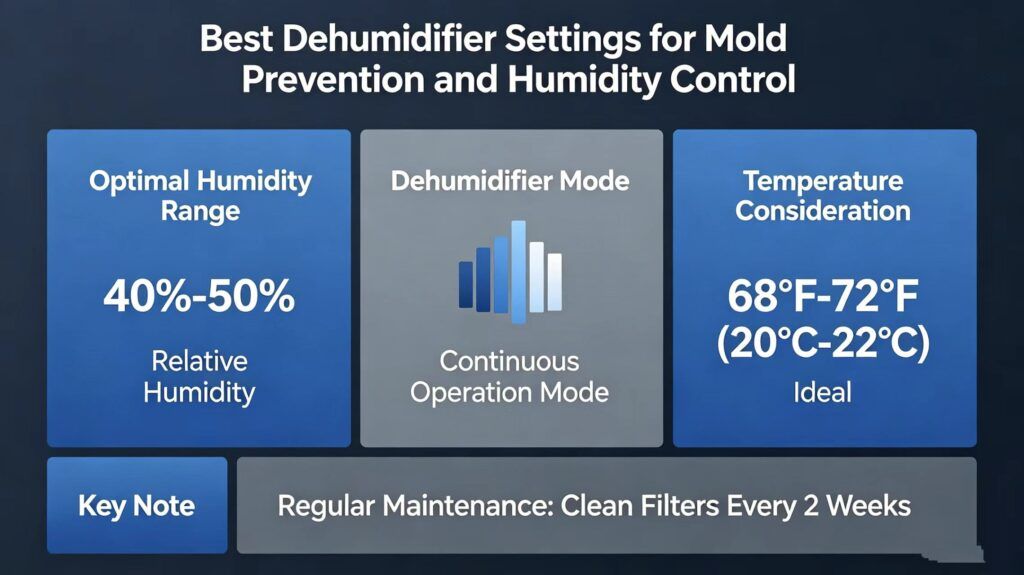
Dehumidifier mold prevention refers to utilizing a dehumidifier to maintain indoor air dryness levels that are inhospitable to mold spore development. Mold loves it when your relative humidity remains over roughly 60%, particularly in closed rooms and around cold walls or windows. By extracting moisture from the air, a dehumidifier works to keep humidity in the safer 40 to 55% range, which reduces mold growth on walls, carpets, furniture, and in concealed nooks. Spaces such as basements, laundry rooms, grow rooms, and bathrooms tend to benefit most from consistent moisture management. To establish background for the remainder of this article, we cover in the following sections how dehumidifiers work, important settings, and easy actions that facilitate long-term mold prevention.
Understand Humidity and Mold
Indoor mold issues nearly always begin with high levels of moisture in the air. Elevated relative humidity provides mold with the moisture it needs and transforms damp surfaces into perfect incubators. If no one is checking the figures, it can stealthily wreak havoc on buildings as well as health.
The Connection
Mold is simple but effective: it needs a food source, oxygen, and water. Food is abundant indoors—drywall, wood, fabric, cardboard, even dust on a windowsill all work. Oxygen is ubiquitous, so water becomes the true catalyst. In so many homes, that water is not a leak; it’s elevated humidity.
When relative humidity remains elevated, particularly above 60%, these mold spores take in moisture from the air and begin to mature on cool or slightly wet surfaces. Mold enjoys the same temperature range that people do, about 16–27°C (60–80°F), which explains why living rooms, bedrooms, and offices often fall right in the sweet spot. Mold can begin growing within 24 to 48 hours on a wall or carpet.
Windows, cold corners, or metal ducts that condensate and slow basement, bathroom, or laundry room leaks accelerate the process. A minor drip behind the washer, steamy showers that never dissipate, and a damp basement floor bring in just enough water to spark new colonies and mildew.
When mold gets going, it doesn’t remain tiny. A coin-sized patch can emit millions of spores per day. Those spores can linger in the air from hours to weeks, travel throughout an entire floor with typical air circulation, and settle in other damp areas. A dehumidifier breaks this cycle by removing the water source in the air and drying borderline surfaces before spores can settle and grow.
Ideal Levels
For the majority of interior rooms, a relative humidity in the 30 to 50 percent range provides a good compromise. Air is pleasant to humans and most typical materials remain sufficiently dry that mold has a hard time germinating.
The trick is maintaining that range around the year. On muggy summer days or extended rain storms, interior humidity can rise rapidly, even if the room seems “a little stuffy.
Anything above 60% RH and you’re in mold and mildew territory, which jumps dramatically from there. At that level, mold can begin new growth on paper, wood, and fabric. Below 60%, it can’t readily start new colonies, even though the ‘old ones’ remain.
Maintaining indoor humidity in the 30% to 50% range is one of the most powerful weapons in your arsenal. A room-sized dehumidifier, calibrated to keep the air under 60%, can nudge conditions out of the mold comfort zone and quickly dry out small damp areas before they develop into visible patches.
Measurement Tools
When it comes to humidity, numbers count more than intuition. Digital hygrometers provide a straightforward relative humidity readout in every room, frequently with a basic interface that presents both temperature and percent relative humidity.
It makes sense to place humidity meters where moisture tends to build up: basements, bathrooms, laundry rooms, near indoor drying racks, and around large aquariums or water tanks. In these areas, humidity frequently runs higher than the general level of the rest of the house.
Spot checks a couple of times a day catch trends. If you notice levels hanging out at 65 to 70 percent following showers, cooking, or heavy rain, that is an early warning sign that more ventilation or dehumidification is needed.
Maintaining a simple log, even a little table on paper or in a phone note, with date, time, room, and humidity reading, will help you observe patterns. When readings remain elevated and surfaces remain damp beyond 24 to 48 hours post-spill, leak, or flood, that’s when you strategize to dry materials quickly or add more drying capacity so mold doesn’t get its 24 to 48 hour window.
Dehumidifier Mold Prevention
Dehumidifiers reduce mold danger by sucking excess moisture from the air. Mold cannot initiate new growth when indoor humidity remains below 60% RH and most homes thrive in the 30 to 50 percent range for both mold control and respiratory comfort. While a dehumidifier doesn’t remove spores, it leaves the air too dry for mold to flourish and keeps surfaces safer.
1. The Right Unit
The unit must be the right size for your room. Select your dehumidifier based on floor area, average moisture load and usage. A tiny bedroom that lingers a bit musty after a shower requires a fraction of the capacity of a damp basement with dripping walls. Look at the litres or pints per day and the rated square-metre coverage. If the room tends to be musty or have damp spots, opt for the next size up, not just the minimum.
Mechanical (compressor) dehumidifiers work for most homes and basements as they deal with higher humidity and perform well above approximately 18 °C. Absorption or desiccant units suit cooler spaces, basements, or unheated storage where compressor types flounder. Mini dehumidifiers, including small thermo-electric models, can help in closets, under sinks, or in a small RV, but they rarely control a full room. For massive open plans, indoor grow rooms, or harsh moisture, commercial dehumidifiers offer greater airflow and duty cycles and are designed for long, consistent operation.
2. Strategic Placement
Place units where air is wettest: basements, bathrooms, laundry rooms, or rooms with aquariums or many plants. A short list helps: “basement corner by sump,” “bathroom with no window,” “room with old leak,” “closet with musty smell.
Maintain a minimum of 15 to 30 cm of space around the unit so it can circulate air. If you stand it up against a wall or the sofa, the coil dries only a small pocket of air and the rest of the room remains humid.
Aim the intake toward the primary moisture source when possible, such as a shower stall, washing machine, or leak point. For long rooms, central placement frequently trumps placing it in one distant corner.
3. Correct Settings
Adjust the humidistat to maintain 40 to 50 percent RH in most inhabited rooms, as this prevents mold and remains pleasant. During very dry seasons, you may permit 50 to 55 percent, but steer clear of extended durations above 60 percent, where mold could flourish.
Change settings as seasons change. In a cold, damp spring, you’ll probably want a lower goal and extended run time than in a warm, dry stint. After water events, such as a carpet spill or small leak, this continuous mode for 24 to 48 hours dries materials quickly enough to prevent mold from initiating.
Verify a separate hygrometer at least once a week in high risk rooms. If values surge, adjust the setpoint or fan speed.
4. Consistent Operation
Mold control demands consistent effort, not sporadic spurts. For mold prevention, run the dehumidifier most days during humid months or in rooms that never fully dry out. Inconsistent use frequently allows humidity to rise above 60%, which is sufficient for spores to rouse themselves.
Timers and smart plugs can distribute run time throughout the day, with extended intervals in the early morning and evening when people shower or cook. This maintains a steady 40 to 50 percent range while still monitoring power consumption.
If the unit logs hours of operation, record them with room average humidity in a basic table. Over time, this indicates how many hours per day you require in each season to remain beneath the mold point.
5. Proper Drainage
Any water that the dehumidifier removes from the air has to go out of the room. Empty the bucket before it fills, usually daily in wet rooms, so the unit does not shut off or overflow. Clean the bucket and surrounding interior surfaces at least once a week so biofilm, bacteria, and mold do not accumulate on wet plastic.
For basement or laundry rooms that regularly encounter moisture, having a direct drain hose into a floor drain or a condensate pump to a higher drain makes the system run without constant daily monitoring. Ensure the hose slopes downwards and is kink free because stagnant water inside a hose can develop mold and even force odors back into the room.
Check the drain path monthly for clogs, slime, or scale. Keeping the bucket, hose ends, and any pump parts clean and sanitized reduces mildew and keeps the unit dry when not in use.
Mold requires a food source, oxygen, and water. Dehumidifiers eliminate only the water. HEPA filters then pick up mold spores in the air, so using both together covers moisture control and spore capture. If you already had mold, you still need to patch that leak, remove the ruined drywall or flooring, and then deploy both a dehumidifier and HEPA purifier to prevent new colonies.
Essential Dehumidifier Maintenance
Dehumidifier mold prevention begins with consistent, basic maintenance. A short checklist helps: clean the air filter, inspect the coils, sanitize the bucket and tank, and check any drain hose. If one of these steps slips, mold can grow in the unit, the machine works harder, and indoor air can carry more spores and odors. Thorough cleaning and inspection every few weeks keep the unit functioning well during heavy workloads of wet seasons and even extend its operating life, reducing repair bills in the long run.
Filter Cleaning
The air filter is the initial line of defense that prevents dust and mold spores from being sucked into the dehumidifier. When it clogs, airflow falls, coils can linger wet, and the risk of mold increases inside the machine. Check and clean the filter every 2 to 4 weeks, or more frequently if the room is very dusty or the dehumidifier runs many hours per day.
Most units include a washable filter that can be whipped out in a matter of seconds. Rinse under lukewarm water, add a bit of mild dish soap, and lightly scrub off film and lint. Rinse thoroughly so no soap remains on the mesh, then allow the filter to dry completely before reinstalling. A soggy filter invites mold.
If the manufacturer says the filter is “replace only,” replace according to their interval, usually every 3 to 6 months. Mark every clean and change date on a basic log or on the calendar. That little log helps prevent you from letting those long gaps slip in and kill the performance.
Coil Inspection
The evaporator and condenser coils do the real work of pulling water from the air, so they require an unobstructed, clean surface. Dust and lint adhere to the fins and hold moisture, which can provide a breeding ground for mold and foul heat exchange. Check both coil sets approximately once a month during heavy use.
Clean coils with a soft brush or vacuum with a brush head. Work in one direction, using only light pressure, to prevent bending the fins. If you see dark spots that do not wipe off with gentle cleaning, a one-to-one mix of water and white vinegar on a cloth can help remove stubborn mold patches. Apply sparingly and keep liquid out of electrical parts.
Keep an eye out for coating build-up, rust, or greasy stains on the coils. Frost that lingers in mild weather, rust spots, or recurrent mold can indicate more serious problems like low refrigerant or restricted airflow. If you notice those signs, arrange for a professional service visit rather than attempting to fix it yourself.
Bucket Sanitation
Any location with stagnant water can breed mold, and the dehumidifier bucket is no exception. Empty and clean the collection bucket and the main water tank if separate at least once a week during humid stretches. This is crucial, as stagnant water is a breeding ground for mold and bacteria, regardless of how clean the room may seem.
Scrub the bucket walls, corners, and handle with warm water using mild dish soap. Rinse well, then spray or wipe with a one-to-one water and white vinegar solution to help kill leftover spores and mildew film.
Make sure to dry the bucket and tank completely before you slide them back in. Wipe with a clean cloth or allow to air dry upside down so no thin water film remains. Investigate for cracks, rough seams, or worn spots where dirt and biofilm can collect, and replace the bucket if you notice any damage. If your unit has a continuous drain hose, ensure it is not kinked or clogged. Backups can leak, raise moisture near the unit, and feed mold.
While drier months mean the dehumidifier may run less often or not at all, it still pays to give the bucket, tank, and hose a quick check and clean before you reboot the dehumidifier for the next humid season.
Dehumidifier Technology Differences
Different dehumidifier technologies wrangle moisture in very different ways, and that alters their ability to halt mold in real spaces. Technology selection impacts energy consumption, operating temperature range, noise, and how close you can maintain relative humidity to the EPA-recommended mold threshold under 60%.
| Type | Best temperature range | Typical use cases | Main pros | Main cons |
|---|---|---|---|---|
| Refrigerant | Warm, ~18–35 °C | Basements, living rooms, warm coastal areas | High capacity, good for high RH, often lower cost | Weak in cold rooms, coils can freeze, heavier and noisier |
| Desiccant | Cool to mild, ~5–25 °C | Small rooms, crawl spaces, cool seasons | Works well in cold air, light, often quieter | Lower capacity per watt, media needs upkeep or replacement |
| Whole-home | Varies, tied to HVAC design | Entire homes, large flats, severe mold cases | Even RH control, high capacity, hidden and automatic | High upfront cost, pro install, not ideal for tiny spaces |
Dehumidifier technology differences. Always tailor technology and capacity to climate, room size, and the real moisture culprit. As a very general rule of thumb, 20 to 30 PPD covers approximately 45 m², while 50 or more PPD covers 230 or more m², both under average ceiling height and intense mold-risk humidity.
Refrigerant
Refrigerant dehumidifiers draw air over cold coils, which causes the water vapor to condense into liquid form and then drain into a tank or out a hose. This cycle is optimal in warm, humid air where the coil remains significantly colder than the air and can easily extract moisture.
These units are ideal for basements, laundry rooms and warm, wet climates, particularly where RH regularly exceeds 70%. Most models allow you to program an adjustable humidistat somewhere in the range of 50 to 55% RH, which inhibits mold but avoids over-drying wood furniture or wood floors.
At low temperatures, coil surfaces approach the dew point and begin to ice. A good auto-defrost is not optional with cool basements. Without it, ice blocks airflow and chops capacity, so runtime and real daily water removal are well below rated PPD.
Most refrigerant units produce approximately 45 to 65 dBA, comparable to a fan or quiet conversation. Therefore, location is important in bedrooms or small offices. Condensate typically collects in a bucket you empty manually, or gravity drains via hose to a floor drain. Sometimes a small pump moves water higher to a sink.
Desiccant
Desiccant dehumidifiers employ a hygroscopic material, such as silica gel or a desiccant wheel, which snatches water molecules even if the air is cold. A heater or regeneration zone then pushes that water off into a smaller airstream and out of the room or into a drain.
They’re perfect for small rooms, sub-ground spaces, boats and cold-season use, where a refrigerant unit would cycle but hardly dehumidify. They don’t require cold coils, so they maintain a more steady capacity over 5 to 15 degrees Celsius.
Most portable desiccant units are lighter and typically quieter than comparable refrigerant models, hovering closer to 40–50 dBA. A tiny 300 g desiccant pot can extract almost a liter of water in its lifetime, but that’s still only about three times its weight, so passive pots are best used as backup rather than primary mold protection in a wet room.
To maintain performance, the desiccant cartridge or wheel requires periodic reactivation or replacement. If the media remains saturated, relative humidity sneaks back above 60 percent and mold danger increases again. Make sure the unit’s humidistat is calibrated and service intervals are in alignment with how moist the area actually is.
Whole-Home
Whole‑home dehumidifiers connect into the ductwork and address air for multiple rooms or the entire house simultaneously, a benefit when moisture sources are distributed, such as bathrooms, kitchens, and a damp basement all circulating the same air mass. They frequently cooperate with HEPA air purifiers, so the humidity decreases as spores become ensnared before they migrate to additional rooms.
They come in handy in bigger properties, buildings with constant groundwater seepage or mold-sore homes where spot units have been unable to do the trick. Their tonnages are far greater than portable models, so runtime and distribution remain even, not running in hot spots from one room to another.
Professional design and installation are key because duct layout, drain routing, and control placement determine whether the system can maintain relative humidity below 60% in all zones. Condensate typically drains by gravity to a sump or direct line. Noise remains in utility spaces, but the fan can still contribute background noise to the HVAC system.
Beyond The Dehumidifier
Dehumidifiers reduce room humidity. Mold prevention requires a comprehensive strategy. Mold requires moisture, organic matter, and a complementary temperature, typically in the 15–27 °C (60–80 °F) range. By keeping indoor humidity under 60% and disrupting one or more of those three requirements, the risk of mold is really reduced.
Ventilation
Daily life pumps a significant amount of water into indoor air. Showers, cooking, laundry, and even people breathing can add approximately 6 to 12 liters of moisture per person per day. Stale air that can’t get out quickly becomes a mold problem eventually. Ventilation expels that moist air and replaces it with drier, fresher air, which remains consistent with what the dehumidifier is already attempting to accomplish.
Practical ways to increase fresh air flow:
- Run exhaust fans in bathrooms and kitchens while they’re in use and for 15 minutes after.
- Open windows on opposite sides of the home generate a cross-breeze.
- Use trickle vents or window vents where available
- Keep interior doors open to avoid dead, stagnant zones
- Run mechanical ventilation or balanced fresh-air where natural airflow is poor.
Bathrooms and kitchens tend to suffer the worst condensation because steamy showers and simmering water force moisture directly onto cold walls, mirrors, and tiles. Fans have to vent to the outside, not into an attic or crawl space, or moisture will migrate instead of escaping.
Combined with dehumidification, solid ventilation provides more control than either alone. Topping off with air purifiers or air scrubbers can help reduce airborne mold spores, which reduces both inhalation risk and the likelihood that they settle onto a damp surface and grow. HVAC filters, ducts, and vents require periodic inspection and sanitizing. Dust caked on fins and inside grilles can trap spores and retain moisture, turning your equipment into a silent mold incubator.
Leak Repair
Liquid water from leaks does more damage than humid air because it imbibes into building materials and remains trapped. Pipes under sinks, behind walls and near water heaters should be examined for slow drips. Check roof flashings, skylights and window frames after heavy rain. When flaking, prompt repair shuts off the continuous water feed that mold would otherwise tap.
Basements and ground floors need extra attention. Whether it’s seepage through old foundations, rooms that were damaged after previous flooding, or hairline cracks in slabs, it can leave behind damp concrete, carpet, or wood. Efflorescence on walls, musty odors, or peeling paint are all signs of hidden moisture.
Seal cracks in floors, ceilings and walls because it blocks future water and makes humidity easier to control. At the same time, gutters and downspouts have to remain clear and be properly sized to divert rain away from the structure, not dump it near the foundation where it can work its way back inside.
Surface Cleaning
Routine surface maintenance prevents spores from landing long enough to mature, particularly when combined with moisture control and leak fixing. Surface cleaning addresses the ‘organic material’ mold requires, like soap scum, skin cells, dust, and food residues.
Simple cleaning habits for wet zones:
- Wipe sinks and counters daily, especially around faucets
- Rinse and squeegee shower walls and doors after use
- Wash tile grout and caulk lines on a schedule.
- Vacuum and wipe dehumidifier, laundry room trays, filters, and floor pans.
- Wash and fully dry bathmats and cleaning cloths
Porous materials such as carpets, wood flooring, and upholstered furniture can retain water deep within and therefore might require targeted sanitization or specialized treatment if mold is suspected. Wet rugs, cardboard boxes, and fabric stored in damp rooms should be dried within 24 to 48 hours or removed, as this is the window before spores typically germinate.
Any wet surface – a spill, an indoor rain leak, a dripping window – must be dried quickly with fans and dehumidifiers. Your mist-free humidifier can work with your dehumidifier to maintain humidity in a nice mid-range, balancing comfort and airways while staying just below that 60% boundary where mold can go wild.
A simple written plan helps in homes or buildings with repeat mold trouble: note who checks humidity, who inspects for leaks, how to clean small spots, and when to call a mold remediation professional. Dehumidifiers do best with annual check-ups so they keep pulling water as expected and do not become moldy devices themselves.
The Sizing Misconception
Dehumidifier “size” isn’t about the box. It refers to how many pints of water a unit can extract from the air in 24 hours, and both undersized and oversized units can misshape mold control. Correct sizing consistently connects output to square footage and actual humidity levels, not speculation or advertising terminology.
| Area (m²) | Approx. area (sq ft) | Moisture level | Recommended capacity (pints/day, current rating) |
|---|---|---|---|
| 23–37 | 250–400 | Slightly damp | 20–25 |
| 37–56 | 400–600 | Damp | 25–35 |
| 56–74 | 600–800 | Very damp | 35–45 |
| 74–93 | 800–1,000 | Very damp | 40–50 |
| 93–112 | 1,000–1,200 | Very damp / wet | 50–70 |
For instance, an 800 sq ft very damp basement might require 40 to 50 pints. A 1,000 sq ft very damp basement might require 50 to 70 pints. In either case, a 30-pint unit would be undersized and probably leave surfaces cool and clammy. Mold can still grow on your walls, joists, and stored things. Local climate shifts the target. In high-humidity regions, you usually move up one capacity band because outdoor air keeps feeding new moisture indoors.
Dehumidifier ratings changed in 2019. A unit that tested 70 pints under the old test might now test 45 to 50 pints under the new, but it’s the same machine. This is the Sizing Myth — pre-2019 and post-2019 pint values do not correspond one to one, so when you replace a unit, size it with the new rating, not the old sticker you recall. They believe a ‘new’ 30-pint model is defective when the issue was its capacity never suited the room size or moisture load to begin with.
Too large and humidity gets stuck above the proper range, approximately 50 to 55 percent, so mold prophylaxis remains a guess regardless if you dump the bucket or wipe walls.
Undersized Risks
An undersized dehumidifier just can’t pull moisture out as fast as it comes in, so humidity stays high, walls stay damp and mold maintains a grip on corners, beneath carpets and within closets. A 30-pint unit in a 1,000 square foot very damp basement fits this pattern. It will work hard, but the air may still sit at 65 to 70 percent relative humidity.
You commonly observe these little ones run near 100%. They hum away all day, the bucket fills, but the room never really feels dry and a hygrometer continues to read too high, above the target range. That ‘always on’ does not mean they are ‘strong’; it means they’re late.
This constant load adds wear and tear. Compressors and fans overheat, filters get clogged sooner, and components break down sooner, setting you up for more repairs and a diminished lifespan. If the space still smells musty after weeks of use and humidity readings stay high, the best solution is often to upgrade to a larger capacity unit aligned with your square footage and moisture level.
Oversized Problems
An oversized dehumidifier overshoots in the other direction. It sucks moisture so fast that it reaches the set point quickly, shuts off, then restarts again soon after. These short, sharp cycles imply frequent parts switching, but the air in dead corners, closets, and behind furniture may never mix and dry well.
Short cycles reduce filtration time. The unit doesn’t run long enough per session to circulate all the room air through its coils and filter, so it sucks up less dust and mold spores than its rating would imply. You might observe decent mean humidity figures yet still find mold patches on chilly exterior walls or in stagnant corners.
Oversized models can be energy wasters. They pull more power per start, cycle frequently, and offer negligible additional advantage over an appropriately sized model that operates in longer, smoother cycles. For mold prevention, it isn’t brute force; it’s stable humidity in the entire room.
Match capacity to the real room air volume, moisture load (bare soil floors, constant seepage, laundry, showers, etc.) and local climate. Then choose the smallest unit that will keep humidity controlled year-round.
Conclusion
If you want to keep mold at bay, control moisture first. A dehumidifier goes a long way, but it’s not a solo act. OK air flow, consistent cleaning and quick leak repair all pitch in.
Grow rooms, basements and tight indoor spaces all have the same threat. Warm, moist air stagnates. Surfaces remain wet. Mold begins quickly. A right size unit set to the right level slashes that risk in a tangible way.
Smart growers don’t pursue a gigantic size unit by default. They align the unit with the room, the crop and the actual load. If you’re trying to hack mold and still save watts, re-evaluate your humidity strategy today and optimize your configuration.
Frequently Asked Questions
How does a dehumidifier help prevent mold growth?
A dehumidifier reduces indoor humidity, typically to 40 to 50 percent. Mold requires extra moisture to flourish. When air is dry, surfaces remain drier, so mold spores have a more difficult time settling, growing, and spreading in your home.
What humidity level should I keep to stop mold?
Try to maintain 40 to 50 percent relative humidity. Above 60 percent, the mold danger escalates rapidly. Use a hygrometer to monitor. Set your dehumidifier setting and fan speed until humidity remains steady in this safe zone throughout the day.
How often should I clean my dehumidifier to avoid mold inside it?
Scrub the water tank at a minimum of once weekly. Just rinse and sanitize with mild soap or a safe cleaner. Wipe coils and housing monthly. Swap or clean filters as the manual directs. Routine cleaning prevents mold growth within the unit.
Can the wrong dehumidifier size cause mold problems?
Yes. An undersized unit might never achieve safe levels. An oversized unit can short-cycle and not remove enough moisture. Pair the dehumidifier capacity with room size, moisture load and climate to keep humidity balanced and mold at bay.
Are desiccant and compressor dehumidifiers different for mold prevention?
Both lower humidity, but they operate differently. Compressor units are really best in warm, humid rooms. Desiccant types are more effective in colder rooms. Selecting one that is properly sized for your temperature and humidity level prevents mold and saves energy.
Do I still need other mold prevention steps if I use a dehumidifier?
Yes. A dehumidifier is just one piece of mold control. Seal leaks, ventilate, and waterproof. Run exhaust fans while cooking and bathing. Mold likes to come back, so clean the damp-prone areas often.
Can a dehumidifier remove existing mold?
A dehumidifier prevents mold growth by drying out the air. It doesn’t kill or remove mold on walls, furniture, or fabrics. You still require thorough cleaning, removal of compromised materials, and perhaps professional remediation.