
Building 34, No. 535 Shunfeng Road, Hangzhou, Zhejiang, China
[email protected]
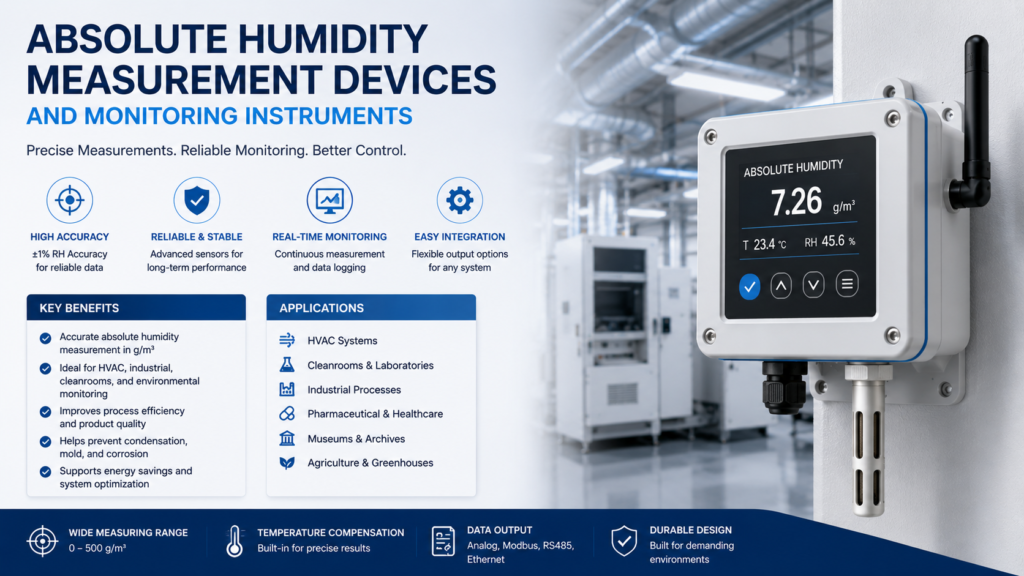


Absolute humidity measuring instruments are instruments that indicate the quantity of moisture in the air in grams per cubic meter. They provide a direct value, not just a relative percentage, so growers and engineers see the actual moisture load in a room or duct. In highly engineered indoor environments — grow rooms, cleanrooms, drying rooms — that information is used to properly size dehumidifiers, design air flow, and keep products within narrow quality specifications. Most devices integrate temperature, relative humidity, and pressure sensors and then calculate the absolute humidity on the fly. To steer application, the feature headliners major device types, how they operate, precision constraints, and what counts most when selecting one for indoor farming and beyond.
Absolute humidity is the quantity of water in terms of mass, suspended in a particular volume of air. It is typically expressed in grams per cubic meter (g/m³). In psychrometry, it is usually denoted as ρv and expressed as the mass of water vapor in 1 m³ of humid air. It considers water vapor as an actual substance in space, measurable and quantifiable, not in percentages or ‘how humid it feels’.
Absolute humidity is the true quantity of water vapor in the air, in physical units, without reference to that air’s temperature. It describes moisture content directly, as a density: how many grams of vapor sit inside each cubic meter of air. If it contains 10 grams of water vapor per cubic meter of air, then its absolute humidity is 10 grams per cubic meter, and that remains constant until water vapor is added or subtracted.
Absolute humidity isn’t a ratio like relative humidity. It’s a straightforward measure. It does not scale with saturation level. It just reports how much water vapor mass is present. The basic formula is:
Ρv = mv / V = 1 / vv
Where ρv is absolute humidity, mv is the mass of water vapor, V is the volume of air-vapor mixture, and vv is the specific volume of water vapor per unit mass. Due to this direct connection with mass and volume, absolute humidity is used extensively in meteorology, HVAC design, drying processes, and indoor grow rooms that require precise moisture monitoring.
Relative humidity (RH) contrasts how much moisture air contains with how much it might contain when saturated at the same temperature. It’s a %, so it’s strongly temperature dependent. The equivalent absolute humidity can indicate very different RH values. For example, 10 g/m³ might be around 50% RH at 25°C but 100% RH at 10°C, because colder air saturates with less vapor present.
The absolute humidity is constant as the air warms or cools, so long as no moisture is added or drained. If a cubic metre of air contains 10 g of water vapour, it contains 10 g per cubic metre whether you heat it or cool it. Relative humidity, by contrast, goes up when air cools and down when air warms, even if the absolute humidity remains constant.
Humidity is often expressed in three main ways:
| Metric | What it measures | Unit | Depends on temperature? |
|---|---|---|---|
| Absolute humidity | Mass of water vapor per volume of air | g/m³ | No (for a fixed volume) |
| Relative humidity | Ratio of actual vapor to saturation level | % | Yes |
| Specific humidity | Mass of water vapor per mass of moist air | g/kg (or kg/kg) | Weakly, via air density |
Selecting the appropriate metric depends on the objective. Use absolute humidity when you’re interested in actual moisture content in an environment or process, like sizing dehumidifiers, tuning drying lines, or protecting stored goods. Use relative humidity when you care about comfort, condensation potential, and how close air is to saturation at a given temperature.
CO2 and temperature are important. Accurate absolute humidity data is key for healthy indoor spaces. When absolute humidity remains elevated, surfaces and organic materials can remain damp long enough for mold and bacteria to develop, even if RH fluctuates during daylight hours. Monitoring ρv provides clear targets for ventilating, dehumidifying, or humidifying homes, offices, hospitals, and indoor farms.
There are many industrial lines — food drying, pharmaceuticals, printing, lithium batteries — that require strict regulation of absolute humidity to maintain quality standards. If the air is too dry, products can crack, shrink, or lose weight. If it is too humid, they won’t dry on schedule, could stick together, or even promote bacterial growth. By knowing the moisture content in g/m³, engineers can tune air conditions to process targets instead of comparing guesses from RH alone.
Weather and climate work to apply absolute humidity to track the true water content in the lower atmosphere. Forecasters use this information to forecast fog, cloud base height, and rain potential. Saturated air at 20°C contains approximately 17 g/m³ compared to roughly 44 g/m³ at 37°C, so a change in temperature at constant ρv alters how close the air is to forming clouds or dew.
Get the humidity levels wrong and people feel less comfortable, static and dust become more abundant, and sensitive gear like electronics or sensors may drift or fail. Absolute humidity provides a stable reference point that enables superior control strategies in HVAC, cleanrooms, and any controlled environment.
Absolute humidity is the mass of water vapor in a given mass of air, commonly in grams per kilogram of dry air, and it connects to air temperature and pressure via the Ideal Gas Law. In reality, sensors utilize alternative physical effects to detect water vapor and then translate this into absolute humidity with psychrometric equations, dew point relationships, or instruments like the Mollier diagram and saturated vapor pressure tables.
Common absolute humidity measurement devices include:
Each device type relies on a different principle: capacitance, resistance, thermal conductivity, or spectroscopy. A few high-end systems use mass spectrometers as moisture transducers. The correct selection is based on required accuracy, response time, anticipated range of humidity, and environment type (harsh, clean, etc.). Building a small comparison chart of sensor type, range, accuracy class, and typical use (for example, clean room, greenhouse, process gas line) helps match the method to the application.
Capacitive humidity sensors have a thin dielectric that absorbs water vapor and alters its capacitance. Electronics monitor that change and relate it to humidity. Software can translate it to absolute humidity in grams per kilogram with the Ideal Gas Law and current air temperature and pressure. They respond quickly to fluctuations, maintain high accuracy over a broad span, and appear in countless HVAC controllers, IAQ stations, and digital hygrometers in storerooms or grow facilities. Since their reading can drift with time, dust, and exposure to high humidity, regularly calibrate them against a reference, especially in locations with large temperature swings or where accurate dew point-based absolute humidity calculations are important.
Resistive sensors utilize a hygroscopic layer, the electrical resistance of which decreases or increases as it absorbs moisture. A straightforward circuit detects that resistance and translates it to a humidity reading.
They’re inexpensive and found in portable meters, entry-level home humidistats, and low-stakes monitoring where some accuracy is good enough. At very high or low humidity, they generally exhibit more error and slower stabilization, so they come best fit when you want a rough absolute humidity estimate instead of tight control.
Thermal conductivity sensors, which measure heat flow through a gas path with dry and moist air, as water vapor affects the rate of heat transfer. The electronics sense the temperature or power difference and back-calculate humidity, which can then be converted to absolute humidity through psychrometric relations or a Mollier diagram if you want a visual check.
These probes are rugged, handle dust and some particulates with ease, and react rapidly to humidity surges, rendering them valuable in industrial flues, dryers, or stacks. They perform well in situations where air conditions change quickly and mechanical strain or contamination would reduce the lifespan of more fragile capacitive or resistive components.
Dew point sensors measure the temperature at which water vapor begins to condense on surfaces, which is the dew point temperature. A chilled-mirror dew point hygrometer, for instance, chills a small surface until liquid forms and then maintains that temperature with great accuracy.
Dew point ties directly to the saturation vapor pressure of water. Once you know dew point and actual air temperature, you can use saturated vapor pressure tables or psychrometric equations to compute absolute humidity. This is why dew point instruments are the go-to tools in HVAC, refrigeration, compressed air, and critical spaces such as labs and clean rooms where strict moisture control is necessary and absolute humidity must remain in tight bands.
Spectroscopic devices measure how water vapor absorbs certain wavelengths of light, generally in the infrared, or alternatively employ mass spectrometers as exquisite transducers. Based on the absorption spectrum, they deduce the exact water vapor concentration and provide absolute humidity directly, even at trace levels.
These systems can be non‑contact, operate in real time, and monitor rapid fluctuations in gas flow, assisting in research laboratories, precision process control, and weather reporting. In gas drying or specialty manufacturing, engineers factor in the latent heat of vaporization, the heat required to convert 1 gram of water into vapor (J per gram), because it defines energy loads when moisture content changes. In those instances, spectroscopic or mass spectrometer‑based methods provide the accurate absolute humidity information required to size equipment and tune control loops.
Pick the device by beginning with the task it has to perform. Then test it to see whether it will survive and remain accurate in your actual environment. Finally, consider the price.
Define where you will measure absolute humidity: HVAC ducts in a commercial building, a growth chamber, a warehouse, a clean laboratory, or a compressed air line at several bar. It varies greatly. A handheld thermo-hygrometer that works fine in a storage room is not appropriate for high-pressure compressed air or a sterile bioreactor line.
About: Pick Your Ruler For regular room monitoring, a basic handheld meter with rudimentary data recording might suffice. If you are doing process control in a dryer, for example, you could use a fixed transmitter with analog outputs and digital communication, a fast response and clear specs on linearity, hysteresis, repeatability and long-term stability. Determine if you require continuous or spot monitoring. Many of them use stationary transmitters for alarms and a different handheld device to confirm readings.
Key features to review up front:
Look at the full set of conditions around the sensor: typical and extreme temperature, humidity, and pressure, plus dust, aerosols, or vapors. Ambient room air with mild dust requires significantly less protection than an exhaust duct with fine powder or a greenhouse with pesticide spray.
Pick tools with metrics that fit this truth. Review the specified operating temperature range, any pressure limits, and IP (ingress protection) class. Most probe-style sensors require protective filters, outdoor radiation shields, or sintered caps to prevent droplets and grime. In cases of corrosive gases or solvents, use chemical-resistant materials and sensor types.
Sensor siting is just as important as the sensor. Put probes in locations where the air flow is representative, not in dead corners or strong jets. Steer clear of direct sun, hot or cold surfaces, and local moisture sources such as humidifier outlets, as these do bias the readings. For true absolute humidity, maintain the sensor in good thermal contact with the gas so it reaches thermal equilibrium. If the probe is colder or warmer than the air, absolute and relative humidity readings will be inaccurate.
Begin with what tolerance your process can tolerate. In an office, plus or minus 3 percent relative humidity may be fine. In a pharmaceutical cleanroom or seed storage room, you may need plus or minus 1 percent relative humidity or tighter over a defined range. If your control limits or standards, for example, GMP or ISO guidelines, are tight, factor in a safety margin and opt for higher-grade devices.
Check accuracy, resolution and repeatability over the entire stated range – not just at one point. Precision generally falls off at either very low or very high humidity, so peruse the fine-print tables. Resolution must be sufficiently fine that changes you care about leap out of noise. Review stability specifications: a sensor that drifts 1 percent RH per year may be fine in noncritical spaces but not for a calibration lab.
Calibration practice is huge. Certain instruments provide simple on-site calibration or in-tool reference checks. Others have to return to the factory, increasing cost and downtime. Multi-point calibration typically provides more accuracy and linearity throughout the measurement range than a one-point check, which primarily corrects at one humidity. Now decide how frequently you need calibration. Severe or dusty environments frequently require shorter intervals than pristine, stable labs.
Remember, humidity is tied to temperature as well. Relative humidity equals partial water vapor pressure divided by saturation pressure at that temperature. Since saturation pressure varies with temperature, even minor temperature errors can introduce significant relative humidity errors, and that cascades into errors when you calculate absolute humidity. See how strongly the sensor output depends on temperature and how well the device compensates for this.
Don’t just consider the sticker price. Plan the full cost over the device life. Add in calibration fees, shipping and downtime, replacement filters or probe caps, and anticipated sensor swan cycles. A lower-cost sensor requiring constant recalibration or that breaks down in harsh conditions can end up costing far more than a rugged industrial probe with a higher initial cost.
Consider the cost of inaccurate information. In a drying operation, an absolute humidity measurement error may produce under-dried product, mold, or wasted energy from over-drying. For compressed air systems, poor dew point control can cause lines of water, corrosion, and machine faults, which are usually orders of magnitude more expensive than a superior dew point transmitter. For mission-critical environments, such as pharmaceutical storage, semitools, or legal-for-trade conditions, it often makes sense to pay for top-notch instruments with demonstrable stability and obvious traceable calibration.
Additional features add value and cost. Data logging, remote monitoring, and integration into a building or process controls are instrumental in helping to spot trends and prove compliance. All that effort is wasted if no one actually uses the data. Wireless connections and cloud-based systems might reduce the expense of physical cabling and introduce their own maintenance and security requirements. Balance those advantages against your real tracking habit so you don’t overpay for features you won’t need.
Absolute humidity is the actual water vapor mass per unit volume of air, usually denoted ρv and measured in grams per cubic meter (g/m³). It sits alongside specific humidity and relative humidity as one of three primary methods to characterize air moisture, each fulfilling a distinct purpose. Air fully saturated at 20 °C contains about 17 g/m³, while at 37 °C it holds approximately 44 g/m³. The same relative humidity can translate into very different actual water loads in warm and cool spaces. These differences are critical to know when you select and position absolute humidity measurement devices for health, product, safety and energy objectives.
Our health is dependent on how many grams of water vapor are in each cubic meter of air, not only relative humidity. As absolute humidity climbs, sweat cools less and evaporation from skin slows. The risk of heat stress rises even if temperature doesn’t budge much. Low absolute humidity dries out mucous membranes, exacerbating asthma, allergies and other respiratory issues, while mid-range moisture keeps the airways clear and less reactive.
Higher humidity can increase the survival of certain airborne pathogens, while extremely dry air allows droplets to remain airborne for longer. There is frequently a tight band of absolute humidity that reduces spread risk in schools, offices, and clinics. At the same time, an excess of moisture feeds mold and dust mites in carpets, beds, and ductwork. Very dry air produces itchy skin, chapped lips, and eye irritation.
Humidifiers, dehumidifiers, and precision hygrometers provide immediate control in this area. Electrical hygrometers, psychrometers (wet and dry bulb pairs), and dew point meters can all track moisture, and when tied to simple controls, they help keep homes, hospitals, and public buildings within a healthy range.
Many materials require constant absolute humidity in storage and processing. Wood swells and shrinks with moisture, so furniture, flooring, and musical instruments can warp or crack if the air oscillates from very dry to very damp. Fabrics absorb and shed moisture and may shrink or generate static. Paper goods curl or lose durability when the humidity in the air wanders outside established thresholds.
Accurate humidity measurements enable you to establish stricter limits on these hazards. In food plants, absolute humidity impacts drying lines, coating steps, and shelf life because too much water vapor can send products toward mold while too little dries out baked goods or powders. Pills and capsules can attract moisture from the air and lose dose accuracy or crumble, and electronics can corrode or malfunction when stored or manufactured in air that is close to the dew point. When dew point temperature equals actual air temperature, relative humidity is 100 percent and surfaces are highly prone to condensation.
Industry typically employs electrical hygrometers, psychrometers, and dew point meters to monitor these levels, as each instrument suits a slightly different process range. Periodic inspections and calibration, together with dehumidifiers, local exhaust, and sealed storage maintain absolute humidity within a tight range to ensure product consistency from lot to lot.
Since a number of industrial processes are sensitive to water vapor, absolute humidity becomes a safety factor, not just a comfort control. Certain chemistries decelerate or accelerate when the air contains more humidity, which can affect reaction yields or generate side products if plant air is not tightly regulated. Powder handling is another factor, as muggy air can cause dust to agglomerate or alter its propensity to explosively ignite, while very dry air can exacerbate static discharge hazards.
Excess humidity frequently manifests as condensation on chilled tanks, pipes, or control panels. That thin water film can initiate corrosion or seep into electrical components. Over time, that increases the probability of shorts, nuisance trips, or in a worst-case scenario, arcs in dangerous areas. In solvent, gas, or fine particle handling areas, humidity sensors tied to an alarm provide early warning when conditions drift out of safe ranges.
Psychrometers and dew point meters remain common here because they connect measurements to definite physical benchmarks, such as wet-bulb cooling or initial condensation, even as advanced electrical hygrometers provide quick digital measurements. Regular maintenance, including cleaning probes, inspecting psychrometer wicks, and performing field calibrations, ensures readings stay within spec. Process safety guidelines rely on accurate information.
Absolute humidity influences how much energy a building requires for cooling and heating. If air in a space contains more water vapor than it should, HVAC systems must circulate and condition more air to draw that moisture out, resulting in oversized equipment and elevated operational costs. When control systems know the actual ρ_v in supply and return air, they can match dehumidifier or humidifier output more closely to the actual load and avoid waste.
Properly sizing this equipment requires accurate absolute humidity rather than simply relative humidity. Relative humidity varies with temperature, so 50% at 26 °C contains more water than 50% at 18 °C. Without this information, systems will short cycle or operate at the incorrect capacity. The water content of air, be it absolute, specific, or relative humidity, alters the perception of warmth. With well-set humidity, sweating serves as a cooling mechanism since evaporation from the skin remains effective. This increases comfort and frequently allows setpoints to drift a bit higher in summer or lower in winter without sacrificing comfort.
Dew point meters and electrical hygrometers can provide input to building automation and smart control platforms, which in turn can adapt airflow, coil temperatures and outdoor air intake based on temperature and water vapor. This blend can enhance coil heat transfer, reduce latent loads and maintain indoor air quality to target limits with less energy use. Knowing the real-world difference between absolute and relative humidity assists designers and operators in selecting the appropriate sensor type, specifying setpoints and maintaining equipment efficiency over time.
Absolute humidity instruments are valuable instruments only so long as their measurements remain consistent day after day. That relies less on the spec sheet and more on how the sensor is selected, installed, calibrated, and maintained throughout its service life.
Take traceable calibration standards as the baseline. That is, salt solutions, reference hygrometers, or certified humidity generators tied to national metrology labs. For absolute humidity, couple these with precise temperature and pressure references, as all three values feed the final result. Even modern capacitive sensors, typically rated from 0 to 100% RH and wide temperature ranges, such as minus 40 to plus 180 degrees Celsius, still drift and require this check.
Keep a calibration log for each device: date, method, reference values, offsets applied, and who did the work. Over time, this record reveals drift trends and aids in determining when a probe should be replaced rather than recalibrated. Periodic confirmation using a handheld reference meter or duplicate sensor at the same location provides an extra safety blanket, particularly in critical labs or clean rooms.
If you’re in regulated or high-risk environments, adhere to ISO or respective national calibration standards and establish specific recalibration periods. Make the interval dependent on exposure level, process importance, and manufacturer recommendations, not on a ‘once a year’ rite. High humidity, dusty, or chemical-heavy sites require shorter cycles, while clean, stable environments can go longer without loss of reliability.
Temperature swings alter both sensor behavior and the physics of water in air, so they impact absolute humidity readings severely. Most accurate RH probes of the last decade or so are combined temp/humidity elements with built-in compensation, and they can even output dew point, enthalpy, and absolute humidity calculations directly. That only works as promised when you calibrate at or near the actual operating temperature, be it a cold storage room or hot drying line.
Service is just as important as hardware. Locate sensors away from heaters, direct sun, cold walls, and supply vents venting hot or cold air directly on the probe. If a process runs across a wide band, for example, minus 20 to 80 degrees Celsius, verify that the sensor’s rated temperature range and accuracy exist across that band and confirm in the field with spot checks.
Absolute humidity is pressure-dependent, so high altitudes, test chambers and pressurized ducts can shift results if you neglect barometric variations. Devices with built-in pressure inputs or automatic pressure compensation keep the calculations consistent when ambient pressure drifts away from standard.
Where the sensor itself doesn’t correct for pressure, apply manufacturer-provided correction factors or your own pressure compensation algorithms in the monitoring software. Log pressure along with humidity and temperature so audits and root-cause checks can trace whether some drift came from hardware, pressure shifts, or both.
Dust, aerosols, and chemical vapors gradually clog or chemically assault sensing elements, resulting in sluggish response, hysteresis, or offset at elevated or low humidity. Select probes with appropriate filters or housings when you’re working in powder processing, exhaust ducts, or industrial drying, and verify that these options do not skew the sensor beyond its rated response time or precision.
Some designs require special attention. Hair hygrometers in low humidity beneath approximately 40% RH require regeneration from time to time by the maker’s technique, or they become insensitive. Capacitive probes tend to fare better across broad ranges, including 0 to 100% RH, but still require periodic, gentle cleaning and inspection.
Set a short checklist: visual check for damage or condensation, filter condition, sensor cleaning status, response-time test, and data drift review against a reference device. If you see recurrent drift that calibration can’t fix, replace the sensor head and log the replacement for quality and compliance.
The new generation of absolute humidity and dew point instruments will combine closer physical precision with wiser, more connected application in real systems, from cleanrooms to greenhouses and data centers.
Thanks to clever integration, the humidity sensor is no longer a loner. Devices already connect to IoT platforms so users can monitor absolute humidity, dew point, and temperature from any browser or phone. On one dashboard, a lab manager can compare rooms across cities, flag outliers, and generate weekly reports without setting foot on the floor.
Real-time data powers automatic control. HVAC and process controllers can read absolute humidity or dew point and then tune fans, dampers, reheat coils or steam injection on their own. This reduces energy consumption while preserving tight bands for comfort, static control, or product drying. Portable data collection is nothing new, but wireless links and cloud storage make this data easier to share with facility, quality, and maintenance teams in one place, rather than in separate loggers.
Continuous measurement streams feed predictive maintenance. Smart analytics can learn normal patterns, detect sensor drift, plugged lines or coil condensation risk and initiate work orders before a failure. This sort of analytics still relies on fundamental physics like the Ideal Gas Law, but it overlays it with new-age instruments so each data point pulls more weight. Calibration routines against known standards will remain paramount here because other bad input data renders any “smart” function suspect.
Miniaturization is already transforming when and where we measure moisture. Small, battery-powered meters that fit in a pocket aid in field checks in cold rooms, ducts or tight process equipment, where older gear was too bulky.
Miniaturizing sensor technologies allows manufacturers to integrate humidity and dew point sensing into wearables, smartphones, or compact smart devices. A service tech could employ a phone-based probe to check dew point near a compressed air line, or a home air purifier could tailor output based on actual absolute humidity. Smaller designs tend to lead to lower power draw and faster response, so they’re ideal for wireless nodes and energy-harvesting tags. This enables dense networks in homes, vehicles, and industrial implements, where dozens or even hundreds of inexpensive probes monitor humidity, curing, or employee comfort simultaneously.
Materials are going to facilitate the greatest jump in sensor performance. Research labs now test graphene films, tailored polymers, and other nanostructures for stronger, cleaner signals when water vapor shifts. For the past 30 years, the dew point and humidity sensor literature exhibits consistent increases as each new material class comes along, and that pattern appears likely to continue.
These materials can increase precision and reduce drift, which is critical given that high-precision dew point is still a tough nut to crack, particularly at extremely low moisture levels. Corrosion-resistant and even self-cleaning coatings seek to keep sensing surfaces stable in grimy air, exhaust, or chemical storage, so calibration periods extend as traceability to standards remains robust.
Future designs will keep using a mix of methods: optical, resonance, electrical, thermal, gravimetric, and chemical sensing. Some will measure dew point directly, while others will infer it from absolute humidity and temperature. This division into direct and indirect techniques, and into families by working principle, remains helpful for users selecting an appropriate instrument. Work by experts such as Dr. Nie demonstrates how innovative new structures and hybrid approaches can cut noise, enhance selectivity, and limit cross-talk from other gases, which makes AI-driven analytics more robust.
Users who track these developments, demand transparent calibration information, and align sensor type to application will benefit most from this new era in humidity and dew point measurement.
To summarize, absolute humidity provides definite, concrete figures on water in air. It is directly connected to plant health, shelf life, indoor comfort, and lab work. A grow room, a cold store, or a clean room all gain from the same thing: solid, stable readings that you can trust.
Handheld meters suit spot checks in the field. Absolute humidity measurement devices, including fixed probes and smart sensors, provide tight control in farms, plants, and labs. Data loggers assist in tracking slow trends, such as mold risk in storage or stress in crops.
To help you navigate, we’ve broken down the devices by your location, budget and need for specificity. Then begin to monitor, contrast and optimize your air so every room accomplishes the task you desire.
Absolute humidity refers to the real amount of water vapor contained within a specific volume of air, typically measured in grams per cubic meter (g/m³). Relative humidity is a percentage of how close the air is to saturation at a given temperature.
Absolute humidity is measured with hygrometers, humidity transmitters, and thermal hygrometers. Most measure temperature and relative humidity and then compute the absolute humidity. More sophisticated instruments are chilled-mirror hygrometers and industrial humidity probes.
Start with your application: indoor comfort, industrial process, or lab use. Then consider measurement range, accuracy, calibration capabilities, and whether you need digital output. Select instruments from trusted manufacturers that provide traceable calibration certificates and transparent documentation.
Professional and industrial sensors typically need to be calibrated every 6 to 12 months. Harsh conditions, such as high temperature, dust, or chemicals, may necessitate more frequent calibration. As with any absolute humidity measurement device, always adhere to the manufacturer’s recommendations and test yourself against a reliable standard.
Absolute humidity is an important factor in comfort and health and for building materials. Too little moisture causes dry skin and static. Excess humidity heightens mold risk and destroys finishes. Measuring absolute humidity keeps things stable and protects people and equipment.
Yes. Most current humidity sensors measure temperature and relative humidity and compute absolute humidity within the sensor. Others show grams per cubic meter directly. You can use psychrometric formulas or software tools to convert values if your device doesn’t.
For the majority of indoor and HVAC applications, ±2 to 3 %RH equivalent accuracy tends to be sufficient. For critical industrial or lab work, choose high-precision devices with lower uncertainty and documented calibration traceable to recognized standards.


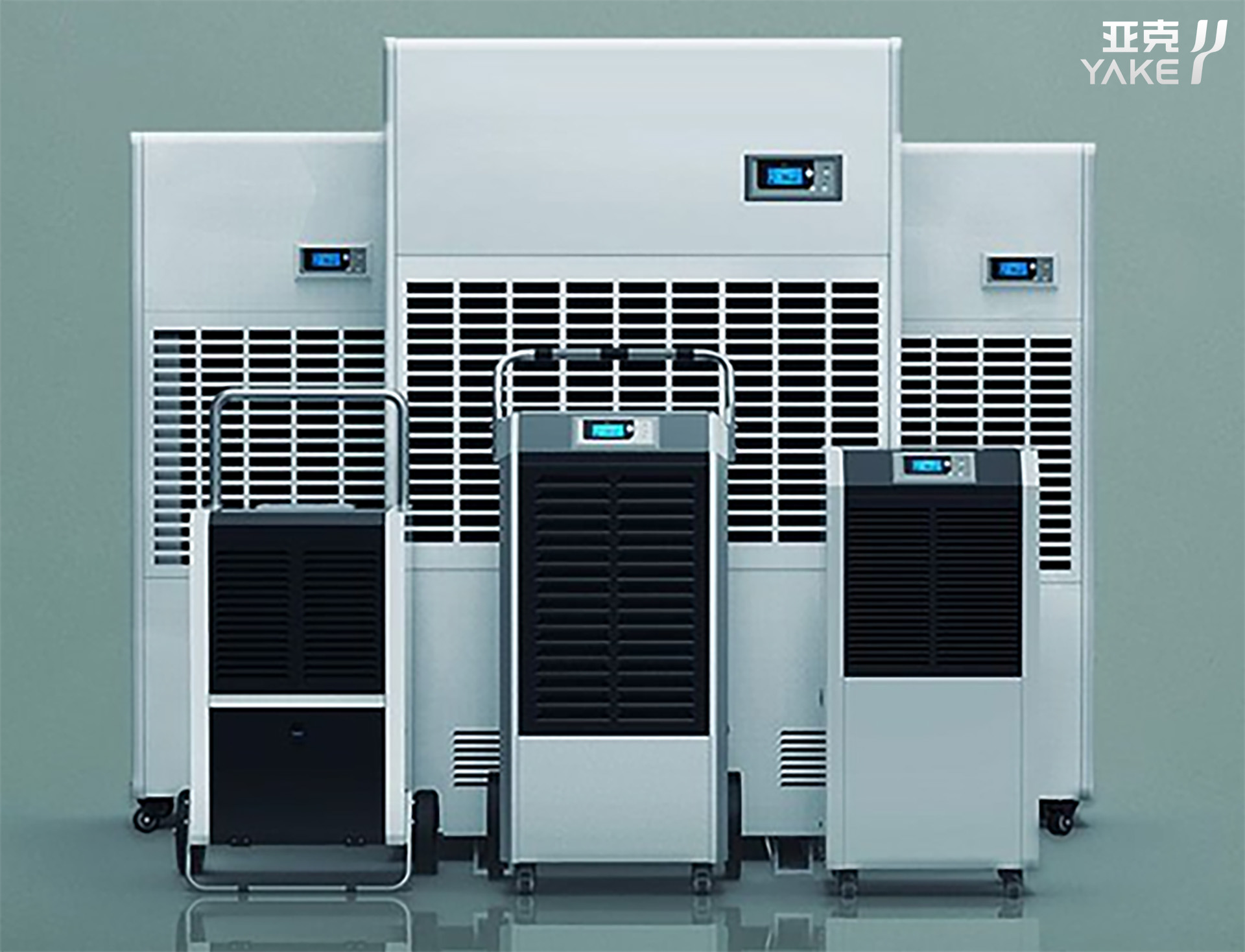
Contact us to find the best place to buy your Yakeclimate solution today!
Our experts have proven solutions to keep your humidity levels in check while keeping your energy costs low.