
Building 34, No. 535 Shunfeng Road, Hangzhou, Zhejiang, China
[email protected]
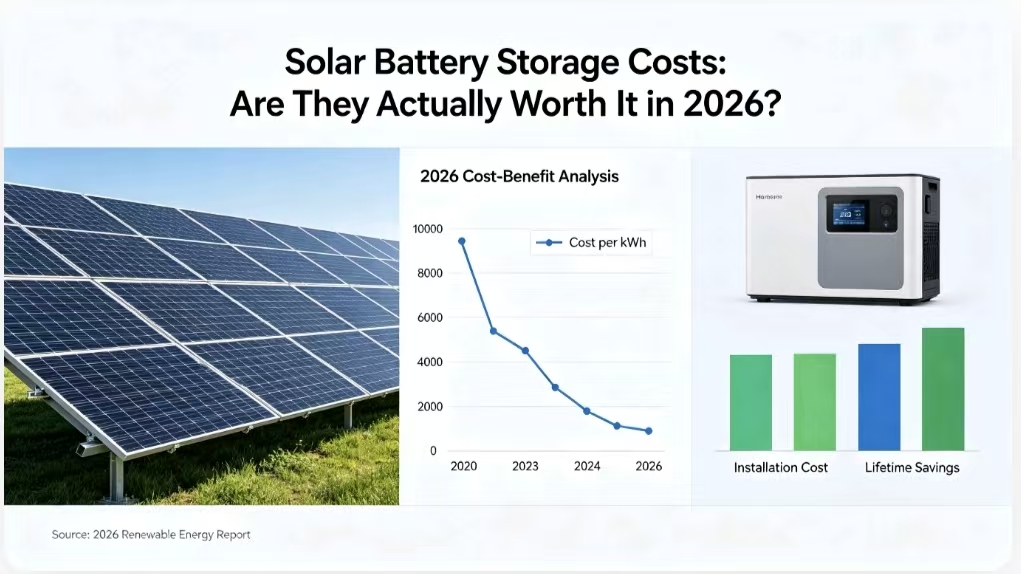

Solar battery storage costs refer to the combined expenses associated with purchasing, installing, and maintaining batteries that capture and reserve solar energy for future consumption. These usually encompass the battery unit, inverter, battery management system, wiring, labor, permits, and extended maintenance. It depends on chemistry like lithium-ion or lead-acid, usable capacity in kilowatt-hours, power rating in kilowatts, cycle life, and depth of discharge limits. A fair number of industrial users include monitoring systems, cooling requirements, fire safety, and integration with existing switchgear or control systems. For planning big projects, plant teams typically compare levelized cost of storage, warranty terms, and life in years. The following sections further explain each cost component.

Solar battery costs sit on several layers: upfront hardware and labor, long-term upkeep, and the value you get back in bill savings and backup power. A typical home-scale system costs around €11,000 to €18,000 (about $12,000 to $20,000), but the range is broad because specs and local regulations vary.
Upfront cost centers on four items: the battery unit, hybrid or battery inverter, wiring and protection gear, and any electrical upgrades such as panel work or a new sub-loads (critical loads) panel. For example, a typical 13.5 kWh battery pack, sufficient to ride through an outage with core loads only, costs on average around €14,000 (approximately $15,228) prior to incentives. Market averages for a full installed system hover in the €8,000 to €16,000 (approximately $9,000 to $18,000) range, but many homeowners come in closer to €11,000 to €18,000 (approximately $12,000 to $20,000) once add-ons are thrown in.
Premium brands, higher usable capacity and higher continuous power push that number higher. Complicated sites requiring panel relocation or structural work also contribute to increased costs. Federal solar tax credits, representing 30% of the total installed cost, can still shave several thousand off the net price. A typical home battery is only eligible for around €4,000–€4,200 (approximately $4,500) in tax credit value. State programs can stack on top, with some, such as California’s Self-Generation Incentive Program, paying in excess of €900 (approximately $1,000) per kWh of storage for eligible projects.
Battery cost per usable kWh is a clean way to compare. Installed costs typically fall somewhere between €650 and €950 (approximately $700 to $1,000) per kWh for mainstream home systems, once you factor in hardware, balance of system, and labor. At €14,000 total installed, a 13.5 kWh unit works out to around €1,040 per kWh upfront, before incentives bring that down.
Bigger banks help bring that per-kWh figure down since the inverter, design, and labor do not scale linearly. You see this when you quote one 10 kWh battery versus two in parallel. The second unit doesn’t double design time or permitting work. Type matters too:
| Chemistry | Typical installed cost per usable kWh |
|---|---|
| Lead‑acid (AGM) | Lowest, but shorter life, more upkeep |
| Lithium‑ion (NMC) | Mid‑range, high energy density |
| LFP (LiFePO₄) | Slightly higher, long cycle life |
For engineering decisions, use cost per kWh along with cycle life and depth-of-discharge limits, not alone.
Each component of the system contributes to price and defines performance. Core components consist of the battery bank itself, a battery-ready inverter, a charge controller or integrated battery interface, and a critical loads/sub-loads panel that separates backed-up circuits from the rest of the home. A dedicated sub-loads panel, by itself, can add an extra €900–€1,800 (approximately $1,000–$2,000).
All have to be compatible in terms of voltage, communication, and protection requirements, or you’re incurring additional time and expense on custom wiring and troubleshooting. Advanced features like energy management systems, app-based monitoring, backup gateways and automatic transfer switches push up the bill and help extract more value from stored kilowatt-hours. A quick checklist — battery size, inverter rating, loads panel, communications hardware, monitoring and enclosure/cooling — keeps budgeting honest and change orders at bay.
Labor is another big slice. Average residential installs cost around €900 to €2,700 (approximately $1,000 to $3,000) in labor, based on simple wall mounting, short cable runs, and a straightforward electrical layout. Retrofitting a battery to an older solar system often adds time. This includes reworking conduit, updating breakers, integrating with an existing inverter that was not battery ready, or bringing an old service panel up to current code.
Local wage levels and the installer’s skill influence final cost. Well‑commissioned teams with good commissioning and after‑sales support might charge steeper hourly rates but frequently save money by staying away. Obtaining a few quotes from certified installers, with line‑item breakdowns for labor versus hardware, is the easiest way to gauge if a bid is in line with your market.
Headline price reveals only half the tale. You have to project cost over the battery’s life. Most home lithium systems are rated for about 10 to 15 years or a specific number of full charge and discharge cycles before usable capacity falls beneath a guaranteed level. Any long-term scheme needs periodic inspections, firmware updates, possibly warranted module replacements, and bank-wide replacement once capacity shrinks too far.
I think one of the simplest apples-to-apples ways to compare systems is lifetime cost per kilowatt-hour. Take the total system cost, which includes hardware, labor, and upgrades. Subtract confirmed incentives, then divide by anticipated lifetime energy throughput according to cycle life and average depth of discharge. This metric can reveal that a marginally more expensive lithium iron phosphate battery with double the cycle life is ultimately cheaper per delivered kilowatt-hour than an inexpensive lead-acid bank that requires premature replacement.
Solar battery storage shifts a lot from home to home. The final price comes down to a few core levers: capacity (kWh), chemistry, brand, and how complex the install is. For an average home system, the complete installation usually ends up in the USD 5,000 to 10,000 range after equipment and labor, prior to subsidies. What really matters is dollars per kWh, round-trip efficiency, expected life, and how well the system cuts grid imports, backs up, and rides future utility rate hikes.
Larger capacity batteries store more energy and therefore cost more initially. Their capacity drives both the cost of the hardware and the perceived value you can capture by solar time-shifting and limited grid arbitrage.
I believe that most homes do not require whole-home backup. It is more cost-effective to size for key loads.
By matching capacity to actual use profiles, you’re not paying for empty storage. Oversizing increases cost per kilowatt-hour and lengthens payback, even if it seems “safer.
| Usable Capacity (kWh) | Typical Use Case | Approx. Price Range (USD) |
|---|---|---|
| 5–7 | Essential loads only | 3,000–5,000 |
| 10–13 | Most key household circuits | 6,000–9,000 |
| 15–20 | Larger homes / longer backup | 8,000–13,000 |
Battery chemistry influences cost, longevity, performance, and upkeep. It is one of the biggest hidden drivers of long-term cost per kilowatt-hour delivered.
Lithium iron phosphate (LFP) tends to carry higher upfront $/kWh than older chemistries. It delivers long cycle life, robust thermal stability, and round-trip efficiency commonly in the 90–95% range. This means more of every stored kWh is truly available for time-shifting and backup.
Nickel manganese cobalt (NMC) packs more energy in less space, which assists where wall area is tight. It can have a slightly shorter life and more stringent thermal requirements. It remains economical where size and style count.
Lead‑acid remains less expensive upfront and requires significantly more maintenance, deeper derating, and earlier replacement. When you account for service life and usable depth of discharge, lifetime dollars per kilowatt-hour frequently comes out higher than lithium.
Flow batteries aim for extended duration and high cycle numbers, yet remain niche and premium in most residential markets. Your chemistry choice should match your budget, maintenance tolerance, and how hard you are going to cycle the system each day.
Brand certainly influences both up-front price and long-term risk. Tesla, Enphase, and FranklinWH systems typically occupy the higher end of that range, as they combine proven reliability with close integration and mature software.
Stronger warranties of 10 or more years, often with throughput guarantees in megawatt-hours, reduce downside risk. They move more performance risk back to the manufacturer, which is important if you expect to rely on the system every day amid increasing utility rates.
Well-reviewed brands often ship cleaner integration with popular inverters, monitoring portals, and load-control hardware. Comparing independent lab results, installer feedback and real-user reviews helps weed out products with poor service networks or opaque warranty terms.
Superior support and demonstrated compatibility don’t just appear in dollars per kilowatt-hour. They manifest in fewer site visits, smoother commissioning, and more stable performance over years of operation.
Installation scope frequently swings the final invoice by thousands. Storage to existing PV can involve adding a hybrid inverter, upgrading a main panel, or installing a dedicated backup subpanel.
Whole-home backup, stacked battery banks, and advanced load-control schemes increase labor and materials costs. They can still be worthwhile when outages are frequent or critical loads are massive, but they shift whole system economics.
Key checks for your electrical system:
Round‑trip efficiency, smart control, and load‑shaping features are important. Solutions that reduce grid imports, shift solar to peak‑price windows, and provide backup power during outages add additional value, particularly as utility rates increase and incentives like tax credits, commonly up to 30% of system cost, offset some of the investment.
Solar battery storage costs go far beyond the battery price per kWh. Equipment can be 50 to 60 percent of the total system cost and installation, permits, design, and follow-up work make up the remainder. To miss these during planning is a frequent cause for projects to jump from a projected 8,000 EUR to 15,000 EUR or higher.
Beyond the battery bank, you pay for the balance of system (BoS): hybrid or battery inverters, charge controllers for some DC-coupled designs, DC and AC wiring, combiner boxes, disconnects, mounting hardware, enclosures, fuses and breakers, and data logging or monitoring devices. A high quality inverter alone can add a couple thousand dollars to the project, particularly in higher-power or three-phase installations.
BoS typically contributes around 15 to 30 percent to the overall battery storage system cost. At 9,000 to 18,000 EUR pre-incentive for a system, which is around 6,000 to 12,000 EUR post-credits, BoS is frequently the difference between “on budget” and “overrun.” More heavy-duty inverters, industrial-style cabinets, and metering gear can increase upfront cost but increase efficiency and reliability.
Cost planning works better when you build a detailed part list: every breaker, conduit run, surge protector, communication cable, and enclosure. This is reminiscent of the way industrial teams specify dehumidifiers and controls line by line to prevent scope creep.
Labor and permitting comprise the majority of “hidden” soft costs. Permit fees, plan reviews, and inspections differ and can add a few hundred to a few thousand euros, particularly in places where grid‑export rules are rigorous or storage interconnection necessitates additional studies.
Professional installation isn’t optional for most systems if you want code compliance, safety, and valid warranties. Unpacking installation and other hidden costs include complex layouts, long cable runs, retrofits in tight spaces, or integration with backup panels. All these factors push labor hours up, increasing the cost per installed kilowatt-hour, even when hardware prices appear low.
Almost all installers provide loans today at around 0–2.99% APR over 5–10 years, so the cash hit is less harsh. Interest and loan fees still belong in your TCO.
Unpacking installation and hidden costs: Itemized quotes that separate equipment, labor, and permits help minimize the chances of budget surprises late in the project.
Maintenance is typically marketed as “minimal,” but it’s not zero. Standard maintenance consists of visual inspections on wiring and terminations, verifying inverter and battery status, cleaning enclosures and vents, and ensuring monitoring and firmware are current. For dust, salt air, or high humidity sites, these checks matter more.
Lithium-ion and LFP batteries demand less hands-on care than lead-acid banks, which can require periodic electrolyte checks, equalization charges, and tighter temperature management. That lighter maintenance load is why so many industrial customers switched from flooded lead-acid to lithium-ion and LFP for UPS and process backup.
For today’s lithium systems, annual maintenance costs are generally small relative to the upfront cost of 400 to 600 EUR per kilowatt-hour on the low end or 1,000 to 1,300 EUR per kilowatt-hour on the high end. Overlooked maintenance reduces battery life and can void warranties, which makes savings today an early replacement tomorrow.
Treat maintenance like you would with critical HVAC or dehumidification: define tasks, schedule them, and log results. That habit safeguards not only uptime but the capital you tied up in storage.
Battery life drives lifetime cost more than many line items in the quote. They tend to be approximately 6,000 to 10,000 cycles for LFP, 4,000 to 6,000 for NMC, and 2,000 for lead-acid in well-managed scenarios.
Longer-life chemistries reduce replacement frequency, resulting in less full system swaps over a 15 to 20 year horizon. A lot of warranties these days promise at least 60 to 70 percent capacity after 10 or more years or a certain cycle count, if you remain within specified operating windows.
Battery health tracking through the monitoring platform lets you observe real-world degradation versus those warranty lines. With that information, you can schedule replacement or augmentation prior to performance dropping below your backup or peak-shaving thresholds and prevent unexpected downtime or last-minute purchasing.
Declining lithium pack costs are expected to decline about 8 to 12 percent annually through 2026. This assists, but planning remains important as soft costs, permits, and labor do not decline at the same rate. Incentives like the Solar ITC and local rebates help defray some front-end costs, but detailed, cycle-based analysis is what keeps total cost of ownership manageable.
Solar battery storage price goes above a line item. Behind the price lurk long-term resilience, control and emissions benefits that outweigh the invoice amount.
A good battery is a buy-one-get-a-decade-long-system-utility kind of deal, frequently hoarding 5 to 15 kWh to tap into your sunshine in the dark or get through a few hours of downtime before you have to dance barefoot back on the grid. You move past “use it or lose it” solar to dispatchable, stored energy that you pull from when it best matches your load profile, not the utility’s.
It mitigates your vulnerability to increasing grid fees and convoluted rate designs. In most markets, evening peaks are significantly more expensive than mid-day. By charging the battery when solar output is high and discharging during peak windows, you protect a significant portion of your consumption from future price hikes and policy shifts. Solar batteries can save homeowners thousands of dollars within the upcoming decade.
More self-consumption boosts actual ROI. Instead of exporting excess solar at a minimal feed-in rate, you store it and then offset kilowatt-hours that would have otherwise been billed at the full retail rate. Tracking your home’s energy use with a monitoring app or smart meter data allows you to optimize battery size and discharge rules for maximum independence instead of the minimum upfront cost.
Home battery storage is the quick, quiet backup generator when the grid goes down or utilities use rolling blackouts to shave peak load. The transition from grid to battery is nearly instantaneous with most hybrid inverters, so lights remain on, electronics remain powered, and life continues for many occurrences that would otherwise knock a home out.
For these critical loads—refrigeration, networking, medical devices, and occasionally well pumps—this uninterrupted power is where the true worth lies. A few battery systems provide load management devices that eliminate the need for critical load panels. They instinctively remove unnecessary circuitry to extend scarce stored watt-hours, which reduces design complexity and eliminates some balance-of-system expense.
On a system level, distributed batteries reduce strain on the grid. When charged from solar and discharged in the evening, they shave peak demand, enable utilities to avoid costly peaker plants, and help stabilize a more distributed energy mix. In certain areas, solar battery owners can engage in energy-sharing programs that pay them to export power to the grid during times of high demand, monetizing their resilience.
Every kWh you hold back from your own array and use later displaces a kWh from a heavily fossil-fueled grid mix. Over a 10 to 15 year life, a residential system cycling 5 to 10 kWh per day can displace many megawatt hours of grid electricity and consequent carbon dioxide emissions, several tonnes per home in many cases.
Batteries support higher renewable penetration beyond the house. By shaving solar’s midday peaks and filling its evening dips, storage smooths the variability that otherwise compels grid operators to maintain large fossil reserves spinning on. This “firming” effect is one reason regulators increasingly see behind-the-meter storage as part of regional decarbonization plans — not just a private backup tool.
Chemistry selection is significant in terms of lifecycle impact. Lithium-ion reigns supreme because of energy density and efficiency. Nickel manganese cobalt (NMC) and lithium-iron phosphate (LFP) are not the same. NMC provides high energy density yet depends on cobalt and nickel, which have more intricate mining and supply chains. LFP typically boasts a longer cycle life, reduced thermal risk, and more abundant materials. All of these factors frequently lead to a lower lifecycle footprint and more straightforward safety engineering at the home level.
When you see the full chain—generation, storage, and use—solar batteries function as a pragmatic component of a larger clean energy play. We’re not trying to save on the bill. It is the firm pivot to low-carbon, domestically sourced fuel that fits with looming regulatory crackdowns and business green targets.
Solar battery storage future-proofs a home for shifts still to come. D) Beyond the price tag: utility tariffs are trending toward increasing time of use and demand-based structures. Some grids literally charge you more for short peaks in your window of usage. With storage, you can flatten your profile and adjust to those new rules, rather than being stuck with whatever the utility chooses next.
As grids get smarter, ever more systems will tap into virtual power plants and sophisticated demand response schemes. A lot of existing batteries already come with the communications hardware required to participate in these programs once offered, enabling homes to combine capacity and function as a miniature power plant. In that context, batteries aren’t just backup; they’re flexible grid assets.
Solar battery costs differ widely according to the type, from lithium-ion batteries, including nickel manganese cobalt (NMC) and lithium-iron phosphate (LFP). Some homes will require an electric panel upgrade, which runs an average of USD 1,000 to 2,500. In places like the U.S., the Residential Clean Energy Credit lets homeowners subtract 30% of the price of a new battery storage system from their federal taxes. This sweetens the upfront sting and encourages longer-term strategizing.
Storage can frequently be expanded in modular increments or upgraded as needs evolve such as when introducing an EV, heat pump or new sensitive loads. Solar and storage can bring peace of mind by delivering a reliable source of power during outages and emergencies in the here and now and by keeping the door open to new services, new grid programs, and increased self-supply over time.
Solar battery storage is still capital‑intensive, so the smartest path is to stack every incentive, select timing strategically, and extract cost savings from both equipment and financing. The point is to reduce net cash outlay, not simply headline system price.
The primary weapon for the majority of buyers is the 30% federal ITC on eligible solar and storage systems through 2032. When the battery is connected to a PV system and charged mostly from solar, the full battery expense often counts.
On a standard home storage project for €10,000 to €20,000, the ITC can cover roughly €3,000 to €6,000. Bigger systems or multi-battery systems drive that number up, so sizing decisions directly affect the tax credit.
To take the ITC, the taxpayer must have enough tax liability, own the system (no third-party ownership), and install it at a property in the same country where they pay income tax. Documentation typically consists of the signed contract, itemized invoice displaying battery and labor, proof of payment, and commissioning date, filed alongside tax records and supported by IRS Form 5695 or local equivalent. Early coordination with your tax advisor helps prevent you from missing the year-of-installation window.
A lot of utilities have demand-response and grid-support programs that provide direct rebates on home batteries. In California, the Self-Generation Incentive Program (SGIP) can save a few thousand euros off the invoice for qualifying residential and small commercial projects, with premium tiers for backup and vulnerable customers. Other hot markets are Hawaii, Massachusetts, and New York where storage incentives frequently involve peak-shaving or time-of-use support.
Rebates typically fall in the neighborhood of €500 for small batteries on modest schemes to €10,000 or more where grid demand is high and storage capacity is significant. Some pay on a per kilowatt-hour of usable capacity basis, while others pay a flat amount for a system. Program rules can cap annual budgets or vary rates with short notice, so verifying with the utility website and energy programs team prior to contract signing is important. When these rebates stack with the 30% ITC, the net installed cost can plunge 40 to 60 percent below list price, which is frequently the gap between a borderline and a compelling business case.
Financing moves the conversation away from “How big is the check today?” to “What is my all-in cost over time?” The three primary routes are secured or unsecured solar loans, leases, and power purchase agreements (PPAs), each with very different risk and ownership profiles.
Loans preserve system ownership with the customer, so they can still capture the ITC and most utility rebates while amortizing the cost over 5 to 20 years. Interest rates depend on credit profile, collateral, and term. A shorter 7 to 10 year loan at a fair rate frequently produces more lifetime value than ultra-long terms with higher interest included in “no-money-down” offers. Leases and PPAs eliminate upfront cost for the most part, but the third party owns the system, captures any incentives, and recoups their capital through fixed rent or per-kWh fees. This can be appealing if money is scarce, but the total paid over 20 to 25 years might exceed that of a plain-vanilla loan and simple ownership.
Before signing, it helps to build a simple total cost of ownership view: sum equipment and labor, add interest or contractual payments over the full term, subtract projected incentives, and compare that net figure to modeled bill savings and backup value. In practice, many industrial buyers already apply similar lifecycle costing when evaluating dehumidification or HVAC upgrades. Applying the same rigor to solar batteries helps avoid “cheap-looking” finance that proves expensive once all fees and interest are counted.
Solar storage is in a very different cost zone than it was in 2010. Battery prices have plummeted and grid tariffs, peak charges, and reliability risk have increased in many geographies. For most homes, it’s less ‘Is this too expensive?’ and more ‘Does the use case fit the cost profile?’
A standard home setup employs one or two lithium-ion batteries, each approximately 10 to 15 kWh. Hardware alone is often around $5,000 to $7,000 per battery, with a lot of installs using multiple units to span evening and night loads. Installed system prices differ by country, labor cost, and incentive structure, but you are typically looking at a five-figure upfront expense with a 20 to 25 year solar asset and 10 to 15 year battery life. After the system pays back, the solar array continues generating “free” electricity for the remainder of its lifespan, often another 10 or more years during which you might replace batteries a single time.
For most homeowners, that figures to be around a 7 to 12 year payback when you include bill savings, TOU arbitrage, and export incentives. Over the system lifespan, net savings of around $10,000 to $20,000 are typical in markets with high power prices and excellent solar resource. The payback is not multi-decade; it is typically closer to a single equipment cycle. Local programs can shorten this further. Some utilities pay bonuses for exporting during peak demand hours, and many regions offer bill credits or tax incentives for storage paired with photovoltaics.
The economic part is just one piece of the value. Storage provides backup power when the grid goes down, supports night loads, and reduces exposure to volatile grid tariffs. Homes in outage-prone regions rely on batteries to preserve cold chains, medical equipment, and essential illumination for hours, no generator required. In time-of-use areas, charging from solar during the day and discharging during the evening peak circumvents the highest tariffs. Meanwhile, stored solar reduces the load on fossil-fuel plants, decreases local pollution, and advances national clean-energy goals. Adoption is soaring; energy trade publication Solar Journal estimates around 28% of PV systems in the US will have batteries by 2028, signaling that storage has gone mainstream.
Solar battery storage is expensive, yet valuable. Panels slash your bill. Storage brings backup, control, and long-term savings. It all depends on size, brand, install labor, and local regulations. No magic dust there. Only hardware, labor, and design.
Smart buyers think through the system. They verify load requirements, rates, and incentives. They compare full quotes on an apples-to-apples basis, not battery price per kWh. That strategy reduces hazard and excess.
Storage makes sense in the long run for many plants and sites. These solar battery storage costs aren’t just electric price sizzle; they can shave peak fees and maintain critical circuits during a grid outage. For your location, the next step is easy. Consult a reputable solar and storage engineer, give them your actual load data, and test the figures.
Almost all home solar batteries run you something like USD 5,000 to 12,000 prior to installation. A full system, including installation, typically costs USD 8,000 to 18,000, varying by battery capacity, manufacturer, and regional labor rates. So always get at least 3 quotes from certified installers.
The main factors are battery capacity (kWh), power rating (kW), brand, chemistry (usually lithium-ion), warranty duration, and installation difficulty. Local permits, electrical upgrades and tax rules shift the ultimate cost. Bigger, premium systems tend to be more expensive but deliver greater performance and longevity.
Yes. Additional costs may consist of electrical panel upgrades, rewiring, permits, inspections, monitoring equipment, and potential structural work. These are rarely apparent in the base battery price. Request a line-by-line quote so you can identify all labor, hardware, and permitting fees.
Solar batteries can reduce bills by storing surplus solar and discharging it when grid prices are high. Savings vary based on your tariff, local electricity rates, system size, and usage pattern. For areas with time-of-use pricing or weak grids, batteries often provide more favorable economics.
Today, most lithium-ion solar batteries age out around 10 to 15 years or 4,000 to 6,000 charge cycles under typical use. Performance tends to degrade with age. Check warranty terms carefully, especially guaranteed usable capacity after 10 years and how many cycles are covered.
Most countries and regions provide tax credits, rebates, or low‑interest loans for solar plus storage. In certain markets, grid services programs compensate you for stored energy as well. Consult national, regional, and utility websites, and inquire with installers about all possible incentives prior to contract signing.
It comes down to what you’re trying to accomplish and local conditions. If you have high energy prices, outages or time-of-use tariffs, batteries tend to deliver robust value in bill savings and backup power. In inexpensive, highly reliable grids, the advantage could be more about resilience than imminent return on investment.


Contact us to find the best place to buy your Yakeclimate solution today!
Our experts have proven solutions to keep your humidity levels in check while keeping your energy costs low.