
Building 34, No. 535 Shunfeng Road, Hangzhou, Zhejiang, China
[email protected]
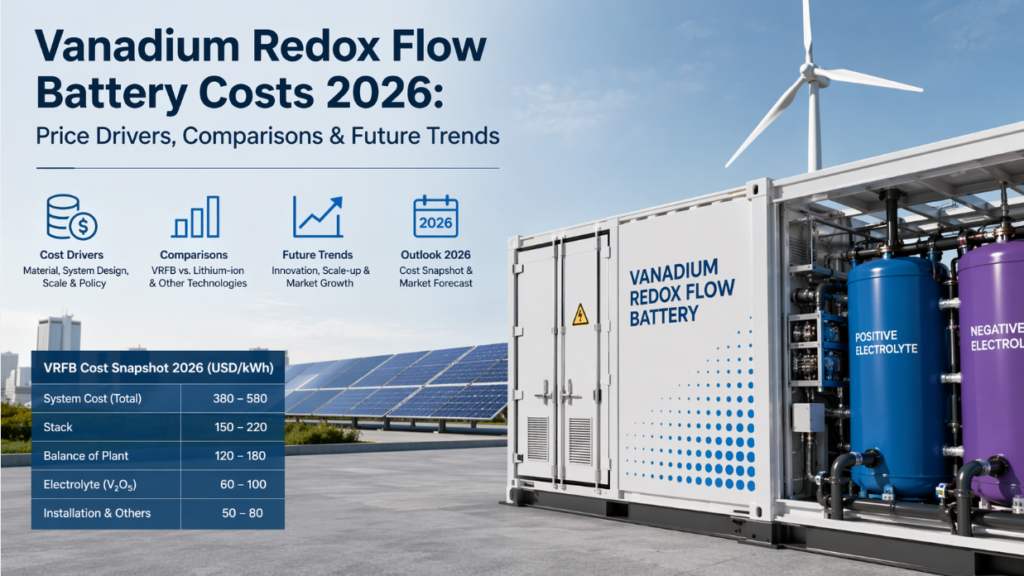


The vanadium redox flow battery cost primarily consists of vanadium electrolyte, large tanks, stack materials, and balance-of-plant components. For the vast majority of projects these days, system costs typically hover in the range of approximately 400 to 800 USD per kWh installed, with long cycle life amortizing that cost over more than 20 years. Costs vary significantly with the vanadium market price, system size over 1 MWh, and if the project requires long duration storage, such as 8 to 12 hours. Many industrial users are more concerned with levelized cost of storage, where long life and high cycle counts can compensate for higher upfront expenditures. The following sections analyze cost drivers, important trade-offs, and how actual projects control cost in reality.
Vanadium redox flow battery (VRFB) cost sits on four main blocks: the electrolyte, the stack, the power conversion system (PCS), and the balance of system around them. For plant and facility teams, the key levers are vanadium price, project scale, and how the system is sized against the duty cycle and revenue stack. Capital expenditures are elevated upfront, but long cycle life, frequently surpassing 20 years, redirects attention to total cost of ownership (TCO) and levelized cost of electricity (LCOE), particularly when integrated in hybrid systems with renewables.
Vanadium electrolyte is typically the single biggest cost item, frequently approaching 40 to 50 percent of total system capex. Cost swings with vanadium pricing, which has exhibited volatility in the range of approximately 30 to 50 USD per kilogram, depend on how much vanadium is dissolved per liter to achieve the desired energy density.
Performance and price both depend on purity and concentration. Greater purity reduces side reactions and increases round-trip efficiency. It requires more precise process control in mining and refining. That drives cost up initially but helps reduce losses and operational risk across the entire service life.
Electrolyte leasing is becoming commonplace among big projects. The project pays a fee instead of purchasing all the vanadium upfront, which reduces capex and moves some of the cost into predictable opex. This can be handy when discount and interest rates impact LCOE.
Electrolyte isn’t “used up” in regular operation. At the end of life, the vanadium solution still possesses strong residual value that can be recovered or reused. As production, standardization, and recycling scale, electrolyte costs will tend down with the ability to monetize residual vanadium increasing.
The stack is the electrochemical core: electrodes, ion‑exchange membranes, cell frames, and gaskets grouped into modules. Its cost is largely a function of membrane type, electrode surface area, and the efficiency with which those components are produced and assembled. High‑performance membranes and well‑treated carbon electrodes contribute additional capital expenditure, but they increase power density and reduce internal resistance. This means fewer stacks per megawatt and lower system cost per kilowatt-hour of rated power. Design for automated assembly and design for tight tolerances help since labor and scrap can be huge hidden cost drivers.
Durability is the other secret. VRFB stacks can go through tens of thousands of cycles with low fade. With maintenance, replacements could be pushed far past ten years, which distributes stack capex over many more delivered MWh than lithium ion in heavy-cycle use. This is where long life cascades directly into reduced TCO and enables operation in tough industrial spaces that already use precise climate and humidity control to protect membranes and seals.
The PCS connects the VRFB’s DC side to the AC grid or plant bus. This includes inverters, transformers, filters, and digital controls that manage dispatch commands, protection, and grid codes.
PCS rating has to measure up to both peak power and the site’s operating strategy. Oversizing contributes expense with minimal benefit. Undersizing limits income for services such as peak shaving, time-of-use shifting, or frequency response. Integration with on-site solar, wind, or microgrids can necessitate additional PCS features such as grid-forming modes or black-start, which increase upfront capex but can unlock more value streams over the 20-year project life.
Scale looms large in per-kWh cost. The largest VRFB systems are in the 100 MW class with shared tanks, common PCS blocks, and bulk procurement to pull unit costs well below those of custom 1 MW units. Smaller, one-off systems, on the other hand, typically pay more per kWh because of engineering time, unique civil work, and non-standard hardware.
Project size rewrites balance-of-system. Utility scale, external tanks, pumps, piping, fire system and foundations all enjoy economies of scale, so the cost per installed kWh of storage goes down as tank volume and stack count increase. This matches VRFB strengths: long discharge durations of many hours up to days, where energy capacity is scaled mostly by tank size and electrolyte volume, not by swapping entire battery packs.
Modular designs assist in bridging scales. OEMs can stack and skid repeat standard units like blocks, then tailor tanks and site works on each project. For very large orders, developers can negotiate better pricing from suppliers down the chain, including vanadium miners, which leads to lower capital expenditures for utility customers.
Operational costs for VRFBs tend to be modest and predictable: routine inspections, pump and valve upkeep, sensor calibration, and periodic electrolyte checks or minor rebalancing. The chemistry itself is stable, meaning there is no steep cycle-linked fade as with most lithium ion systems. Degradation is minimal, reducing stack replacements and enabling a service life of over 20 years with maintenance.
Remote monitoring and automated control systems assist in further reducing opex. With well-designed SCADA, analytics, and sturdy environmental control in the battery room, operators can catch problems early, schedule short service windows, and keep labor hours and unplanned downtime low. For large multi-MW sites, this kind of centralized monitoring is now standard.
Relative to lithium ion, VRFBs tend to experience lower cycling-related costs and fewer major replacement events throughout the project term. The electrolyte can be topped up or reconditioned and at the end of service it still contains a great deal of its initial value, which can be reclaimed through recycling or repurposing in another system. Over 20 years, this blend of low degradation, simple maintenance, and residual electrolyte value is a big reason VRFBs can reach competitive LCOE in grid-scale and industrial storage roles.
VRFBs appear expensive on a price-per-kWh chart. The chart hides nearly all of the actual value. For long-duration storage, grid support, and mission-critical loads, lifetime performance, safety, and end-of-life options matter more than the day-one invoice. Add in a 20-year service life, stable capacity, and full recyclability and the economics change in ways a lot of CAPEX-only comparisons overlook.
VRFBs routinely achieve 10,000 to 20,000 full charge and discharge cycles with very low capacity fade, and many fielded systems continue to operate for over 20 years with minimal performance drift. The electrolyte does not plate, swell, or crack like solid electrodes in lithium-ion, so you do not have the steep degradation curve that drives early replacement in high cycling plants.
Energy and power are physically split: energy is in the vanadium electrolyte tanks, power is in the cell stacks. If you want more hours of storage, you scale tank volume. If you want more power, you add stack area. You can swap stacks, update membranes, or add parallel loop skids while preserving the electrolyte asset, which slashes mid-life capex and downtime.
Over an entire project life, this architecture reduces total cost of ownership. You amortize the upfront electrolyte and balance-of-plant expense across significantly more cycles and years. This is a potential game changer for utilities, microgrids, or massive industrial consumers pursuing levelized cost benchmarks and sustainability objectives.
VRFBs use aqueous, non-flammable vanadium electrolyte, so there’s no organic solvent to catch fire and no vapor pressure to develop. Thermal runaway, a fundamental issue with compacted lithium-ion racks, is irrelevant to this chemistry. Temperature fluctuations affect efficiency, not safety thresholds.
This safety profile unlocks opportunity in dense urban sites, data centers and factories where fire codes, separation distances and insurance policies frequently restrict high-energy systems. Lower fire hazard, easier suppression requirements, and more predictable failure modes may result in less compliance overhead and more streamlined permitting.
Nor do researchers stop working on higher round-trip efficiency by tuning flow fields, state-of-charge windows, and electrolyte composition, for example, which raises performance without introducing new safety risks.
At end-of-life, vanadium in the electrolyte is fully recoverable and reusable in new VRFBs or other metallurgical streams. You retain the valuable active material as a long-term asset rather than a waste liability, bolstering circular economy goals and ESG disclosures.
Most stack components—graphite or carbon electrodes, plastics, and metals—are recyclable, with many projects already contracting take-back schemes with electrolyte leasing or buy-back clauses that hedge vanadium price exposure.
This recyclability, combined with long mechanical life, increases residual value and can transform financial models from pure depreciation to asset-based planning.
Energy storage options now join power quality, cooling, and humidity management on the essential design checklist for new plants. For long-duration and high-cycle use, VRFBs compete primarily with lithium-ion, lead-acid, and sometimes pumped hydro or compressed air. A simple way to frame it:
Across these, VRFBs generally lose on first cost, win or tie on lifecycle cost for 4 to 8 plus hour duty, and occupy a clear niche for high cycle, grid scale and industrial applications where longevity and stable capacity are more important than small size.
A comparison table is generally worth constructing in your design file, with columns for CAPEX, LCOS, duration range, round-trip efficiency, cycle life, footprint/m² per MWh, safety, and reuse or recycling paths. That kind of table makes trade-offs obvious quick when you juxtapose lithium-ion, vanadium flow, and legacy lead-acid against the real duty profile of your plant or grid-connected microgrid.
Vanadium flow batteries continue to have a higher upfront capital cost per kWh than lithium-ion or lead-acid. The stack, vanadium electrolyte, PCS, and heavy site infrastructure all come in the upfront invoice, along with a bigger physical footprint for the same kWh. For dense urban sites, that footprint can be a constraint, but in many industrial zones or solar-plus-storage fields it’s not a deal-breaker.
That being said, the cost curve is shifting. That’s why electrolyte leasing, containerized stacks, and standardized PCS packages are driving unit prices lower quickly. New project finance and leasing models now distribute the initial impact over 10 to 20 years, just as many plants already do for chillers, dehumidifiers, and other essential utilities. Their longer life and infrequent replacement mean the first CAPEX line item is only partly true to the tale.
Levelized cost of storage (LCOS) is what counts when you live with an asset for 20 to 25 years. It aggregates all capital, O&M, augmentation, and replacement costs, then divides by total delivered MWh. For multi-day storage with daily cycling, vanadium flow frequently ends up at a lower LCOS than lithium-ion, even if the initial CAPEX was higher.
There are a few drivers behind this. VRFBs operate for 25 to 30 years with minimal degradation, offer 100 percent usable capacity daily, and bypass ongoing augmentation initiatives. A few early large-scale VRFB sites that went live around 2005 to 2010 still exhibit over 95 percent capacity after 15 to 20 years. Round-trip efficiency is lower, at 75 to 85 percent compared to lithium-ion’s 85 to 95 percent, but the cost of lost kilowatt-hours is frequently offset by savings from not swapping packs, re-rating systems, or adding parallel containers mid-life.
Above roughly a 4-hour duty cycle, and particularly in the 8+ hour regime, full-lifecycle analysis already finds VRFBs competitive and in many cases cheaper than lithium-ion on a €/MWh-delivered basis. That’s why LCOS, not sticker price, is the more honest metric when screening storage options for utility-scale plants or industrial campuses.
The obvious performance sweet spot for vanadium flow batteries is long-duration energy storage, four hours and above, and high cycle counts. Unlike conventional batteries, the architecture decouples power (stacks) from energy (electrolyte tanks), so scaling capacity is as easy as adding more electrolyte, not entire battery packs. This provides extremely precise control when you are chasing a load profile, supporting evening peaks or holding reserve for extended outages.
VRFBs tolerate deep discharge and near-daily cycling with minimal degradation. They support 100% depth of discharge daily without the degradation curve of lithium-ion or lead-acid. For grid balancing, renewable firming, and industrial backup where discharge events can be long and irregular, that stability is useful. In big factories that already take containerized plant rooms for chillers, compressors, and dehumidifiers, the additional footprint can be designed into the site.
Round‑trip efficiency is a bit lower, so they’re not the best pick for brief, high‑turnover use cases such as fast frequency response at sub‑hour timescales where lithium‑ion shines. For 4–12 hour windows, hundreds of cycle counts per year and 20+ year horizons, VRFBs align perfectly with utility grids, renewable hubs and industrial facilities seeking reliable storage and low replacement risk.
Future vanadium flow battery cost will track the same path seen in other grid technologies: innovation, scale, and better business models cutting both capex and life-cycle cost. For plant teams watching energy and HVAC loads, this matters because cheaper long-duration storage makes it easier to run clean power, stabilize the grid, and still fund core process upgrades like dehumidification.
Material work sits at the heart of cost decline. Ongoing projects and research still huddle around approximately $4,000 per kW and $750 per kWh of upfront capex, but that is not an immovable ceiling. Better membranes, electrodes, and electrolyte chemistry can increase power density and round-trip efficiency. Therefore, that same tank size provides more usable kWh during the system’s life.
One big lever is vanadium itself. Exploration into lower-grade ores, co-production from steel slag, and full electrolyte recycling all seek to even out price spikes and provide long-term supply. It is stable vanadium pricing that lets OEMs lock in multi-year contracts and quote bankable dollars per kilowatt-hour numbers.
New electrolyte additives and formulations assist. They can expand the operating temperature range, minimize side reactions, and extend capacity retention. Over 20 to 30 years, that’s less over-sizing at the start and fewer electrolyte top-ups, which pushes effective capex per kWh down.
Optimistic projections already indicate more competitively priced systems, with capital costs of approximately 260 euros per kilowatt-hour at a 10-hour duration as chemistry and stack design advance. These are the kind of costs that begin to make sense for long-duration grid services and industrial load-shifting at scale.
Cost will drop as manufacturing matures. Scaling stack and tank production brings classic economies of scale: higher throughput, better tooling, lower per-unit labor, and tighter quality spread. Automation of stack assembly, welding, and leak testing reduces build time and helps standardize performance.
Soaring demand from utility‑scale renewables, data centers and long‑duration projects is already pushing investors in the direction of bigger factories. Once more 6 to 12 hour systems come online, capital expenditure on a dollar per kilowatt-hour basis improves, particularly at longer durations where flow batteries typically outperform lithium-ion.
Market outlook backs it. The redox flow market should reach approximately US$9.2 billion by 2036, justifying global supply chain work on key components, from membranes to balance-of-plant hardware, and bringing more predictable pricing for industrial users planning multi-site rollouts.
Electrolyte cost and handling are a big part of VRFB economics, which is why new business models matter. Electrolyte leasing and “liquid-asset” schemes move a big chunk of capital from upfront to operating expense, which can make a plant pencil out with payback hurdle rates even when stack hardware is still not at fully mature scale pricing.
Local vanadium electrolyte production reduces freight, currency risk, and customs delays, which is critical when the project schedule is tied to a wider site refresh, such as new HVAC and dehumidification capacity. Paired with robust recycling efforts, this insulates against vanadium price fluctuations.
It’s in the longer-duration realm where, economically, redox flow starts to shine. Old projects indicate a 6-hour battery at $3,000 per kW would require a storage spread of approximately $0.20 per kWh to achieve a return of about 10% over 30 years with near-daily cycling. A 12-hour system doing around 250 cycles a year gets within the same $0.20 per kWh spread as a 6-hour unit cycling about 360 days, while capex per kWh declines with duration. When storage extends beyond roughly 6 to 8 hours, redox flow frequently appears more cost-effective than lithium-ion for grid-scale applications, particularly considering longevity and deep cycling with minimal degradation.
For industrial sites, that long life and lower effective dollars per kilowatt-hour at high duration open space in the budget for other efficiency work, like better climate control and humidity management that safeguard product yield.
Vanadium redox flow battery (VRFB) cost doesn’t shift on its own. It follows vanadium price and availability, the general direction of policy in key markets, and where new production capacity is constructed and scaled.
| Factor | What Changes | Directional Effect on VRFB Cost | Timeframe |
|---|---|---|---|
| Vanadium ore supply | New mines, closures | More supply → lower cost | 2–5 years |
| Refining capacity | Plant build‑outs | More capacity → lower bottlenecks | 1–3 years |
| Electrolyte production | Local vs imported | Local mix → lower logistics | 1–3 years |
| Government subsidies | Capex / tax support | Higher support → lower net cost | 0–5 years |
| Renewable targets (MW) | Storage demand growth | Higher demand → short‑term price up, long‑term down via scale | 1–10 years |
| Safety / recycling rules | Tech qualification | Favor VRFB → more volume → lower unit cost | 3–10 years |
| Regional manufacturing | Local gigafactories | Higher volume → learning curve savings | 2–8 years |
| Price of vanadium ($/kg) | $30–$50 volatility | Higher feedstock → higher electrolyte cost | Immediate |
Asia-Pacific, spearheaded by China, Japan, India, and South Korea, is already drawing a significant portion of new VRFB demand. Europe and the US add more grid-scale projects, which tightens the connection between global vanadium supply and project capex.
Vanadium ore mining, conversion to V2O5 or similar, and final electrolyte production are the three cost-critical phases. Mines in Australia, South Africa, China, and Russia supply refineries. Those refineries then supply electrolyte plants near battery factories or sites.
Vanadium price swings, which have fluctuated between approximately 30 to 50 USD per kilogram, impacted electrolyte cost initially. As emerging and expanding mines in Australia and South Africa come online through 2025, global output should increase and help dampen spikes. Any disruption from strikes, export quotas, or shipping issues can send prices higher again.
Multi-sourcing and a degree of strategic stock, either by electrolyte producers or developers, can smooth sourcing for big fleets of industrial projects. Vertical integration, where a VRFB maker owns or contracts mines, refining, and electrolyte lines, trims margins at every step and provides plant managers more reliable long-term pricing.
Policy determines the “effective” cost of VRFB systems more than the nameplate capex does. Investment tax credits, capital subsidies, and low-interest financing for storage linked to wind or solar can bring levelized storage cost down enough to beat diesel or gas peakers over a 10 to 20 year view.
Through Asia-Pacific, aggressive renewable targets and grid-scale storage tenders in China, India, and South Korea spur consistent demand growth and support the economics of new electrolyte plants. Europe, with markets such as Germany, the UK, France, and Italy, supports capacity markets, grid codes, and long-duration storage incentives that prioritize flow batteries over short-duration lithium. The US pairs renewable portfolio standards with federal funding for resilient grids, which pulls VRFB into microgrids, municipal utilities, and critical-load campuses.
Tighter rules on safety, fire risk and recyclability tip the scales to VRFB’s advantage, as vanadium electrolyte is non‑flammable and 100% recyclable. Government-supported pilot plants, demonstration microgrids and public procurement programs accelerate early volume, abbreviate bankability checks and get the industry farther down the cost learning curve faster.
Local vanadium extraction and regional VRFB manufacturing minimize freight, tariffs, and working capital committed in transit. For big industrial sites or grid projects, shaving a few percent off logistics and import duties can determine which storage tech wins a tender.
Vanadium-rich countries like Australia and China have a structural cost advantage if they have electrolyte plants and integrators. With more mines running steadily, these hubs can provide long-term supply contracts that bring price stability to developers planning 50 to 200 MWh fleets.
Europe and the US close the gap by subsidizing local assembly lines, containerized system manufacturing, and port or rail enhancements that reduce handling expenses. Asia-Pacific’s strong growth and forecast global VRFB compound annual growth rate topping 21% from 2025 to 2032 will give supply hubs in China, Australia, and possibly India substantial leverage on global pricing.
For plant managers and energy project owners, it’s logical to follow vanadium mine news, subsidy changes in Asia-Pacific, Europe, and the US, and the build-out of regional manufacturing clusters to time procurement, lock in contracts, and identify cost dips for new investments.
Cost per kWh sounds straightforward and equitable. For long-life assets such as VRFBs, it obscures more than it reveals and can drive teams toward the wrong technology selection.
Cost per kWh is usually an upfront capex number: total project cost divided by rated energy (kWh). It doesn’t care about how the system runs in real plants. It ignores round-trip losses, cycle life, depth of discharge limits, or how many times you can use that energy over 20 to 30 years. Consider, for instance, that numerous lithium-ion systems waste 5 to 15 percent of capacity simply maintaining cells in the proper temperature window. That wasted energy never appears in the straightforward kWh cost. VRFBs use pumping energy, but in well-designed systems, this is typically less than 3 to 5 percent of throughput and remains very stable over life.
The metric overlooks lifespan. Certain flow systems can operate 25 to 30 years without a mid-life battery replacement, just routine pump and seal maintenance. By comparison, numerous lithium-ion projects anticipate a full battery module swap or several. If you purchase twice during the project lifetime, the actual cost per delivered kWh varies vastly from that initial capex line item.
Usable capacity is yet another blind spot. Certain batteries cannot operate at full depth of discharge without obvious life repercussions, so operators reserve a buffer. A vanadium redox flow battery can typically deliver close to 100% of its rated capacity per day with zero cycle fade in the electrolyte. That boosts the real energy you obtain from the same nameplate size, which reduces the levelized cost even if the upfront euros per kilowatt-hour or dollars per kilowatt-hour appears greater.
A more honest view uses a checklist of metrics, not one number:
Vanadium flow batteries remain pricey on day one, but the narrative changes once you amortize cost over twenty-plus years. The stack, pumps, and tanks require some TLC, but the vanadium remains in the cycle. There is no fuel loss. There is no precipitous capacity crash.
For extended, daily cycling, they begin to outcompete a lot of lithium on delivered kWh cost. For example, a grid site that cycles two times per day for 15 years. A vanadium system can maintain near its beginning capacity, while most lithium packs require at least one full replacement.
For your plant or grid project, the next move is easy. Conduct an actual duty cycle analysis, not merely a capex inspection. Long life use usually turns the cost tale on its head.
Generally, commercial VRFB systems are currently in the range of 400 to 800 USD per kWh, depending on size, configuration, and supplier. Large utility-scale projects will likely have lower costs per kWh than small custom systems.
Cost per kilowatt-hour disregards lifetime and cycling capability. Vanadium redox flow batteries can go beyond 15,000 to 20,000 cycles with little degradation. When you amortize that upfront cost over more cycles and years than it would take to degrade, the levelized cost of storage comes out measurably lower than that initial kilowatt-hour price might imply.
Key cost drivers are vanadium electrolyte price, system size, stacks and power electronics, and balance-of-plant components. Vanadium commodity prices and long-term electrolyte supply contracts are particularly crucial for total system cost and bankability.
For short durations (less than or equal to 4 hours), lithium-ion often has a lower upfront cost. For extended durations (6 to 12 or more hours) and intense cycling, VRFBs may be cheaper over their lifetime since they deliver long service life, deep cycling, and flexible energy scaling.
Costs will continue to come down with manufacturing scaling, electrolyte leasing scaling, vanadium supply chain maturity, and system design standardization. Many industry projections show significant cost decreases over the next 5 to 10 years, particularly for large utility-scale projects.
Vanadium is a traded commodity primarily used in steel. Price spikes can boost electrolyte costs and hold up projects. Long-term supply agreements, electrolyte leasing, and secondary vanadium sources, such as recycling, can stabilize costs and minimize exposure to market volatility.
VRFBs provide long life, many cycles, non-flammable electrolytes and simple capacity scaling by adding tanks. They decrease replacement risk and operating costs, enhancing total cost of ownership and helping make them compelling for grid-scale and industrial energy storage.


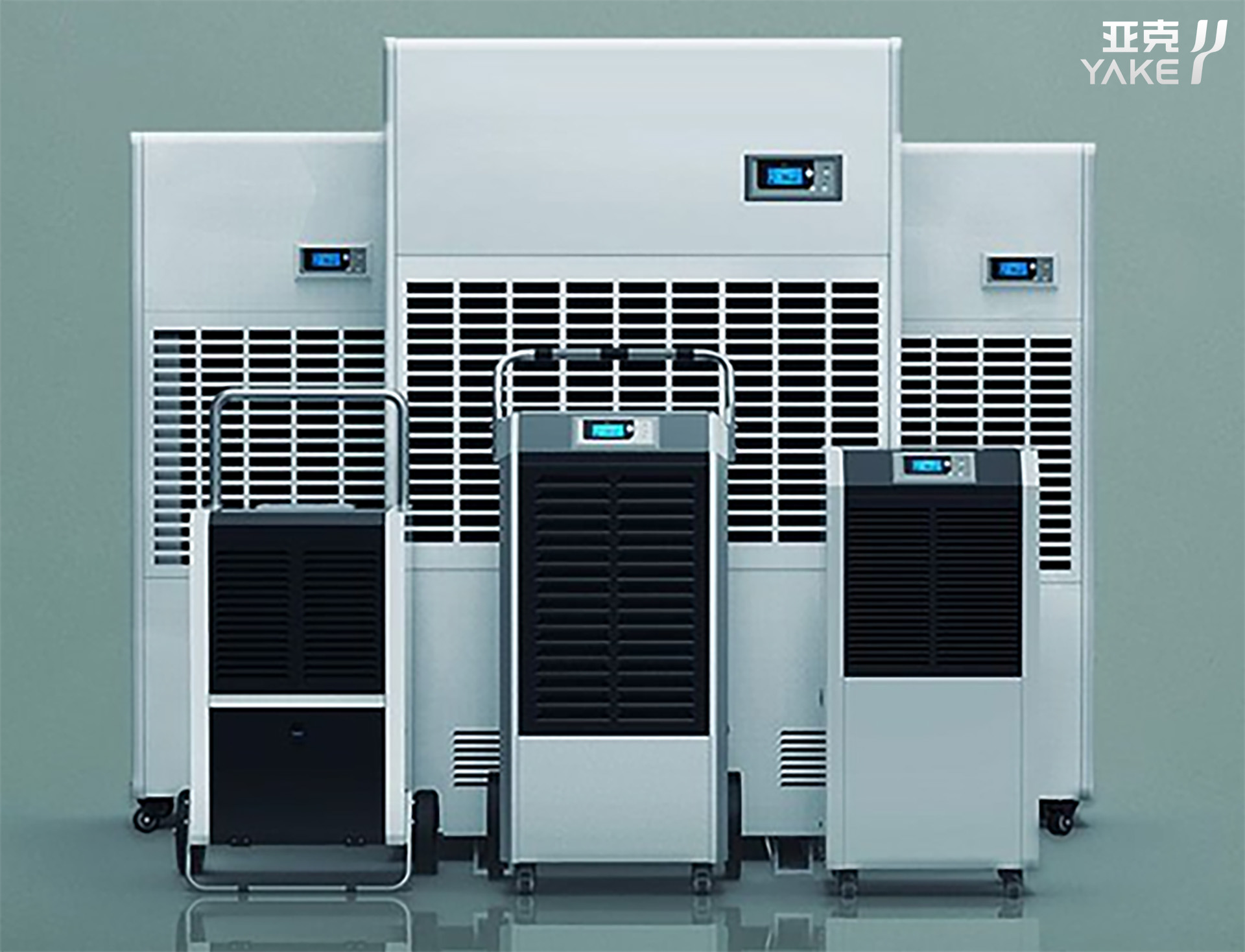
Contact us to find the best place to buy your Yakeclimate solution today!
Our experts have proven solutions to keep your humidity levels in check while keeping your energy costs low.