
Building 34, No. 535 Shunfeng Road, Hangzhou, Zhejiang, China
[email protected]
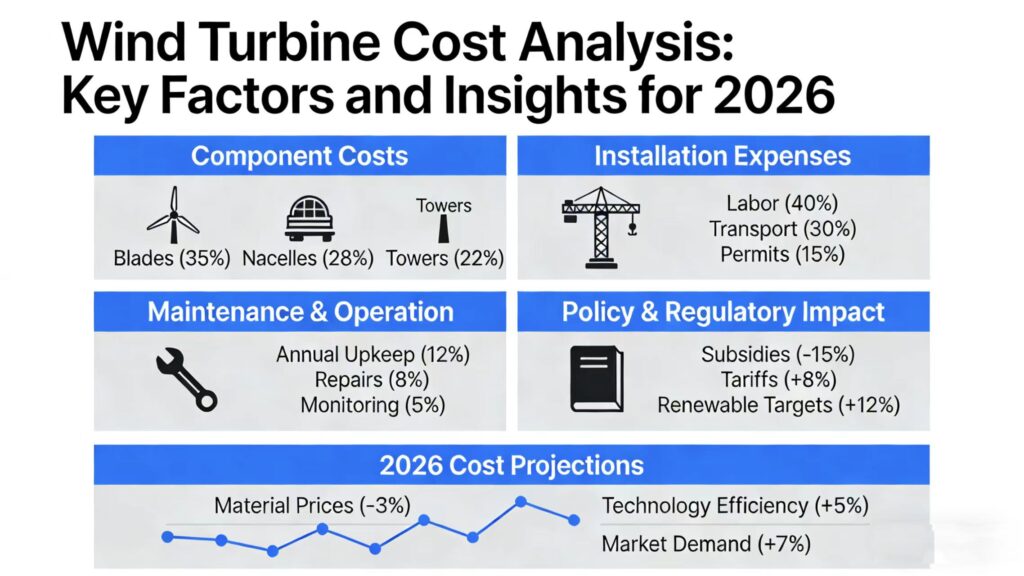

Wind turbine cost analysis is essentially reviewing all the expenses associated with constructing, operating, and maintaining wind turbines. Folks are interested in the true costs to get them started on wind power. Upfront expenses such as purchasing the turbine and constructing the site and wiring can amount to the majority of the budget. Maintenance costs, including repairing components, regular inspections, and insurance, contribute significantly. These costs vary by turbine size, location, and local regulations. Understanding the total cost therefore allows farm owners, city planners, and investors to make wise choices and plan for sustained profit. The bulk of this blog will divide out each cost component and provide advice for savvy spending on wind projects.

Wind turbine costs aren’t just in the price of the machine. What determines the overall price includes up-front spending, site characteristics, operating costs, external financing, and logistics for getting components to the project. All of it contributes to how much a developer, company, or homeowner will shell out.
Purchasing and installing a wind turbine requires covering the cost of the turbine, tower, blades, and foundation. A single onshore turbine foundation can range anywhere from $200,000 to $500,000 in cost, while offshore projects can incur between $2 million to $5 million per foundation. Turbine size and model really affect price. Larger turbines generate more energy but are pricier to purchase and install. Local labor and material prices matter as well. In certain areas, installation labor costs might add an extra $100,000 to $300,000 per turbine. Site prep, such as roads and electrical, can add $150,000 to $300,000 per turbine and substations run $2 million to $10 million. Several developers finance or lease to cushion initial expenditures.
Location changes everything. Wind speed, land size, and access all factor into the final cost. Remote projects require new roads, crane pads, and power lines, which drive costs much higher. Environmental regulations demand studies costing between $50,000 and $500,000, and permits costing up to $100,000 per turbine. Local regulations and community input can drag things down and increase expenses even more.
Operating a wind turbine continues to cost. Scheduled maintenance is between $42,000 and $48,000 per machine each year, and surprise repairs can add an extra $15,000 to $35,000. Major part swaps cost between $200,000 and $800,000 over the turbine’s life. Newer models with smarter technology can reduce some of these expenses by detecting issues early. Capacity factor, which refers to how much energy the turbine actually produces, affects your cost per unit of power. Onshore wind farms achieve a capacity factor of 25 to 45 percent, while offshore farms can reach up to 65 percent. Adding batteries or other storage increases initial costs, but can help in smoothing supply.
| Aspect | High Impact | Moderate Impact | Low Impact |
|---|---|---|---|
| Interest Rates | ✓ | ||
| Investment Risk | ✓ | ||
| Subsidy Availability | ✓ | ||
| Power Purchase Agreements | ✓ | ||
| Market Conditions | ✓ |
Loans and interest rates influence project costs from day one. You can add subsidies, tax credits, and energy certificates. All of these things can make or break a project’s bottom line. Power purchase agreements help lock in income, so it’s easier to plan in the long term. Fluctuating market prices and risk adjust the payback period. Payback is typically 5 to 10 years for commercial projects, 10 to 20 years for residential projects, and 8 to 15 years for offshore projects.
Components and logistics can make or break a project’s budget. If a blade or gearbox is late, it can stall an entire build. Global shortages or shipping slowdowns drive prices even higher. Local suppliers help shrink transport costs and accelerate builds. Excellent relationships with trusted producers keep shipments on time and assist in maintaining expenses.
Knowing wind cost per kWh demands a deeper examination of these figures. LCOE measures the average cost of producing one kWh of electricity over the lifetime of a power plant. This is useful for comparing wind with other power sources so you can better put wind in perspective.
| Energy Source | LCOE (USD/MWh) | LCOE (Euro/MWh) |
|---|---|---|
| Onshore Wind | $20–$60 | €18–€54 |
| Offshore Wind | $60–$120 | €54–€108 |
| Solar PV | $30–$50 | €27–€45 |
| Natural Gas (CCGT) | $40–$80 | €36–€72 |
| Coal | $60–$120 | €54–€108 |
The wind projects’ cost per kWh comes from a few sources. First, you’ve got the capital cost of a wind turbine, which runs roughly $1.3 million per MW for onshore wind. Offshore wind turbines cost a little more, approximately $1.5 million per MW. The average commercial wind turbine, for instance, can cost $2.6 million to $4 million. Once installed, O&M costs account for about 1 to 2 cents per kWh. In Germany, this works out to roughly 1 to 2 Eurocents per kWh. Such O&M costs cover regular inspections, repairs, and system management. Location impacts the price. In parts of the so-called “wind belt,” costs are even lower, coming in at approximately $20 per MWh.
Historically, wind’s price has fallen quickly. That’s because in 2009, the average price for wind PPAs hit $70 per megawatt-hour. Since then, costs have plummeted, with current prices remaining stable at considerably lower levels, particularly in the interior wind belt. This decline is driven by a combination of technological advances, increased competition, and improved supply chains. Wind is now one of the least-cost renewables in many parts of the world, especially against fossil fuels.
Tech change has driven wind costs down. Turbines are larger, more efficient, and have more intelligent controls. New materials and smarter designs make each turbine produce more power per dollar invested. These efficiencies slice the LCOE and position wind as an increasingly competitive choice for numerous grids. Reduced wind costs deliver public health and climate advantages. In 2020, these benefits averaged $76 per MWh nationally.
Wind power has become a major force in the world’s energy mix, buoyed by declining costs and improved technology. Wind supplies over 8% of the national electricity and greater than 20% in a few states. Average capacity factors are greater than 40% for new projects. Cost trends illustrate wind’s rising affordability and value, with national average prices declining since they topped out at $70 per megawatt-hour in 2009.
Today’s turbines employ improved blade aerodynamics, higher towers, and advanced control systems. These improvements help wring more power per square foot and drive costs lower. The Betz Limit, at 59% efficiency, gives the engineers a target and every new model gets closer. Blades made from lighter, stronger materials reduce weight and have longer lifespans. Mass production, 3D printing, and modular parts all help reduce turbine costs.
Smart grid systems allow wind to weave into the energy tapestry with less waste. They assist in real-time supply and demand balancing. Predictive maintenance technology utilizes sensors and data analytics to identify potential issues early. That translates to less downtime and repair costs and more efficient and cost effective operations.
To be cost efficient, we need larger wind farms. Big projects distribute fixed costs over more turbines and conserve labor, land, and grid links. For instance, a 100 MW project is less expensive per unit than ten 10 MW projects. Large wind farms attract more attention from investors and receive more favorable financing terms.
Scaling up does introduce challenges. It’s hard to move huge blades and towers. Securing sufficient land and grid connections requires coordination. The savings frequently justify large scale projects.
Tax credits and subsidies enable wind to vie with fossil fuels. They incentivize new projects and innovation. Renewable energy mandates provide explicit demand, making wind a safer investment bet. It turns out that cost effective wind energy is more about policies year after year keeping costs low and markets stable.
Wind turbines move more than the energy portfolio. They influence the economy in direct and subtle ways. For much of the country, wind projects generate employment, ignite economic activity, and assist in the transition away from fossil fuels. They can disrupt established sectors and transform communities in complicated ways.
The intermittent character of wind energy can burden the power grids. Even grid operators who must balance supply and demand when winds change have these unseen economic ripple effects. This frequently results in expenses for reserve generation and sophisticated control equipment. Grid upgrades, such as new lines and smart technology, are essential to manage wind’s fluctuations, and wind’s portion of electricity is exceeding 8% in the U.S. More than 20% in some states.
Storage, such as batteries, can hold surplus energy when the wind blows and release it when it’s still, increasing grid reliability and costs. As additional wind feeds onto the grid, power prices may briefly plunge during periods of abundant generation. This produces both savings and volatility in power markets. Areas with more sophisticated grid planning and storage have experienced easier integration and lower costs over time.
Yes, it costs money to remove old wind turbines. Site restoration and safe removal need to be planned and budgeted from the beginning. Certain components, such as steel towers, can be recycled to recoup costs, but blades are a more difficult material to reuse. It’s important to plan for end-of-life management to avoid significant costs down the road.
Laws typically require complete site cleanup, which can increase the cost burden, in particular if there are no strong markets for recycled components. Including these needs in project budgets helps prevent surprise. Regulatory rules differ per country and state, so budgeting has to adjust accordingly.
Wind, for instance, generates jobs typically in rural communities where employment is in short supply. In the U.S., more than 49,000 coal jobs disappeared between 2008 and 2012, and wind farms have made up some of the difference, not necessarily in the same towns. Unnoticed economic ripple effects include local tax revenue that might increase, supporting roads, schools, or health clinics.
Wind’s ascent can devalue homes and inflict noise on neighbors. Community support varies: some see wind as a boon, others as a burden. Cleaner air is a huge bonus, as wind reduces greenhouse gases relative to coal or gas.
Wind turbine costs continue to evolve as new technology emerges, regulations transform, and the global energy demand shifts. Bigger turbines have a big role to play in reducing costs. SIZE is about future cost trajectories. Cost models indicate that bigger units average the fixed costs across more output, so each kilowatt becomes less expensive. This is why wind remains a first choice for new power, from Asia to Europe and elsewhere.
Future cost trajectories China’s costs, a major propellant, are now decelerating after years of steep declines, with analysts forecasting roughly a 3% annual decline through 2027. For western markets, costs peaked in 2025. Relief should come post-2027 as supply chains settle and more projects scale. Even so, the cost per megawatt has risen nearly 25% from its mid-2024 trough. This occurred despite shipping and raw material costs declining by 20%. Here’s why. Big turbine makers now opt for stable profit rather than sell more units. They concentrate on maintaining prices to recoup prior losses and support research and development.
Capex, or upfront spend, remains the dominant cost for onshore wind. They cost from $1,000 to $3,000 per kilowatt. These swings derive from what steel, copper, and towers cost, combined with the scalability of a site. The cost to make power, called the levelized cost, runs at around 5 to 7 cents per kilowatt hour. This yields a 5 to 10 percent return for investors on new ventures at current capex. When they tracked what made turbines cheaper, they found that roughly a third of the savings came from smarter material purchasing, less complicated permitting, and quicker construction.
Harder climate policies drive wind’s cost. Governments demand more clean power so wind projects receive more support from tax breaks to faster permits. Meanwhile, global competition drives prices lower. Each region competes to make wind less expensive and more dependable so that buyers receive a superior bargain.
As energy demands expand and evolve, wind will continue to attract substantial investment. Big power users and new grids require a stable, low-cost supply and wind checks that box.
Wind turbine costs vary globally and are shaped by local demand, regulations, and markets. These price drops have been massive. Since 2008, tech improvements have approximately halved the costs. Today, new wind farms continue to become less expensive, with analysts forecasting costs to decline by 2 to 5 percent annually through 2030. Costs vary immensely, depending on where you locate. Nations with robust local supply chains, such as China and Denmark, tend to construct turbines for cheaper. Elsewhere, material price increases, particularly for steel and copper, drive prices higher. Offshore wind, for instance, tends to be $3,500 to $4,000 per kW, while onshore can be much less. Floating offshore wind is even higher, around $145 per megawatt-hour, indicating that new technology has both potential and teething issues.
Digging deeper, huge forces like worldwide supply chains determine what wind power costs in an area. When supply chains are steady and nearby to the build location, costs fall. If steel or copper prices go up globally, every project is impacted. Shipping, tariffs, and exchange rates introduce additional complexities, so it is difficult to pin down a ‘typical’ cost. For instance, land leases alone can range from $3,000 to $8,000 per turbine per year in some areas. These local specifics add up, altering what wind really costs from nation to nation.
Global collaboration powers wind. Nations sometimes collaborate on research, exchange novel designs, or construct jointly, accelerating innovation. This, in turn, helps bring down costs for everyone, not just the country that’s taking the lead. For instance, when Germany and China collaborate on turbine blades, both get superior outcomes at reduced costs. There’s so much to learn from one another about sharing best practices, like how to cut ongoing costs, which constitute 25 to 40 percent of wind’s lifetime price. That makes a real difference.
Global energy policies post wind’s growth about costs. Supportive rules and incentives, such as feed-in tariffs or tax breaks, allow wind to compete with fossil fuels. In 2019, new wind deals fell under 2 cents per kilowatt-hour in select markets, demonstrating how policy can cause wind to be among the cheapest new power available. Local laws, grid rules, and targets continue to shape these gains, making policy a key chapter in the wind cost narrative.
Wind is an excellent option for cheap, clean power. The upfront costs might seem steep, but consistent usage really lowers the cost per kilowatt hour. Local regulations, site size, and daily wind variation make costs vary quite a bit. The savings creep in over time since wind has no fuel cost and requires minimal maintenance. Wind jobs power the world and clear our air. Each area experiences a combination of expenses and benefits. The fundamental phases remain consistent. To determine the most appropriate type, examine your local regulations, the site wind resources, and your long-term strategy. For additional information or assistance with wind setup, contact and receive straightforward support from reliable professionals.
Wind turbine costs vary depending on size, location, technology, labor, and installation logistics. Maintenance, grid connection, and local regulations contribute significantly to the final price.
Cost per kWh is total project costs divided by energy generated over the turbine’s lifetime. This reveals the price of producing each unit of energy.
Wind can be cheaper with bigger turbines, advanced technology, optimal siting and policies. Routine maintenance helps keep down long-term costs.
Wind projects generate local employment, invigorate local economies, and can add to tax bases. They decrease reliance on imported fuels and decrease long term energy costs.
Future costs should come down from better technology, bigger turbines, mass production, and optimized supply chains. World competition drives price down.
Wind turbine costs vary regionally. Factors include local labor, materials availability, and government incentives. Nations with robust wind industries tend to have the lowest average costs.
Cost analysis helps investors, policymakers, and communities understand value, set realistic budgets, and plan for sustainable energy solutions. It keeps projects competitive and efficient.


Contact us to find the best place to buy your Yakeclimate solution today!
Our experts have proven solutions to keep your humidity levels in check while keeping your energy costs low.