
Building 34, No. 535 Shunfeng Road, Hangzhou, Zhejiang, China
[email protected]
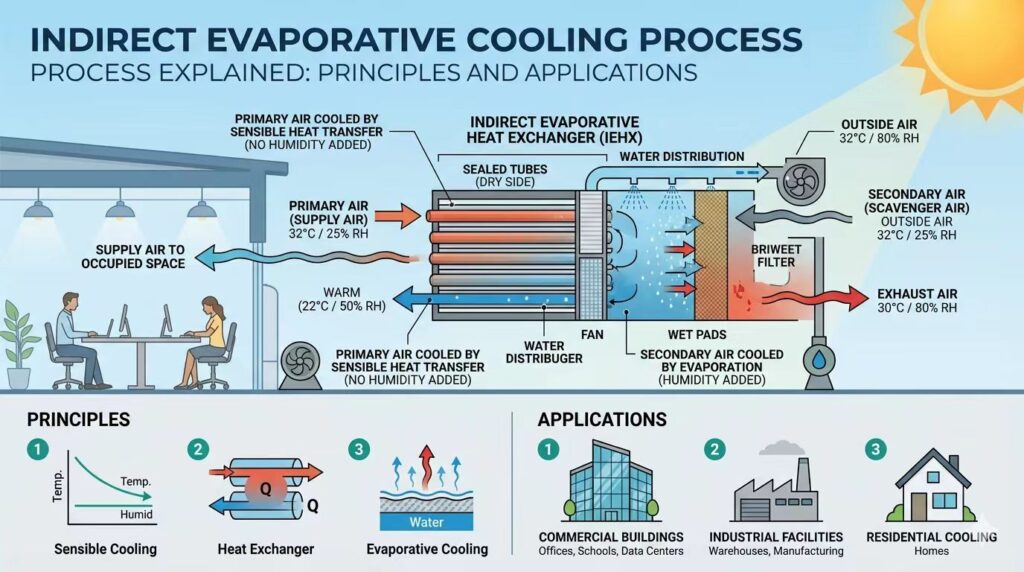

Indirect evaporative cooling cools air by running it over a heat exchanger that physically separates water and air streams. This allows the air to shed heat to water-cooled surfaces without adding additional moisture. Common in numerous industries, indirect evaporative cooling provides consistent temperatures for locations such as food plants, electronics lines, and data centers. The process works well in dry and humid climates and aids in reducing energy consumption compared to typical air conditioning. It consumes less water and maintains superior air quality because supply air never touches the water. To plant managers and engineers, indirect evaporative cooling provides reliable control of indoor climate and it can integrate with other dehumidifiers for complete climate control. Key points come next.

Indirect evaporative cooling uses two air streams, separated by the heat exchanger walls, so cooling occurs without adding moisture to the airstream you want to use in your process. This one is exact, energy-wise, and essential for worldwide sectors requiring steady spaces for delicate work.
Fresh air enters directly from outside. It is pulled into the unit, passing through the dry channels of the heat exchanger. The flow rate affects the cooling rate; a higher flow increases cooling rate, but if it’s too high, the air won’t have time to cool much. The temperature and relative humidity of this air establish the basis for cooling. Industrial units have channels formed to distribute the air uniformly and reduce pressure drop. This keeps each section of the heat exchanger operating at its maximum efficiency despite the variation of the ambient air.
There is secondary airflow through the wetted channels. It never contacts the main air but flows immediately adjacent to it, separated only by the exchanger wall. This flow absorbs heat from the main air by conduction. Controlling the velocity and volume of the secondary air is crucial. If the velocity is too low, heat transfer decreases. If the velocity is too high, energy consumption increases. In applications where outside humidity fluctuates, controlling the secondary air can maintain stable efficiency. Some systems redirect some conditioned exhaust air to the wet side for additional control.
The primary cooling occurs at the heat exchanger, which consists of flat plates or tubes of aluminum or coated steel, usually. Alternating dry and wet channels push heat from the primary to the secondary side. Maintaining a strong temperature gradient keeps the system humming. Most systems are cross-flow or counterflow, selected for space, airflow arrangement, and cooling requirements. The exchanger’s surface area and channel size, as well as material, determine how much heat migrates from one stream to the other.
Evaporation is the core of the cooling stage. Water on the wet channel surfaces removes heat from the secondary air as it evaporates. How fast depends on how dry or hot the air; drier, hotter air means faster water loss, which drives more cooling. Others employ treated pads or porous ceramics or wetted metal fins that distribute water uniformly. It follows the wet-bulb line and absorbs roughly 6.5 grams per kilogram of dry air. Better evaporation leads to more wet-bulb effectiveness, with indirect evaporative coolers topping out at 125%, which is much higher than direct models.
The now cooler, non-humidified air is prepared for delivery. In factories or cleanrooms, this air is piped through ducts to manufacturing areas. Keeping tight temperature control protects your products and gear from heat and humidity swings. Circulating air in cavernous halls is brutal, therefore systems deploy variable speed fans and intelligent diffusers to diffuse cool air as evenly as possible. Adding stages like direct evaporative or chilled water coils delivers additional cooling if necessary. The process works and it consumes far less power than traditional rooftop DX units while maintaining comfortable indoor climates.
Evaporative cooling is a well-established solution for industrial facilities looking to reduce energy consumption and enhance climate stability. Direct and indirect evaporative cooling are compared, with a look at the traditional air conditioning alternative. It emphasizes energy savings, indoor air quality, and the optimal fit for various climates and applications.
Direct evaporative cooling pulls air over wet pads. As the air passes, it picks up moisture, which causes its temperature to fall rapidly, sometimes as much as 16°C. These systems are easy, requiring only a fan, water pump, and media. They’re most effective in dry climates since air absorbs more water when humidity is low. Direct cooling is cheap and consumes little energy, around a quarter of that of regular AC. The primary trade-off is humidity. High indoor humidity can be bad for electronics, paint, and pharmaceuticals. In warehouses, greenhouses, and other large open areas, direct is a solid choice, especially where humidity isn’t an issue. Air may be cleaner with filtered pads, but comfort suffers if it becomes too humid.
Indirect evaporative cooling makes use of a heat exchanger. Hot outdoor air sweeps over one side, cooled by evaporation, while indoor air circulates on the other, never contacting water. This stabilizes indoor humidity. Indirect systems can reduce air temperature by 6 to 8 degrees Celsius in summer. They excel in environments where humidity control is critical, such as cleanrooms, labs, or electronics plants. Although requiring two fans and more power than direct systems, the reward is improved control and lower risk of mold or corrosion. Indirect cooling performs well in dry and moderate climates, where it can be combined with direct cooling for two-stage systems, driving efficiency even higher.
Traditional AC uses refrigerants and compressors. It cools air through heat extraction, not moisture introduction. AC has crisp, dry air, exact temperature control, and suits high-value manufacturing. It’s expensive, consuming up to four times the energy of evaporative systems. Maintenance is complicated and costly, with refrigerant leaks bringing environmental concerns. In humid or fluctuating climates, AC beats evaporative cooling for comfort and reliability. For buildings seeking both energy savings and green cred, evaporative methods—particularly two-stage systems—have a distinct advantage.
About Core System Components Indirect evaporative cooling systems utilize a series of core system components to provide energy-saving, refrigerant-free cooling in industrial environments. Every piece plays its own special role in the cooling process, and their collaboration defines both performance and sustainability. As industries shift to less energy consumption and waste, improvements in these components have become key to fulfilling those demands.
About the heat exchanger is the heart of indirect evaporative cooling. It allows heat to transfer from warm indoor air to an outdoor airstream, without mixing them. Most systems use an air-to-air heat exchanger constructed with alternating wet and dry channels. This design provides two independent air flows, increasing heat transfer while preventing moisture from rising indoors. Plate type and polymer tube exchangers are typical. Their design must optimize between efficient heat transfer and compact size, which is an ongoing challenge in plant retrofits. New composite materials now assist, providing superior heat conduction and water resistance. These modifications increase heat transfer effectiveness by 30 to 50 percent and reduce the unit’s footprint. Maintenance is simple but crucial: keep surfaces clean and free from scale. If not serviced, it can cause the system to lose up to 20 percent of its rated cooling.
The wetting system supplies water to heat exchanger channels, enabling evaporation. Water cascades or sprays through nozzles, saturating the passages and increasing the wet-bulb efficiency to beyond 125%. It is significantly higher than direct evaporative coolers. Wetting system options such as spray, drip, and wicking setups each have a unique method to disperse water. How the system handles water with recirculation, filtration, and purge cycles has a direct impact on cooling and prevents scale formation or residue. In dry climates, the most advanced systems keep loss low, using sensors to adjust water use to load. If you don’t manage your water well, it will foul, it will be costly to run, and it will cool less.
The fan assembly circulates the air over both the wet and dry sides of the exchanger. The majority of configurations employ axial fans for large volumes or centrifugal fans for higher pressure tasks. Fan efficiency ratings are important because fans comprise a large portion of the system energy, often twenty to thirty percent. Fan speed and layout impact how efficiently air contacts the exchanger and, consequently, how much heat gets transferred. Variable speed drives let fans shift output depending on cooling load or mode (dry, wet, or two-stage), conserving power and compressing noise. Noise is a real concern in plants. Sound baffles, slow-speed fans, or isolated mounts can keep workplaces safe and comfortable.
IEC systems provide real energy savings and operational stability to industrial users. There are many factors that shape their performance and efficiency, including ambient humidity and temperature, system design, and efficiency factors. Understanding these factors helps facilities select the appropriate configuration and operate it for maximum performance.
Ambient humidity is the prime mover for IEC cooling capacity. High humidity compromises the system’s cooling ability, as the air’s moisture content restricts evaporation. For some areas, this can equate to only minor temperature reductions. To enhance performance in humid climates, engineers can incorporate pre-cooling stages or implement desiccant dehumidifiers. All these actions dry the air, enabling the IEC unit to operate nearer its design specifications. In arid climates, IECs provide robust and comparable cooling results, frequently outperforming traditional air conditioning in terms of energy consumption and cost. Low humidity allows the system to push supply air temperatures lower than outdoor wet bulb temperatures, occasionally achieving wet bulb effectiveness greater than 100 percent. This is key for delicate spaces like data centers, where exact humidity regulation maintains equipment security and employee comfort.
Air temperature swings dictate how much cooling an IEC system provides. When outdoor air is hot, IEC units must lower the temperature of incoming air before it reaches core spaces. Pre-cooling, like heat exchangers, keeps supply air stable. Seasonality matters too. IEC systems may need to switch modes between summer and winter to remain optimal. Units built for a variety of temperatures can adjust airflow or wetting rates to the season, maintaining efficiency. For instance, during January, the average coefficient of performance can be as high as 9.13 and falls to 5.35 during hotter months.
Performance and efficiency issues. Adequate sizing and duct layout provide airflow to process requirements. Choosing corrosion-resistant materials extends life and maintains low maintenance, particularly in harsh industrial environments. Smart controls allow operators to toggle between modes, frequently running 70% of the year without the compressor, which is a significant power-saving measure. Studies have shown IEC systems may reduce energy consumption by 40 to 80 percent and reduce power costs up to 91.6 percent. The annual average COP of 7.34 proves this strong performance as well. City to city, savings rates vary. Energy-saving rates run between 39.41 percent and 57.46 percent, and power savings range from 29.95 percent to 41.11 percent, but the trend is obvious.
About The Sustainability Advantage Taking advantage of water evaporation’s cooling power without contacting water and supplying air directly, this approach generates striking environmental benefits. The system provides a solution for manufacturers to reduce energy consumption, slash greenhouse gas emissions, and achieve global sustainability goals.
Indirect evaporative cooling systems have only about 20% of the electric power consumption for vapor-compression air conditioning. This means there is up to 60 to 80% less energy used, depending on site climate and system design. For plant managers and facility engineers, that translates into steep reductions in power bills and operational expenses. These savings provide enterprises with a direct way to achieve green building certifications and long-term energy objectives.
Less energy draw means less of a carbon footprint. Research suggests it cuts carbon dioxide emissions around 44 percent versus conventional cooling. These systems aid grid resilience, particularly during summer peak loads, by mitigating stress on electrical demand. Adding renewables like solar or wind becomes easier because the overall power load is far smaller.
Water use in indirect evaporative cooling is lower than that of direct systems, as water is not added directly to the air stream. This is beneficial in regions with water stress. Good water management, such as closed-loop and water recapture, can make these systems even more efficient.
Water quality is important to performance and maintenance. Mineral-rich water causes scaling, which disrupts heat transfer and increases maintenance expenses. Filtration or softening can help keep the system running at maximum efficiency. Their newest models include water-saving technology, like smart sensors and recirculation to keep consumption low and help you adhere to local water regulations.
These systems operate without harmful refrigerants such as HFCs or CFCs, eliminating the possibility of environmentally damaging leaks. This change is in favor of more stringent global control of refrigerants and industry efforts to move toward safer, greener technology. Refrigerant-free cooling is safer for workers and reduces toxic exposure.
Market is demanding these systems. More companies are looking for clean, low-risk cooling for both new and retrofit projects. With regulations increasing, refrigerant-free cooling will soon be the norm for sustainable facilities.
Indirect evaporative cooling functions in many spaces with high heat load, humidity, and equipment requirements. It seems like a good fit in industries seeking to save energy and be more sustainable. The system’s flexibility allows it to help industries like manufacturing, commercial real estate, agriculture, and tech. It can cool spaces in climates with large humidity fluctuations such as the Yangtze River Basin. Design modes, dry, wet, or mixed, assist with fluctuating outdoor air and indoor requirements. Solar can be integrated, enabling routes to zero carbon cooling.
Data centers require stable and consistent cooling to maintain operation of servers. Indirect evaporative cooling keeps temperatures low with zero added humidity to the space, a must for delicate equipment. Its system cuts energy use by as much as 80% depending on configuration and climate. Fewer watts vying for attention reduces stress on backup systems and expenses.
For big server farms, uptime is everything. Cooling touches upon both aspects. Overheating can result in outages or reduced asset life. Indirect cooling plays a vital role in maintaining server longevity by preventing parts from overheating. New cooling layouts, for example, combining indirect cooling and hot aisle containment, can increase efficiency further.
Indirect evaporative cooling is a good fit for offices, malls and mixed use buildings. It reduces energy costs. One 10,000 m² office can save 100,000 to 150,000 yuan annually. The system maintains indoor conditions, typically maintaining temperatures of 26 to 28°C in summer. This makes for comfortable workers and keeps productivity humming.
Initial indirect cooling expenses are balanced by long-term energy reductions. Cooling accounts for up to 40% of building energy, and making systems more efficient has a huge impact. For new buildings, designers can design for indirect cooling from the beginning, allowing them to leverage mixed or wet modes as necessary. Solar power connections can reduce carbon emissions as well.
Big workshops such as auto assembly depend on cooling to protect workers and stabilize processes. Indirect systems are simple to scale for large areas. They stabilize temperatures, even in extreme or fluctuating climates, and can maintain workshop air at 26 to 28 degrees Celsius.
Indirect cooling works in greenhouses, where it can maintain crops at 25–30°C and humidity at 50%–70%. This is crucial for yield and plant health. The system’s flexible design allows it to grow with facility needs. For factories, reduced energy consumption lowers both cost and emissions.
Indirect evaporative cooling is a standout in plant work. It smartly uses less power to keep your air cool and dry! It goes swimmingly with large-scale vegetation. Steady weather makes for steady work and secure equipment. Essential components, such as heat exchangers, maximize air circulation and achieve close tolerances. Actual figures demonstrate significant improvements in energy consumption and pricing. Plants in chip making, drug work, and car build all leverage these systems to reduce waste and reduce bills. The green side attracts major brands that need to reduce their footprint. To achieve solid airflow and hard equipment, consider load indirect evaporative cooling for your location. Contact us for a unit that suits your product line, requirements, and area.
By indirect evaporative cooling, we mean the cooling of air with no addition of moisture. Air flows across a heat exchanger cooled by evaporating water. It maintains supply air dry while lower in temperature.
One important consequence is that indirect cooling does not introduce humidity into the supply air. In direct cooling, air touches water, so humidity rises. Indirect systems have a heat exchanger that separates air streams.
Core components are a heat exchanger, water distribution, fans, and controls. These combine to cool air effectively without raising its moisture content.
Indirect evaporative cooling consumes less energy than conventional air conditioning. It can provide up to 60 to 75 percent of the temperature drop of mechanical cooling while using a fraction of the energy.
Yes. Through this, it uses water and less electricity, which means it is able to cut down greenhouse gas emissions. It is a sustainable way to cool things down, particularly in the dry lands.
This method of cooling is used in data centers, commercial buildings, and industrial facilities globally. We’ve found it to be ideal for low to moderate humidity.
Advantages in energy savings, operating cost and environmental issues. It keeps comfortable indoor air quality by holding humidity levels stable.


Contact us to find the best place to buy your Yakeclimate solution today!
Our experts have proven solutions to keep your humidity levels in check while keeping your energy costs low.